
Affiliate disclosure: We may earn a commission from purchases through paid links. As an Amazon Associate I earn from qualifying purchases.
Choose a single bowl for bulky cookware and flexible open space. Choose a double bowl when keeping two wet tasks separate is genuinely useful. Compare each usable basin, not just the sink’s overall width.
The quickest way to choose
| Question | Single bowl tends to suit | Double bowl tends to suit |
|---|---|---|
| What is hardest to wash? | Sheet pans, wide trays and large pots | Smaller dishes washed in batches |
| How do you handle dishes? | Dishwasher does most routine work | You regularly wash and rinse by hand |
| Do tasks overlap? | You can clear one bowl between jobs | You need one basin available while another soaks |
| What do you dislike? | A divider catching pan handles | Sharing wash water with another task |
Neither layout is automatically more hygienic or more water-efficient. Those outcomes depend on how you clean, rinse, drain and use the sink. A divider makes separation easier; it does not keep dirty hands, tools or splashes from crossing between basins.
The best starting point is yesterday’s washing-up. List the three objects that were most awkward, whether someone else needed the tap at the same time, and where clean dishes drained. Those observations are more useful than a generic “best for families” label.
Run the pan-fit test
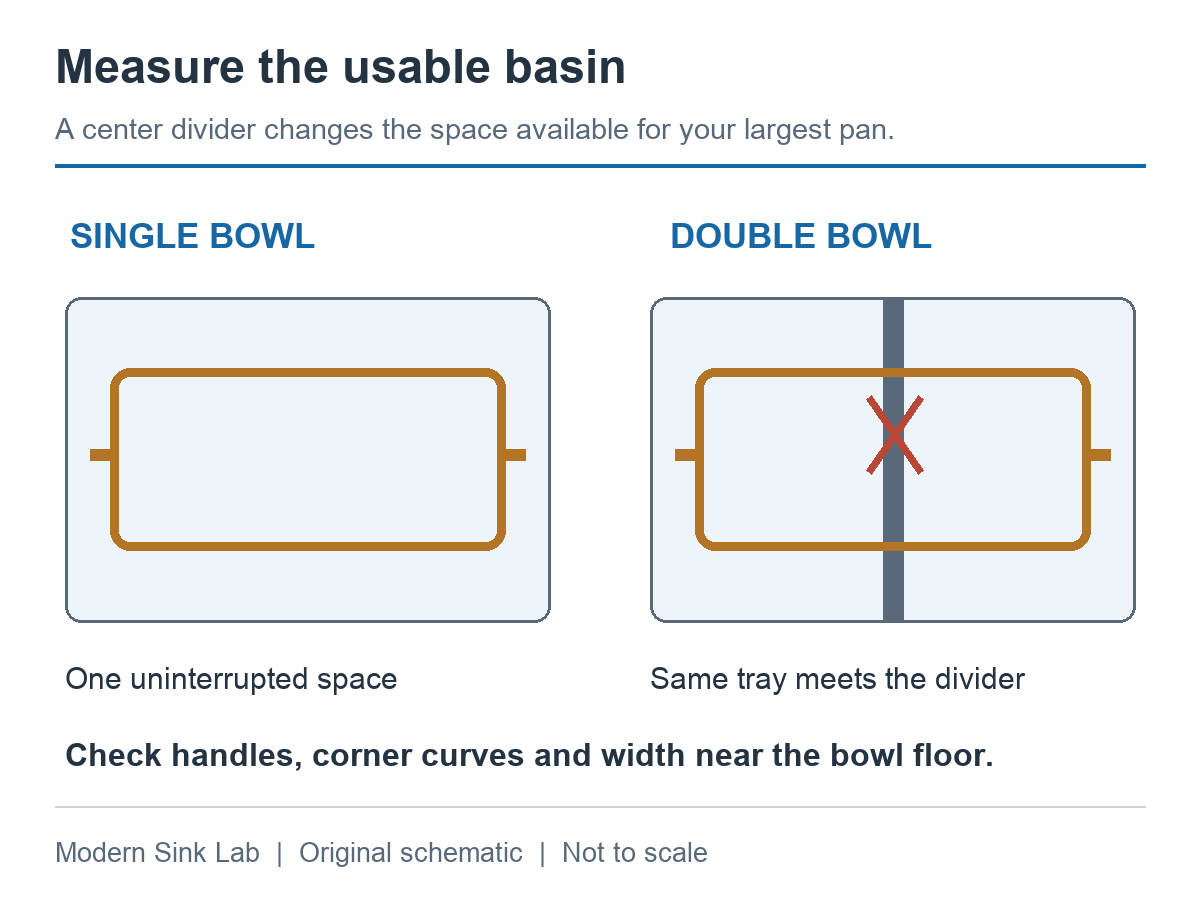
Measure your largest pan across its rim and handles, then measure its front-to-back dimension. Compare those measurements with the manufacturer’s internal basin dimensions, not the outside sink dimensions. Check near the floor as well: sloping walls and rounded corners can reduce the space available for laying an object flat.
Do not divide a 32-inch sink by two and assume each double basin is 16 inches wide. The outer rim, divider and wall geometry all take space. A 60/40 layout can offer a more useful large basin than an equal split, but its published interior dimensions must support that conclusion.
You can wash a tray diagonally or standing on edge, but call that a compromise. If your main frustration is splashing while rotating a roasting pan, buying another sink that requires the same motion will not solve the problem.
For a quick rehearsal, make full-size paper outlines of the proposed bowls and place the real cookware on them. This is a layout check, not a substitute for the sink’s cutout template.
How the layouts change ordinary tasks
Cooking with a dishwasher
A large single bowl gives you one broad space for the pots and trays that do not go into the dishwasher. A removable dishpan can provide a small soaking zone. You still need somewhere to put that dishpan when a large pot arrives.
Hand-washing most dishes
A double bowl can keep washing and rinsing separate, especially if the second bowl remains clear. Compare the depth and width of both basins. A tiny secondary bowl may hold utensils comfortably but add little for dinner plates or a large colander.
Two people preparing a meal
A double bowl does not necessarily create two independent stations. Both people may still share one faucet and the same standing space. An offset faucet, accessory placement and the position of the dishwasher can matter more than the divider.
Soaking a pan while making dinner
A second basin preserves access to the drain and tap, which can be the strongest reason to choose it. A single-bowl workstation may support a colander above the soaking pan, but stacking tasks requires adequate clearance and sensible food-handling practices.
Full divider, low divider or removable accessories?
A full-height divider gives each basin a distinct water-holding space up to its rim. A low divider can make it easier to maneuver a wide item over the center. Its separate soaking depth ends at the divider height; filling higher connects the two sides.
Check where the faucet stream lands. A tall pot in the small basin may block a spray head, while a centrally positioned faucet may require an awkward reach to rinse the far corner of the large basin. Review the full faucet-and-sink combination.
For a single bowl, a supported rack, colander or dishpan may provide temporary separation. Choose this approach when you want to reclaim the full bowl regularly. Choose a permanent divider when separate basins are useful more often than the large uninterrupted opening.
Our workstation value guide compares this temporary-workspace tradeoff without assuming more accessories mean a better sink.
The cabinet and plumbing can settle the choice
Replacing a double bowl with a single bowl can change the drain position and trap connections. Replacing a single bowl with a double adds a second drain assembly, with the actual arrangement depending on the disposal and dishwasher connection. Neither conversion is automatically a drop-in plumbing job.
Map the disposal body, water filter, shutoff valves, pull-out bin and hoses inside the cabinet. A rear or offset drain may move equipment away from one area while conflicting with another. Make room for service access, not just the closed-door outline.
Keep three dimensions separate: outside cabinet width, sink outside dimensions and the existing countertop cutout. The 30-, 33- and 36-inch cabinet guide explains this distinction. Also check vertical disposal clearance before moving to a deeper bowl.
If you are keeping the countertop, ask the installer to approve the actual replacement model. “Same nominal width” is not enough to establish that the old opening, corner radius or mounting supports will work.
Single-bowl examples after the layout decision
If the pan test favors a broad single bowl and you have an appropriate 36-inch cabinet, two examples are the KRAUS KWU110-32 and Ruvati RVH8300. Both are documented 32 × 19-inch undermount workstation sinks with a 10-inch-deep bowl. These are not double-bowl substitutes; their usefulness depends on wanting an open basin.
The KRAUS specification lists a 30 × 16-inch bowl and rear-offset drain. The Ruvati specification lists a 30⅜ × 16-inch bowl and rear-center drain. These nominal dimensions do not establish interchangeability or prove your pan can lie flat at every point.
Check KRAUS KWU110-32 on Amazon
Check Ruvati RVH8300 on Amazon
For a double bowl, shortlist actual internal basin dimensions and divider height first. We have not verified a matching double-bowl affiliate product for this guide, so we are not labeling a single-bowl purchase button as a double-bowl recommendation. The KRAUS/Ruvati comparison is useful only once a single bowl is your preferred layout.
A five-minute decision sheet
- Largest difficult-to-wash item, including handles: write down both dimensions.
- Task that needs a separate basin: name it and how often it happens.
- Usable dimensions of every proposed bowl: copy them from the exact model drawing.
- Accessory parking space and dishwasher access: rehearse them with cardboard.
- Installer approval: confirm cutout, mounting, drain connections and equipment clearance.
If the second item is blank, you have little evidence that a divider improves your routine. If the first item will not fit the large basin, the double bowl needs a stronger reason to justify the compromise.
Will a single bowl use more water?
It may hold more water when filled, but you do not have to fill it. A dishpan, running rinse or dishwasher changes the comparison. Avoid a universal savings claim without measuring your own routine.
Is a double bowl outdated?
Style is a preference; separate wet tasks remain a valid practical need. Select the layout that resolves your daily problem, then choose the finish and mounting style.
What is the safest default when replacing an existing sink?
There is no universal default. The easiest project is usually the compatible model your installer has approved, provided its usable bowl solves your actual complaint. Changing layout is worthwhile when the functional benefit justifies the additional installation work.
How this guide was prepared: Documentary research and editorial planning examples, reviewed September 14, 2026. We have not physically tested these sinks. Dimensions come from the named model documents; examples and drawings are illustrative, not fabrication plans. Sources: BLANCO sink buying guide and workflow guidance; KRAUS KWU110-32 and Ruvati RVH8300 model specification sheets. Confirm the exact item, included accessories and installation drawing before ordering.
If you have settled on a low divider, compare how the KRAUS KBU32 and Ruvati RVH7419 divide the actual washing space. Their equal versus 60/40 bowl widths suit different routines.
If baking trays are the reason you prefer one large bowl, our RVH7300 half-sheet pan fit guide shows how to compare the pan rim with the bowl, grid and finished countertop opening before choosing a sink.
For a concrete unequal-bowl example, compare the KGD-50 60/40 bowl dimensions and work zones. The larger and smaller basins need to fit separate tasks; the 33-inch exterior does not describe one uninterrupted washing area.
If soaking volume affects your choice, compare the water level needed for your cookware rather than the sinks’ outside dimensions. The sink-capacity calculation and measurement guide shows how to estimate US gallons and check an installed bowl at an ordinary working level.
13 thoughts on “Single-Bowl vs Double-Bowl Kitchen Sink: Which Fits Your Routine?”