
As an Amazon Associate I earn from qualifying purchases. Purchases through our links may earn us a commission at no extra cost to you.
Choose stainless steel when a metallic finish and a broad choice of bowl layouts suit your kitchen. Choose granite composite when the color and feel are worth the specific care routine to you. Neither material removes the need to rinse, clean and check the installation. “Scratch-proof,” “maintenance-free” and a universal winner are poor starting points.
We use the stainless KRAUS KHU100-32 and Black Onyx KGD-433B as concrete examples. They have different bowl layouts and mounting options, so this is a material decision guide—not a claim that any performance difference between those two products is caused by material alone. Research checked September 17, 2026; we have not conducted impact, stain or sound tests.
Make three decisions separately
First decide how much uninterrupted bowl space you need. Then determine which sink and mounting method fit the cabinet and countertop. Finally choose the material and finish among the products that pass those tests. Starting with a color and discovering later that it comes with an unsuitable divider is an expensive way to shop.
| Question | Stainless example: KHU100-32 | Composite example: KGD-433B |
|---|---|---|
| What is the basic product? | 32-inch undermount single bowl, 16-gauge stainless steel. | 33-inch quartz-composite, 50/50 double bowl in Black Onyx. |
| What is a sensible reason to choose it? | You want one open washing basin and a metallic finish. | You want the dark finish and will use two separate basins. |
| What is not a fair comparison? | Calling its larger uninterrupted space a benefit of stainless itself. | Calling a divider or dual-mount option a feature of every composite sink. |
| What must be checked independently? | Cabinet, template, plumbing, accessories and maintenance instructions. | The same checks, plus the selected installation method and finish-specific care. |
For large trays, assess the bowl rather than the outside width. A 33-inch double sink can provide less continuous pan-washing room than a narrower single basin. Read the single versus double-bowl guide if that remains unsettled.
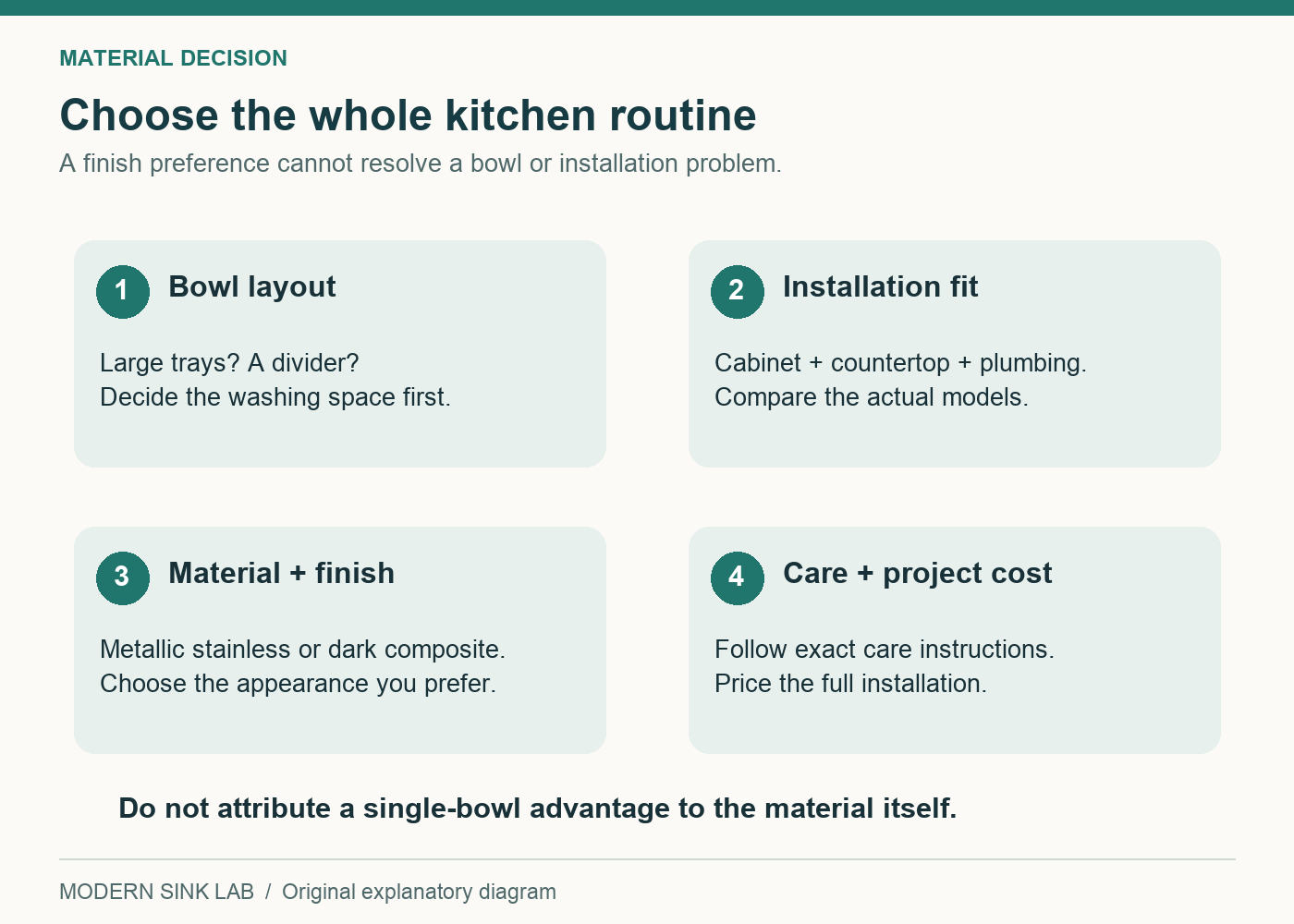
Buy the cleaning routine you will actually follow
Water left to dry can leave mineral residue; switching to a dark color does not stop that process. On the KGD-433B, a contrasting film may matter more to you than a few ordinary marks on a metallic surface. That is an appearance preference, not evidence that one sink is contaminated or permanently damaged.
For both examples, start with the manufacturer’s mild-cleaning approach: a soft cloth or suitable soft sponge, thorough rinsing and drying. Do not transfer a cleaning recipe between materials merely because it worked on the previous sink. In particular, an abrasive powder, steel wool or a harsh chemical can conflict with the prescribed finish care.
The practical decision is whether you will lift the grid or mat, rinse around the drain and wipe standing water at the end of use. If that already happens in your kitchen, a dark composite may fit comfortably. If wet cookware routinely stays in the sink overnight, be honest about that habit before paying for a finish whose appearance you want to preserve.
| Concern | What to ask before buying | What we would not promise |
|---|---|---|
| Visible marks | Which finish changes would bother you in your actual kitchen lighting? | That either material will look new indefinitely. |
| Heat | Where will hot cookware land, and what does the exact model require? | That a heat-resistance claim permits every hot-pan contact. |
| Cleaning effort | Can you reach corners, lift the grid and dry the basin? | A measured cleaning-time advantage without testing. |
| Noise | What damping, support and countertop arrangement will be installed? | A decibel ranking based only on material or gauge. |
| Damage and repairs | What does the manufacturer say about your finish and the type of damage? | That every scratch, chip or stain can be removed at home. |
Gauge does not compare stainless with composite
Steel gauge describes sheet thickness. It does not provide an equivalent quality scale for a molded quartz-composite sink. Even within stainless, a thicker sheet is only one construction detail; support and damping also belong in the comparison. Our 16 versus 18-gauge explanation keeps thickness, steel grade and finish separate.
Likewise, the word “granite” on a composite sink is not permission to treat it like a slab countertop. Follow the sink’s instructions for cleaning and any treatment. Do not add a sealer or coating without confirmation that it belongs on that exact product.
Compare two complete project quotes
Write down the delivered sink price, removal, countertop work, support, drain parts, faucet work and likely accessory purchases. Then obtain the quote for each actual model. A lower-priced basin may lead to a larger project if it cannot use the current opening or plumbing arrangement.
A dual-mount label can be useful, but the two mounting methods do not share a guaranteed interchangeable cutout. The KGD-433B offers a choice of drop-in or undermount installation; the fabricator still needs the correct template for the selected approach. The KHU100-32 is an undermount example. Compare installation plans rather than treating mounting flexibility as a saving already achieved.
For either route, keep cabinet size and countertop opening ahead of styling. If the existing countertop is staying, the practical shortlist may be much narrower than the online catalog.
Two conditional recommendations
Shortlist KHU100-32 when you want an open stainless basin and your undermount project passes the documented fit checks. It is less suitable if you need a divider or specifically want a dark composite finish. We are not recommending it as scratch-proof, silent or universally more durable.
KRAUS KHU100-32 — stainless single-bowl option
Check price on AmazonShortlist KGD-433B when you want Black Onyx, have a use for two bowls and accept its care requirements. It is less suitable when an uninterrupted large-pan basin matters most. Our KGD-433B hard-water guide goes further into that particular finish.
KRAUS KGD-433B — Black Onyx 50/50 double-bowl option
Check price on AmazonA ten-minute decision exercise
Write three things you dislike about the current sink and label each one: layout, installation, material or maintenance. “My tray will not lie flat” is primarily a bowl-space problem. “I dislike the silver finish” is a finish preference. “Water marks appear overnight” includes a water-and-care issue. Buy the model that addresses your highest-priority problem without introducing a worse one.
Then imagine an ordinary busy evening, not a showroom photograph. If the new sink makes that routine easier and the full installation is affordable, its material choice has a practical justification. If the decision depends entirely on a claim of zero maintenance, reconsider the premise.
KRAUS KHU100-32 — check current purchase options
Check price on AmazonKRAUS KGD-433B — check the exact black double-bowl variant
Check price on AmazonSources and scope: KRAUS KHU100-32 and KGD-433B model documentation, KGD-433B specification, KRAUS Care & Cleaning Guide (stainless and granite sections), selected US retail variants. Checked September 17, 2026. Recommendations concern fit and routine; no comparative laboratory performance is implied.
Already seeing a brown mark on stainless steel? Our KRAUS rust-spot guide separates a gentle first cleaning check from situations that need a manufacturer assessment before further treatment.