
As an Amazon Associate I earn from qualifying purchases. This page contains affiliate shopping links.
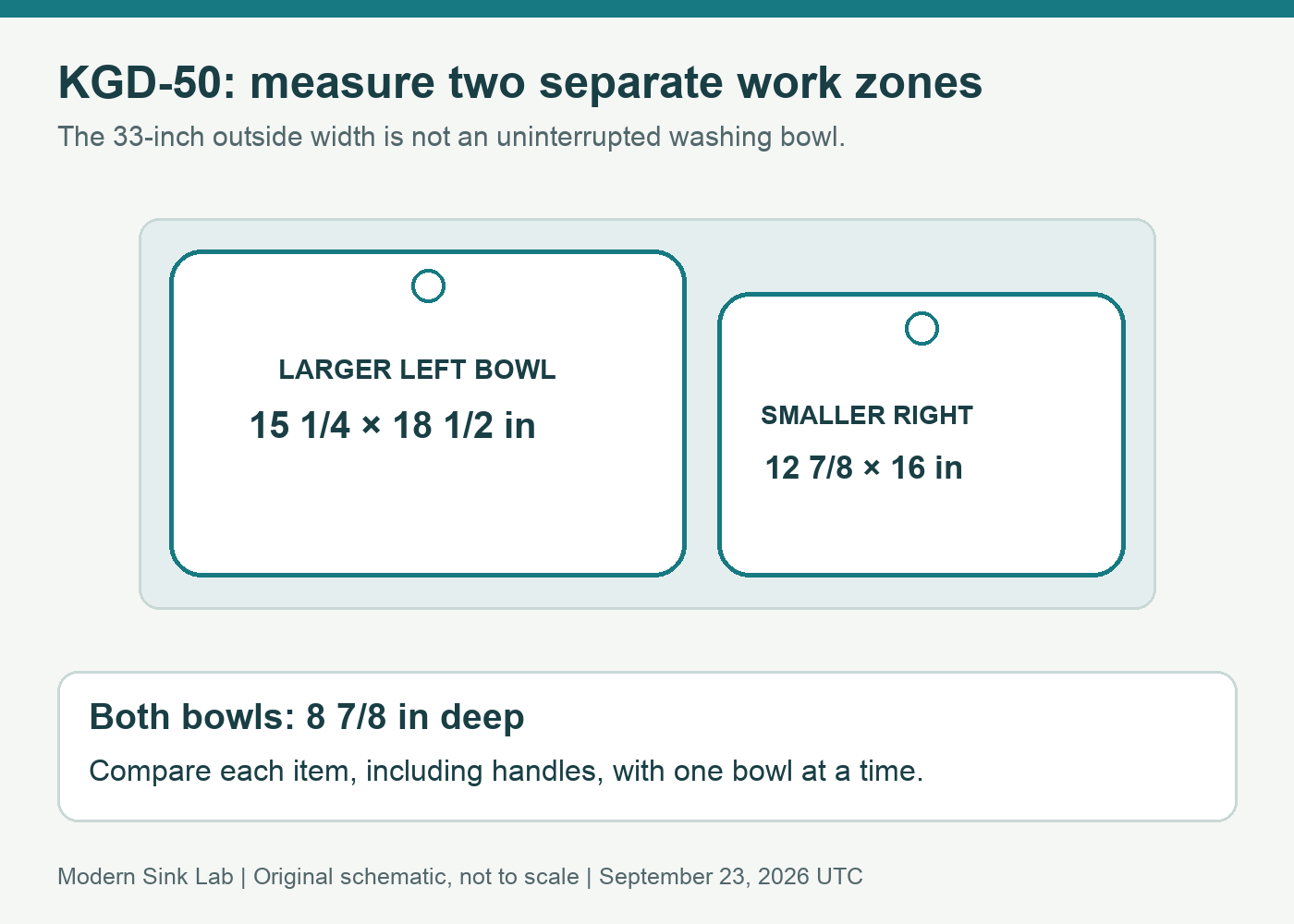
The KRAUS KGD-50GREY suits someone who wants to keep one wet task available while another occupies the sink. Its 60/40 split gives you unequal bowls, not a 33-inch-wide washing basin. The larger bowl is listed at 15 1/4 × 18 1/2 inches and the smaller at 12 7/8 × 16 inches; both are 8 7/8 inches deep.
Choose it because those two spaces match your washing routine. If your main frustration is turning a wide roasting pan around a divider, two bowls may preserve that frustration even though the outside sink width looks generous.
Check KGD-50GREY double-bowl sink on Amazon
The linked model is the grey KGD-50 60/40 double bowl. Check the selected color and layout before ordering; nearby KGD models include different bowl arrangements.
What the 60/40 label does—and does not—tell you
| Measurement | KGD-50 reference | Buying use |
|---|---|---|
| Outside footprint | 33 × 22 inches | Initial countertop planning, not usable bowl width or cutout size |
| Larger bowl, left in the manufacturer’s drawing | 15 1/4 × 18 1/2 inches | The first space to check for your largest routinely washed item |
| Smaller bowl, right in the drawing | 12 7/8 × 16 inches | A separate rinse, draining or small-item task |
| Bowl depth | 8 7/8 inches | Reach and washing-space planning |
| Minimum cabinet requirement | 36 inches left to right; 24 inches front to back | Installer must still check structure, mounts and plumbing |
The 60/40 name describes the layout family. It does not mean every object gets 60 percent of the outside width, and we would not use it to calculate an exact water-volume split. Bowl contours and the divider take space that a simple percentage misses.
Give each bowl a job before you commit
For someone who washes and rinses by hand, the larger side might hold the wash batch while the smaller stays clear for rinsing. For a dishwasher household, a more useful division might be a soaking saucepan on one side and a clear bowl for filling a kettle on the other.
These are suggested workflows, not claims that one arrangement saves a measured amount of water or time. Try assigning the two jobs during an ordinary meal cleanup. If you keep moving the same large item between both sides, you may need uninterrupted space more than separation.
Also consider handedness and the counter beside each bowl. In the published layout the larger bowl is on the left. Do not assume you can turn the sink around to reverse the bowls while preserving the intended faucet-deck and drain arrangement. Confirm the actual model and installation orientation with the installer.
Check cookware using its full outside dimensions
Measure handles, rolled rims and pouring lips, not just the size stamped on a pan. Then compare the object with one bowl at a time. A pan spanning the divider may be washable, but that does not mean it can lie flat for soaking.
For example, a hypothetical object measuring 18 × 13 inches is smaller on paper than the larger bowl’s listed 18 1/2 × 15 1/4-inch dimensions when oriented accordingly. That comparison only passes an initial screen. The published bowl dimensions do not prove a flat rectangle of that size exists at the bottom; corners, wall slope and handles can still interfere.
Use the actual sink or an accurately dimensioned bowl drawing for a close fit. A paper rectangle can help compare your cookware with the listed opening, but it is not a countertop cutting template and cannot model the basin’s three-dimensional shape.
The two-bowl choice changes the space below it too
The specification lists two rear-offset 3 1/2-inch drain openings. Have the installer plan the connection from both bowls, any disposal, the trap and other cabinet equipment together. A rear drain position does not guarantee room for your existing bin or filter.
This is a quartz-composite dual-mount sink. Drop-in and undermount installation require the matching instructions and template. The 33 × 22-inch exterior is not evidence that it will reuse an old opening. KRAUS also advises using protection for extremely hot cookware because direct contact can discolor the composite surface.
When a single bowl is the better use of the cabinet
Choose a single bowl when bulky cookware is the recurring problem and you rarely need simultaneous wet tasks. The related KGD-54WHITE fit guide covers a single-bowl alternative with a similar outside footprint; a shared footprint still does not make the installation templates interchangeable.
If you are undecided about the layout rather than this specific model, start with our single-bowl versus double-bowl decision guide. For the KGD-50, the strongest reason to buy is a repeatable two-zone routine—not the 60/40 label by itself.
Check KGD-50GREY double-bowl sink on Amazon
Research scope
Reviewed September 23, 2026 (UTC): KRAUS KGD-50 specification (January 6, 2025 revision), KGD/KGU installation manual and the selected US KGD-50GREY listing. Dimensions are manufacturer figures. The cookware example is an illustrative calculation, not a physical fit test. We have not installed the sink or tested its finish, noise or long-term wear.