
As an Amazon Associate I earn from qualifying purchases. Purchases through our links may earn us a commission at no extra cost to you.
Choose the KRAUS KBU32 when you want two equally useful bowls. Choose the Ruvati RVH7419 when one larger washing bowl matters more than an equally roomy rinse side. Both are low-divide undermount sinks with a documented 36-inch minimum cabinet, but the Ruvati’s 18-inch left bowl is the practical difference to consider first. The KRAUS gives you 14½ inches of width on each side.
A lowered divider helps you move large items across the sink; it does not remove the divider or turn the floor into one uninterrupted basin. If your main complaint is that a baking tray cannot lie flat, measure the tray before treating either design as the answer.
This is a document-based comparison of the US KBU32 and RVH7419, checked September 18, 2026. We have not tested their drainage, noise or resistance to dents.
The split matters more than the nominal sink width
| Planning dimension | KRAUS KBU32 | Ruvati RVH7419 |
|---|---|---|
| Outside footprint | 32¼ × 18⅞ inches | 33 × 19 inches |
| Left / right bowl opening | Both 14½ × 16⅞ inches | 18 × 17 / 12 × 17 inches |
| Bowl depth | 8⅝ inches; overall height 9 inches | 10 inches |
| Minimum cabinet | 36 inches wide; KRAUS also specifies 24 inches front to back | 36 inches wide |
| Drain position / openings | Center set / 3½ inches | Rear center / 3½ inches |
| Steel and installation | 18-gauge stainless; undermount | 16-gauge T304 stainless; undermount |
| Documented package | Two strainers, mounting hardware, cutout template | Two basket strainers, two grids, mounting clips, cutout template |
The RVH7419 gives its larger side 3½ inches more width than either KBU32 bowl. Its smaller side gives up 2½ inches. That is a meaningful redistribution within a similar overall footprint, not simply a slightly bigger version of the same sink.
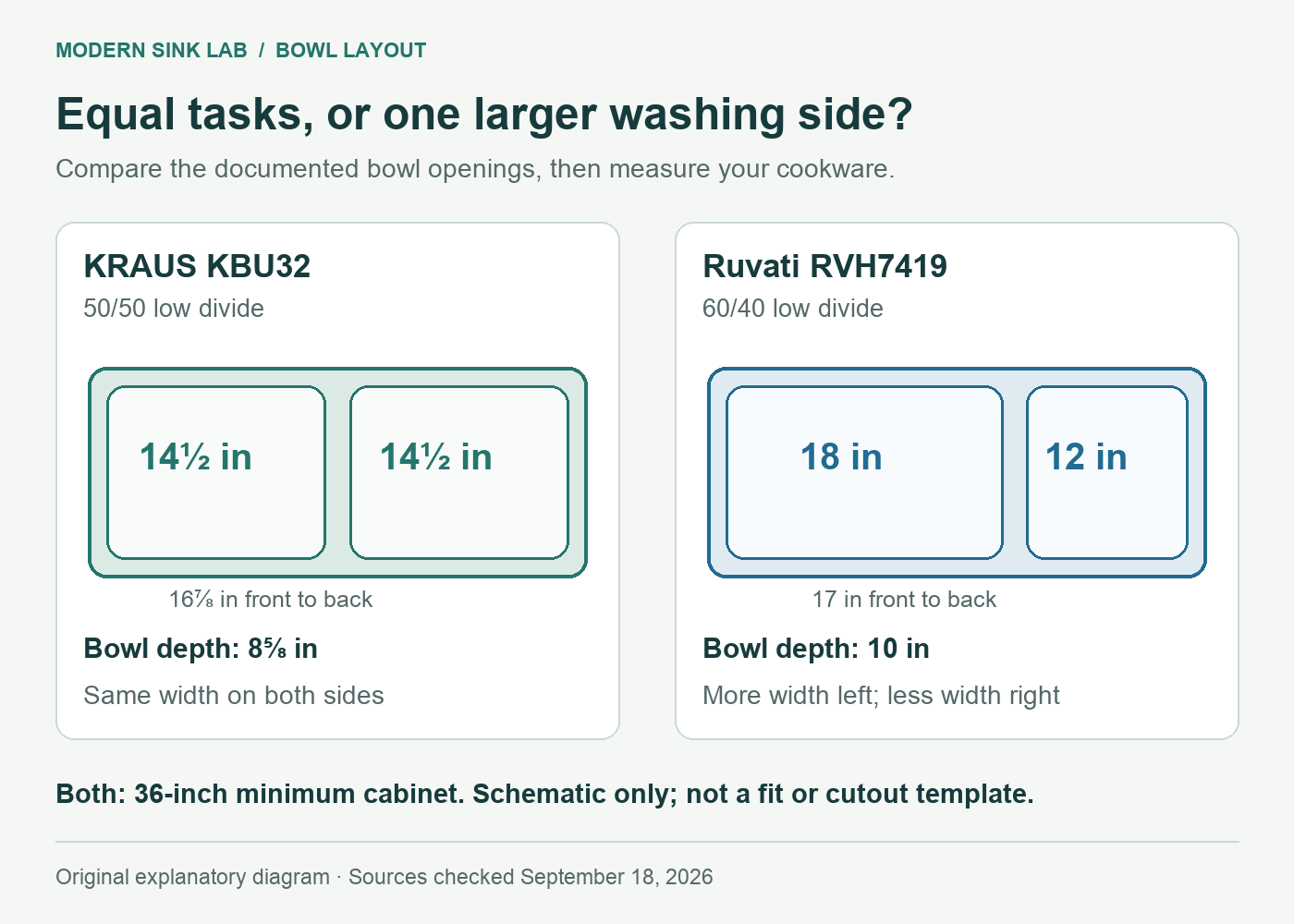
For example, if one side holds a drying rack all evening, decide how much working room the other side needs. An equal split is useful when both bowls take comparable loads. A 60/40 split makes more sense when washing is the main job and the smaller side mainly receives rinsed utensils. Put your colander or dish rack inside a measured 12-inch-wide area before assuming the smaller Ruvati bowl will be enough.
Check cookware over its handles and rolled edges, and consider whether you need it flat or merely tilted under running water. The specification describes the bowl opening; it does not promise that an object of the same dimensions fits the curved floor. An 18-inch-long tray against an 18-inch nominal dimension leaves no allowance for your hands, corner shape or manufacturing variation.
KRAUS KBU32 — 32-inch 50/50 low-divider sink
Check price on AmazonRuvati RVH7419 — 33-inch 60/40 low-divider sink
Check price on AmazonLow divide: easier movement, less separated soaking depth
The KBU32 specification drawing places the divider top 3⅛ inches below the upper rim. Ruvati specifies a 4-inch drop from the rim on the RVH7419. These are clearances above the divider, not the height of water each bowl can hold independently.
The extra open space can make it easier to rinse a long pan held across both bowls or swing its handle over the middle. The compromise appears when you fill one bowl: once water reaches the divider, it can pass into the other side. A low divide therefore suits shallow separation better than a requirement for two independently deep soaking compartments.
Neither sink is a substitute for an uninterrupted single-bowl floor. If oversized roasting pans must sit flat in water, compare their actual dimensions with a single basin too. Our single- versus double-bowl guide explains that broader layout decision.
Similar cabinet requirements do not make them interchangeable
Both need the manufacturer’s 36-inch minimum base cabinet. A sink marketed as “32-inch” does not automatically fit a 33-inch cabinet. Inspect rails, side panels and mounting access as well as the nominal cabinet label. The KBU32 sheet also gives a 24-inch front-to-back cabinet requirement.
For a replacement, have the fabricator compare the actual opening with the delivered sink and its current template. Different outside dimensions and corner profiles prevent a reliable swap prediction from the product names alone. Keep the existing countertop only if its opening, support and exposed edge can be made appropriate.
Underneath, plan two drain connections, the trap route and any disposal together. The Ruvati’s rear drains and deeper bowls change where equipment sits. A rear drain does not guarantee room for a pull-out bin, and the 10-inch depth may affect the route to the wall outlet. Use our depth and disposal-clearance guide before ordering around existing plumbing.
Compare the delivered package, not steel gauge alone
The RVH7419 includes two protective bottom grids; they are not listed in the KBU32 package we checked. If you want grids, include compatible ones in the KRAUS total instead of assuming the two offers contain identical accessories. A basket strainer also does not replace the flange required by a particular garbage disposal.
Ruvati’s 16-gauge steel is thicker than KRAUS’s 18-gauge steel. That specification alone does not establish which installed sink will be quieter or how either will respond to an impact. Cabinet support, insulation and the rest of the construction matter; we have not performed that comparison. Both documents list sound-damping treatments, without giving us a comparable measured noise result.
A practical decision before checkout
- Map the jobs: write what normally occupies each side during a meal.
- Measure the awkward item: include handles, the intended angle and room for your hands.
- Check the smaller bowl: test whether 12 inches of width works for the Ruvati’s secondary job.
- Check soaking: choose a low divide only if water crossing the lowered center is an acceptable trade-off.
- Price the whole project: sink, needed grids, drain/disposal parts, countertop work and plumbing.
Our choice by use: the KBU32 is the more balanced layout for two similarly sized tasks. The RVH7419 is the stronger layout candidate for a larger main washing side, provided its 12-inch secondary bowl and deeper installation work for you. If full-depth separation or a completely open floor is essential, choose a different layout instead of expecting the low divider to do both jobs.
KRAUS KBU32 — confirm the low-divider 50/50 package
Check price on AmazonRuvati RVH7419 — confirm the 60/40 package and grids
Check price on AmazonSources and scope: KRAUS KBU32 specification sheet, revision March 27, 2025; Ruvati RVH7419 two-page specification and model description; selected Amazon US variants. Checked September 18, 2026. Model-specific dimensions take priority over abbreviated retail dimension fields. Illustrations and workflow judgments are our own document-based analysis.