
As an Amazon Associate I earn from qualifying purchases. Purchases through our links may earn us a commission at no extra cost to you.
For an undermount sink, choose the reveal allowed by the exact sink and countertop plan before fabrication. For the KRAUS KWU110-32 workstation example, KRAUS recommends positive or flush reveal and advises against negative reveal because it can cover the accessory ledge. A preferred appearance should not prevent the accessories from working.
Reveal describes the relationship between the countertop edge and the bowl edge as seen from above. It is different from choosing undermount versus drop-in installation. This guide explains the practical trade-offs and provides a fabricator handoff checklist. It is document-based research, checked September 17, 2026, not a cutting template.
What the three terms mean
| Reveal | What you see | Question to settle |
|---|---|---|
| Positive | A strip of the sink rim is visible inside the countertop opening. | How much rim should show, and what does the approved template specify? |
| Zero / flush | The countertop opening approximately aligns with the bowl edge. | Can the fabricator achieve the intended alignment with this actual sink? |
| Negative | The countertop edge projects over part of the bowl/rim. | Is that overhang permitted, and does it obstruct the ledge or cleaning access? |
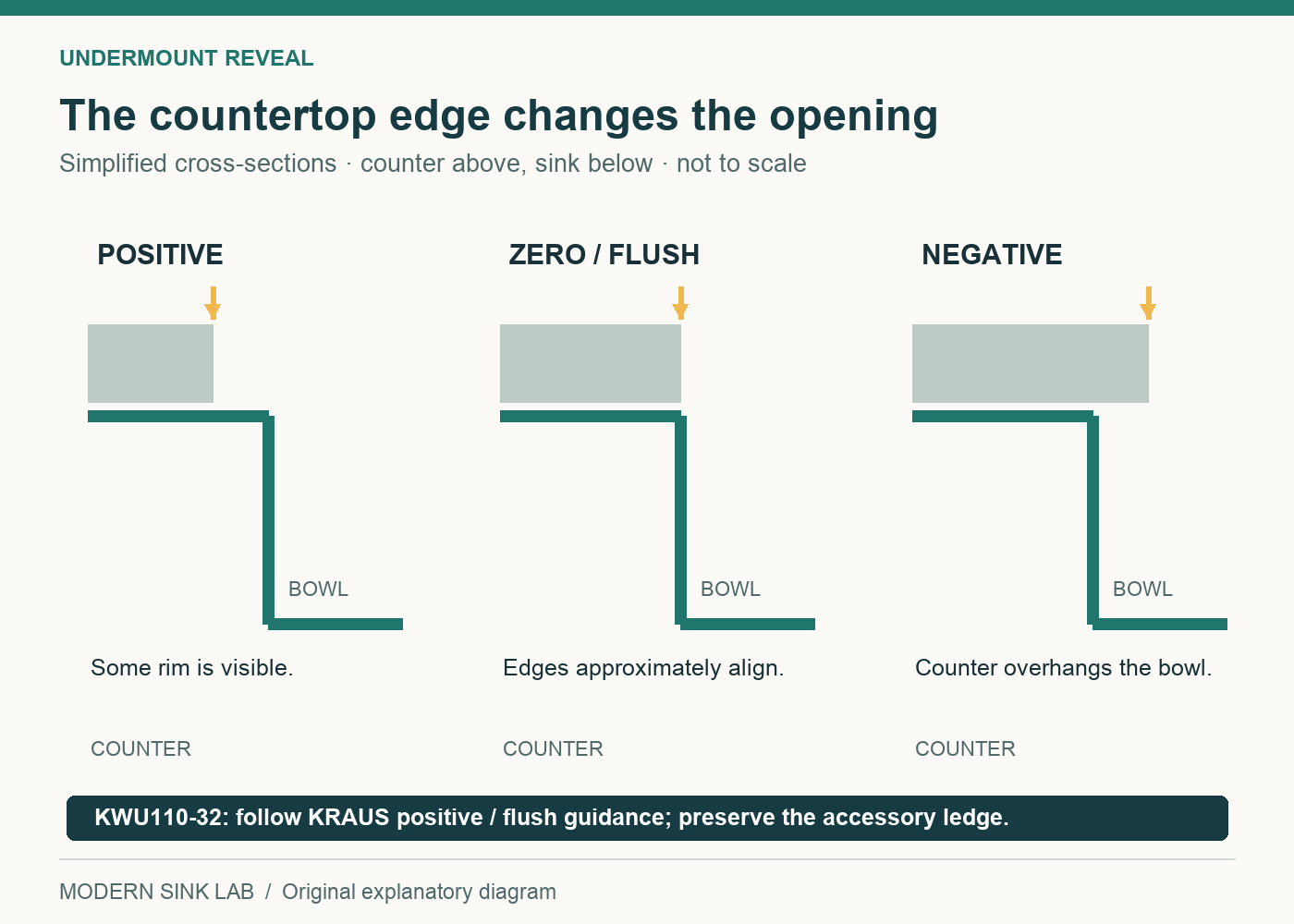
Positive reveal does not mean the sink sits on top of the countertop. It is still an undermount installation; the opening simply exposes some rim. Zero reveal is also not a separate sink material or a promise of a completely invisible seam.
Descriptions can be interpreted differently in a showroom conversation. Ask the fabricator to mark the intended relationship on the exact template and show a small sketch. A signed plan should be more precise than “a little lip” or “make it modern.”
Workstation accessories need their intended bearing surface
A workstation board or rack relies on the designed ledge and clear opening. If the countertop covers part of that path, a nominally compatible accessory may not sit or move as intended. Check the sink, board, rack and countertop together before treating any standard reveal preference as suitable.
For the KWU110-32, KRAUS’s product guidance specifically favors positive or flush reveal. That is a stronger basis than assuming a negative reveal will work because it looked good on a different plain-bowl sink. The manufacturer’s general KWU installation manual also illustrates positive and flush options, but the delivered model’s current instructions and template govern the final dimensions.
We deliberately do not turn a reveal measurement from a family manual into a universal cutout instruction. A printed number can belong to a different model, revision or bowl geometry. The sensible buyer action is to approve the correct template and have the fabricator check it against the physical sink.
KRAUS KWU110-32 — 32-inch undermount workstation
Check price on AmazonIf you are deciding whether the workstation concept is worthwhile at all, start with our workstation workflow guide. Reveal is the next decision once you know the accessory system serves a real purpose in your kitchen.
Cleaning access: choose the edge you can maintain
A positive reveal exposes a surface you can see and wipe. That visible strip may be attractive to one buyer and distracting to another. A negative reveal hides more of the rim from an overhead view, but an overhang still has an underside and a junction that need attention. Hiding a seam is not the same as removing it.
For zero reveal, ask how small alignment differences will appear around corners. You are approving a real product and a fabricated opening, not a perfect line in a rendering. The sink may have curved or sharp corners, and the countertop edge has its own profile.
| Preference | Useful question | Avoid assuming |
|---|---|---|
| Easy visual inspection | Can I see and reach the sink-to-counter junction? | That an unseen seam cannot collect residue. |
| A minimal top view | What will a slight alignment difference look like? | That zero reveal guarantees no visible transition. |
| Accessory movement | Can the delivered board and rack sit and slide correctly? | That all workstation ledges tolerate countertop overhang. |
| Simple cleaning | Can I wipe the edge and underside without awkward access? | That any reveal makes cleaning unnecessary. |
An existing cutout can limit the options
If the countertop is staying, the opening already determines much of the reveal. Moving the sink underneath an unchanged opening may expose one edge while hiding another. It can also change faucet, support or plumbing clearances. Do not approve a new sink based only on its outside width.
Have a fabricator establish whether the existing opening can support the intended result and whether any modification is practical. Cutting a larger opening is irreversible; restoring a smaller one is not a simple adjustment. Our mounting and replacement guide covers the earlier decision about keeping or replacing the countertop.
A useful fabricator handoff
Give the fabricator the exact model number, current manufacturer template, actual sink and the accessories you plan to use. Include the faucet model, backsplash arrangement and cabinet measurements. Then ask for these items to appear in the agreed plan:
- The selected reveal type and which template line defines it.
- Confirmation that the opening has been checked against the delivered sink.
- Unobstructed seating and movement for the intended workstation accessories.
- Faucet handle clearance, surrounding countertop material and support approach.
- A clear responsibility for checking the layout before cutting.
At handover, look around all four sides and corners. Check the visible alignment and ask the installer to demonstrate accessory seating. This is a functional acceptance check, not a substitute for the installer verifying support and sealing.
Which reveal would we choose?
For a KWU110-32 workstation, start with the manufacturer’s positive or flush options and choose the one that best balances appearance and access in your countertop plan. We would not choose negative reveal merely to hide more of the rim when it risks covering the ledge. For other sinks, consult their own instructions rather than borrowing the KWU rule.
Shortlist the KWU110-32 if you want this workstation layout and have a compatible undermount project. If you want an unobstructed plain bowl or have an existing opening that cannot preserve the ledge, compare another sink before fabrication. The KHU100-32 versus KWU110-32 comparison addresses that choice.
KRAUS KWU110-32 — confirm the workstation model
Check price on AmazonSources: KRAUS KWU110-32 product FAQ on reveal and accessories; KWU workstation installation manual, reveal and template sections; current US variant. Checked September 17, 2026. Diagrams illustrate concepts only. No universal cutout dimensions or installation compliance claim is provided.