
As an Amazon Associate I earn from qualifying purchases. Purchases through our links may earn us a commission at no extra cost to you.
For a rectangular estimate, multiply the bowl’s inside length × inside width × water depth, then divide by 231 to get US gallons. This is a useful planning calculation, not an exact capacity test of a tapered, rounded sink.
The most useful depth is usually the water level for your task. A bowl that is 10 inches deep does not require 10 inches of water to soak a pan. Keep space above the water for hands, dishes and movement; do not measure everyday capacity by filling to the rim.
Start with inside dimensions and a chosen fill level
NIST defines a US liquid gallon as exactly 231 cubic inches. With dimensions in inches:
Estimated US gallons = inside length × inside width × water depth ÷ 231.
For an approximate conversion to liters, multiply the gallons by 3.785.
Do not use the sink’s exterior width, cabinet size or countertop cutout as the liquid dimensions. Those include or describe space that cannot hold water. For a double bowl, calculate the side you intend to fill; combining both outside dimensions ignores the divider and the shape of each basin.
A KHU100-32 example: 3 inches and 6 inches are different jobs
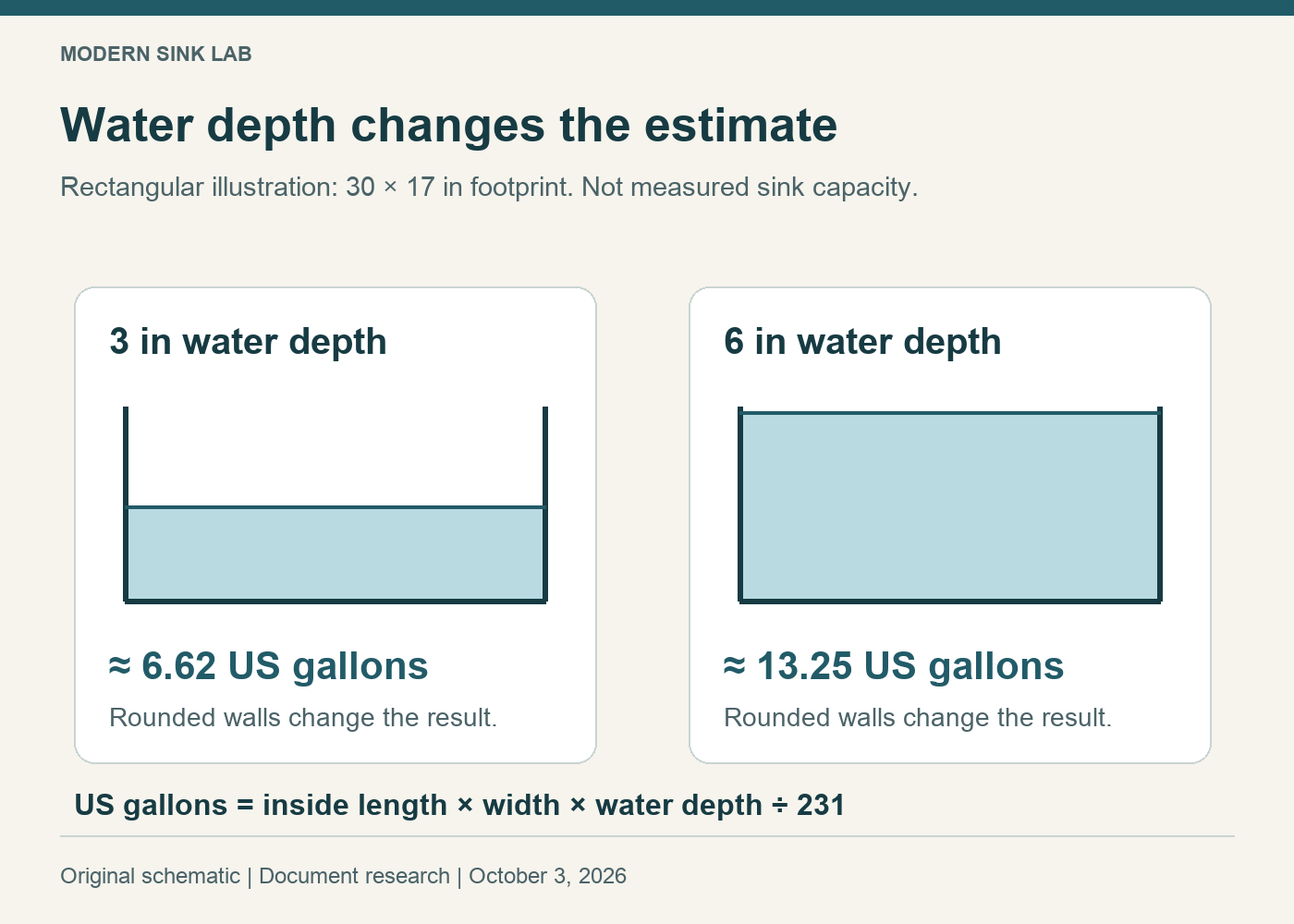
The KRAUS specification lists a 30 × 17-inch bowl with a 10-inch depth. Treat a 30 × 17-inch rectangle as a simplified footprint. The following numbers assume vertical sides and square corners, with nothing inside the bowl.
On a narrow screen, scroll the table sideways if needed.
| Illustrative water depth | Calculation | Rectangular estimate |
|---|---|---|
| 3 inches | 30 × 17 × 3 ÷ 231 | 6.62 US gallons / about 25.1 liters |
| 4 inches | 30 × 17 × 4 ÷ 231 | 8.83 US gallons / about 33.4 liters |
| 6 inches | 30 × 17 × 6 ÷ 231 | 13.25 US gallons / about 50.1 liters |
These are calculated rectangular volumes, not KRAUS-rated capacities or measured fill quantities. Wall taper, rounded corners and the floor shape change the actual result. Using maximum inside dimensions throughout the depth generally overstates the volume of a bowl that narrows toward its floor. Do not apply an invented percentage correction; the exact geometry is not established by three headline dimensions.
Doubling the depth doubles volume in this rectangular model. It does not prove that two actual sinks, or two actual fill levels in a tapered bowl, have the same relationship. Our example is intended to show why fill depth matters before comparing advertised sink sizes.
Measure an installed sink at the level you use
For a sink already properly installed and supported, a known-volume container gives a more direct answer than a box calculation. Choose an ordinary working level well below the rim. Stay with the sink throughout; this is not a stress or overflow test.
- Clear the bowl and record whether the bottom grid is in place. Close the normal stopper and check that it holds water.
- Add water using a container with a known volume in one consistent unit. Keep a count of full containers and measure the final partial one.
- Stop at your chosen working level. Record its depth and total added volume. If the stopper leaks or you lose count, the result is not a reliable capacity measurement.
- Drain the bowl normally. Keep the record with a photograph or a sketch of the chosen level; you do not need to leave a mark on the finish.
For example, five 1-US-gallon additions plus one measured ½-gallon addition give 5½ US gallons at that level. This is an illustration of the method, not a reported test of the linked sink. Do not mix an Imperial-gallon container with a US-gallon calculation.
Account for the pan, not just the empty basin
A sealed object displaces water; an open pot that fills with water behaves differently. A grid also occupies some volume and changes where cookware rests. To compare your own routine, record the empty-bowl result and the actual task separately instead of assigning a universal deduction for “dishes.”
A larger bowl can hold a wider tray while requiring more water for a particular soaking depth. A small washing tub inside a large bowl is another arrangement to evaluate with your cookware. None of these calculations proves lower household water use: running-water rinsing and the way you fill the bowl remain separate parts of the routine.
Use capacity as one buying check
The KHU100-32 is a candidate when you need a large uninterrupted stainless bowl. Choose it for the items and tasks that fit, not for a claimed gallon capacity we have not measured. It needs the specified 36-inch minimum cabinet width and an approved installation.
Use the single-bowl versus double-bowl guide for task separation, and the depth and disposal-clearance guide for the space below. Gallons do not establish either kind of fit.
Check the KHU100-32 bowl and package on Amazon
Research scope: NIST Handbook 44 Appendix C, KRAUS KHU100-32 specification and Franke sink-capacity guidance, checked October 3, 2026. Numerical examples are original calculations; no sink was filled or water-saving performance measured.