
Affiliate disclosure: As an Amazon Associate I earn from qualifying purchases. We may earn a commission when you buy through the shopping links in this guide.
The useful difference between these two sinks is the layout and the kit. Choose the KRAUS Kore KWU110-32 if its rear-offset drain works better with your cabinet equipment. Choose the Ruvati Roma RVH8300 if you want the included colander and its rear-center drain suits your plumbing. Both require a documented minimum 36-inch cabinet; neither earns a universal win from its 16-gauge label.
This guide compares the standard stainless steel models using their specification sheets, installation instructions and current product information. We have not installed or performance-tested either sink. Our recommendations explain the practical implications of the documented differences.
Which one fits your kitchen?
KRAUS KWU110-32: a sensible shortlist for someone who wants a board and drying rack and has a reason to prefer an offset drain. Its colander is a separate purchase.
View KRAUS KWU110-32 on Amazon
Ruvati RVH8300: a sensible shortlist for regular produce preparation when the included colander will be used. Confirm its bowl measurement with the supplied template before fabrication.
Choose neither yet if you have a smaller cabinet, a fixed countertop opening that has not been checked, or plumbing that cannot accommodate the depth.
In this guide
- Which one fits your kitchen?
- The differences that matter
- Drain position: plan around the equipment below
- Accessories: what is included, and what is useful?
- A dimension discrepancy worth resolving
- Countertop reveal can affect the workstation ledge
- Warranty and ownership: separate the sink from its accessories
- What the specifications cannot settle
- Our final buying rule
- Questions before ordering
The differences that matter
| Buying detail | KRAUS KWU110-32 | Ruvati RVH8300 |
|---|---|---|
| Installation | Undermount workstation | Undermount workstation |
| Outside width × front-to-back | 32 × 19 inches | 32 × 19 inches |
| Bowl depth | 10 inches | 10 inches |
| Minimum cabinet width | 36 inches | 36 inches |
| Steel thickness | 16 gauge | 16 gauge |
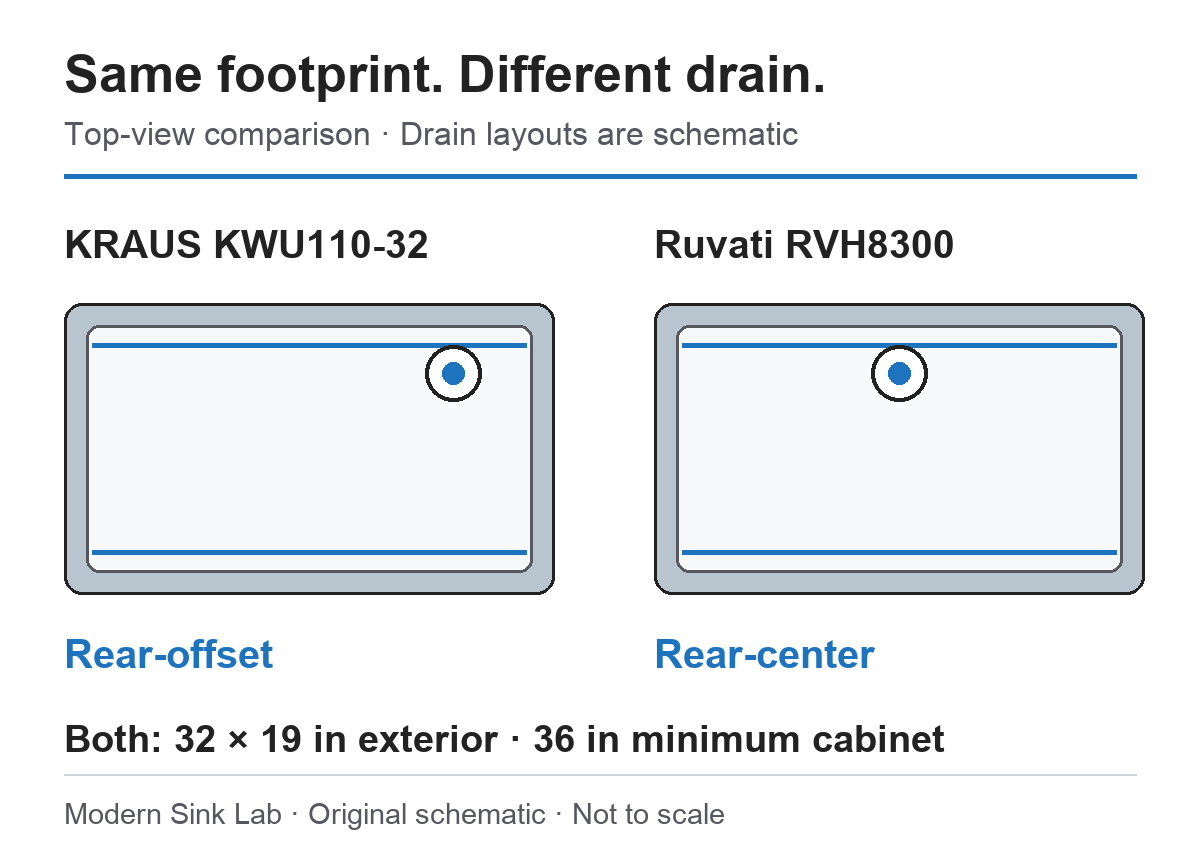
| Drain position | Rear-offset | Rear-center |
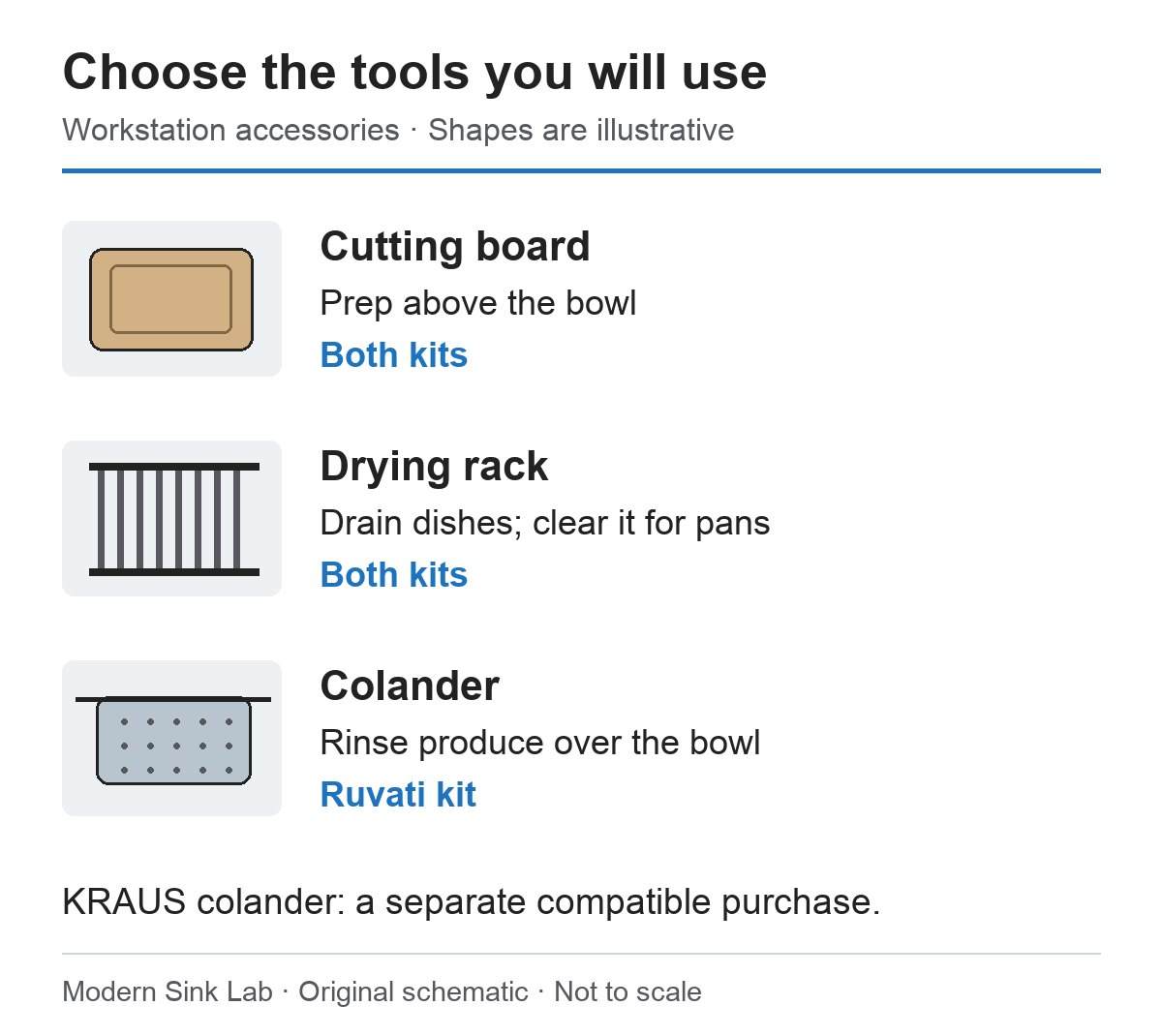
| Prep accessories | Board and roll-up rack | Board, folding rack and colander |
| Bowl width in specification PDF | 30 inches | 30⅜ inches; product page says 30½ |
| What to resolve first | Offset drain versus cabinet equipment | Drain layout and the dimensional discrepancy |
The shared outer dimensions do not make these interchangeable replacements. Corner shape, countertop reveal, mounting hardware and the actual template still matter. A different finish, width or retailer bundle may also change what you receive.
Drain position: plan around the equipment below
The drain is where a garbage disposal hangs, so moving it changes the usable space underneath. An offset opening can move that bulky assembly away from the middle of the cabinet. That is useful only if the new position does not occupy the space needed for a filter, bin or shutoff valve.
Take a photo of your open cabinet and draw a simple plan before choosing. Mark the wall drain, supply valves, disposal, water filter and any pull-out hardware. Include the space needed to remove a filter cartridge or reach a valve, rather than checking only whether everything can be squeezed inside.
Choose by the complete arrangement: the KRAUS is worth prioritizing when its offset location improves the actual equipment layout. A rear-center arrangement may be easier in a cabinet already organized around a central drain. We have not measured installed storage gains for either sink, so neither receives a blanket “more storage” claim.
Both models document a 3½-inch drain opening. That describes the opening, not a guarantee that your entire disposal installation will fit. The Ruvati product information specifically distinguishes its included basket strainer for standard plumbing from the flange used with a disposal. Include the disposal model in the installation plan; do not assume every drain piece in the box will be used.
Accessories: what is included, and what is useful?
Ruvati’s included colander is the clearest kit difference. It can be valuable if you regularly rinse produce over the bowl and would otherwise buy a matching accessory. If food preparation happens on a separate counter, its presence alone is a weak reason to choose the whole sink.
| Accessory | KRAUS reference | Ruvati reference |
|---|---|---|
| Cutting board | KCB-WS103BB | RVA1217 |
| Drying rack | KRM-11BL | RVA1395 |
| Bottom grid | KBG-UN1-32 | RVA68300 |
| Colander | Not listed in the standard included kit | RVA1317, included |
These are identification references, not a promise of current parts inventory. The documents also list strainers, covers, mounting hardware and a template. Check the seller’s exact bundle before ordering, particularly when a listing includes a faucet, disposal or extra accessories.
Do not assume a “32-inch workstation” accessory is universal. The relevant fit is the support ledge and accessory dimensions, not the overall sink width. Use the exact sink and part numbers when buying a replacement board, rack or grid.
A meal-prep test you can do before buying
Walk through dinner in your current kitchen. Where would you rinse vegetables? Where would the board sit? When you put a large pan in the bowl, where would the board and rack go? A workstation is helpful when these steps share the sink comfortably; it is less helpful when the accessories constantly block access.
- Frequent produce preparation: the included Ruvati colander is a practical advantage to evaluate.
- Mostly washing large pans: prioritize open-bowl usability and an easy place to store accessories.
- Two people cooking: check whether one person’s chopping position prevents the other from using the faucet.
- Limited counter space: overhead prep can help, but still needs a place for wet accessories afterward.
Also think about maintenance. A wooden board is a separate item with its own cleaning and drying instructions. A bottom grid adds a surface to lift and clean underneath. These are manageable tasks, but a useful comparison should account for them alongside the convenience.
A dimension discrepancy worth resolving
The Ruvati product page lists an interior width of 30½ inches, while the linked RVH8300 specification PDF lists 30⅜ inches. The difference is ⅛ inch. We cannot tell from the documents whether that reflects a revision or a measurement convention.
This does not establish a defect. It does mean the fabricator should verify the supplied unit and its template before approving the countertop opening. Neither interior measurement is a cutout dimension. We would not choose Ruvati solely for its apparent extra bowl width until that difference is clarified.
For KRAUS, the 10-inch bowl depth and 10½-inch exterior height are also different measurements. The space taken up below the counter continues beyond the usable depth of the bowl. When replacing a shallower sink, check the drain assembly and disposal outlet relative to the wall drain.
Our 36-inch cabinet sizing guide includes a worksheet covering width, front-to-back space and plumbing clearance.
Countertop reveal can affect the workstation ledge
The reveal is the relationship between the countertop edge and the sink opening. A negative reveal leaves a countertop overhang; a positive reveal exposes some sink ledge; a flush reveal aligns the edges.
KRAUS’s specification sheet advises against a negative reveal because it can prevent workstation accessories from fitting. Ruvati’s workstation installation guide recommends a ¼-inch positive reveal, permits flush installation and rejects an overhang. Give your fabricator the instructions for the actual sink being installed.
During a dry fit, check that the board, rack and colander can be inserted, moved and removed with the planned counter edge and faucet arrangement. This is a functional check, not simply a preference about how much metal is visible.
If you are keeping an existing countertop, read undermount versus drop-in installation before assuming either model is a straightforward replacement.
Warranty and ownership: separate the sink from its accessories
| Item | KRAUS | Ruvati |
|---|---|---|
| Residential sink | Limited lifetime terms for the original purchaser, authorized purchase and original installation; tied to residence conditions | Limited lifetime terms for the original purchaser and qualifying residential use |
| Accessories | Separate one-year limited warranty | Current warranty overview lists one-year limited coverage; accessories are excluded from the lifetime sink coverage |
| What to retain | Receipt, seller details, model and part numbers | Receipt, seller details, model and part numbers; inspect delivery promptly |
“Limited lifetime” is not a promise that scratches, installation damage or every replacement cost will be paid. Ruvati explicitly excludes installation labor from product replacement and requires notice of missing parts or shipping damage within 30 days of delivery. Do not leave the unopened box waiting until the countertop installer arrives.
Older installation literature can describe accessory exclusions without explaining a separate accessory warranty. Use the current applicable terms and seek clarification for a disputed item. A manufacturer’s warranty also serves a different purpose from the retailer’s return policy: compare both before committing to a countertop cutout.
What the specifications cannot settle
Both brands describe sound treatment and drainage features. Without controlled noise tests, drainage measurements or long-term cleaning trials, we cannot call either sink quieter, faster-draining or more scratch-resistant. The shared 16-gauge label does not settle those questions.
For a showroom visit, ask to see the underside treatment, inspect the bowl corners and handle the accessories. That can help you assess workmanship and convenience, but tapping an uninstalled sink is not a controlled comparison of two installed kitchens. Our 16 versus 18 gauge guide explains which claims thickness can and cannot support.
Our final buying rule
Buy the KRAUS KWU110-32 when the offset drain fits your cabinet plan and the standard board-and-rack kit covers the way you cook. Add the cost of any compatible colander you actually want when comparing offers.
View KRAUS KWU110-32 on Amazon
Buy the Ruvati RVH8300 when the rear-center layout suits your plumbing and you will use the included colander. Resolve the bowl-dimension discrepancy with the supplied sink and template before fabrication.
Pause on both when cabinet width, the existing cutout or plumbing depth is unresolved. The lower-cost sink on a shopping page can become the more expensive choice if it creates avoidable fabrication or plumbing work.
Compare the complete purchase: sink, missing accessories you need, compatible disposal parts, installation and the seller’s return conditions. Prices and bundles change, so use the merchant page for the current offer and confirm the exact model before ordering.
Questions before ordering
Will either fit a 33-inch cabinet?
The listed minimum cabinet width for both models is 36 inches. For a smaller cabinet, start with a model whose documented requirement matches the cabinet; the 32-inch exterior alone does not establish fit.
Are the accessories interchangeable?
Do not assume so. Match the accessory’s compatibility information to the exact sink. Equal outside sink dimensions do not establish equal support ledges.
Does the Ruvati kit include everything for a disposal?
No. Its included basket strainer is for standard plumbing. Check the flange and other parts supplied or specified for your disposal, plus the available space below the sink.
Continue your sink research
- Kitchen Sink Size Guide for 30-, 33- and 36-Inch Cabinets
- 16 vs 18 Gauge Stainless Steel Sinks: What Matters?
- Undermount vs Drop-In Kitchen Sinks: Which Fits Your Remodel?
Sources and research method. KRAUS KWU110-32 specification sheet (January 26, 2021 revision), current product page and kitchen-sink/accessory warranty terms; Ruvati RVH8300 two-page specification, current product page, Undermount Workstation installation guide and current warranty overview.
Sources checked September 14, 2026. This guide uses AI-assisted research and analysis of documentation; no physical installation or comparative performance testing was performed. Illustrations are original explanatory schematics, not product photographs or fabrication drawings. Model details, seller bundles and warranty terms can change.
Read our editorial policy and affiliate disclosure.
Finish your buying checklist
Before ordering, decide whether a workstation suits your routine and check grid and ledge-accessory compatibility. If the deeper bowl will carry a disposal, complete the vertical-clearance worksheet.
If you like the Ruvati workstation layout but prefer rounded inside corners, compare the RVH8300 and RVH8301 corner shapes and shared accessories. Similar exterior dimensions do not establish interchangeable cutout templates.