
Affiliate disclosure: As an Amazon Associate I earn from qualifying purchases. We may earn a commission when you buy through the shopping links in this guide.
16-gauge stainless steel is thicker than 18-gauge, but thickness should break a tie between suitable sinks—not decide the whole purchase. Start with cabinet fit, mounting style, usable bowl shape and the quality of the complete sink. Then decide whether the thicker sheet is worth the additional cost for your routine.
A well-specified 18-gauge sink can be a sensible residential choice. A 16-gauge option deserves a closer look when you frequently handle heavy cookware and the upgrade preserves the layout, finish and accessories you want. Neither number proves that the sink is scratch-proof, quieter in your kitchen or better made in every respect.
Two real choices, with different trade-offs
Consider the 18-gauge KRAUS Fairlane KHU640-33 if its shallower bowl and offset drain work better for your reach and plumbing, and its complete installed cost is favorable. Consider the 16-gauge KRAUS Standart PRO KHU100-32 if the deeper bowl and thicker sheet solve a specific need. Its extra 1⅜ inches of listed bowl depth also requires a clearance check below the counter. Neither is a workstation sink.
Both specify a 36-inch minimum cabinet width and 24 inches front-to-back. That shared requirement does not make their cutouts interchangeable. Gauge alone does not establish scratch or noise performance. Compare their dimensions, drain positions and exact model variants below.
In this guide
- What do the two numbers mean?
- Dents and scratches are different problems
- Why “thicker means quieter” is incomplete
- Gauge, steel grade and finish are separate specifications
- How to compare two real candidates
- When is an upgrade worth paying for?
- A real 18-versus-16-gauge choice
- Questions about stainless steel gauge
What do the two numbers mean?
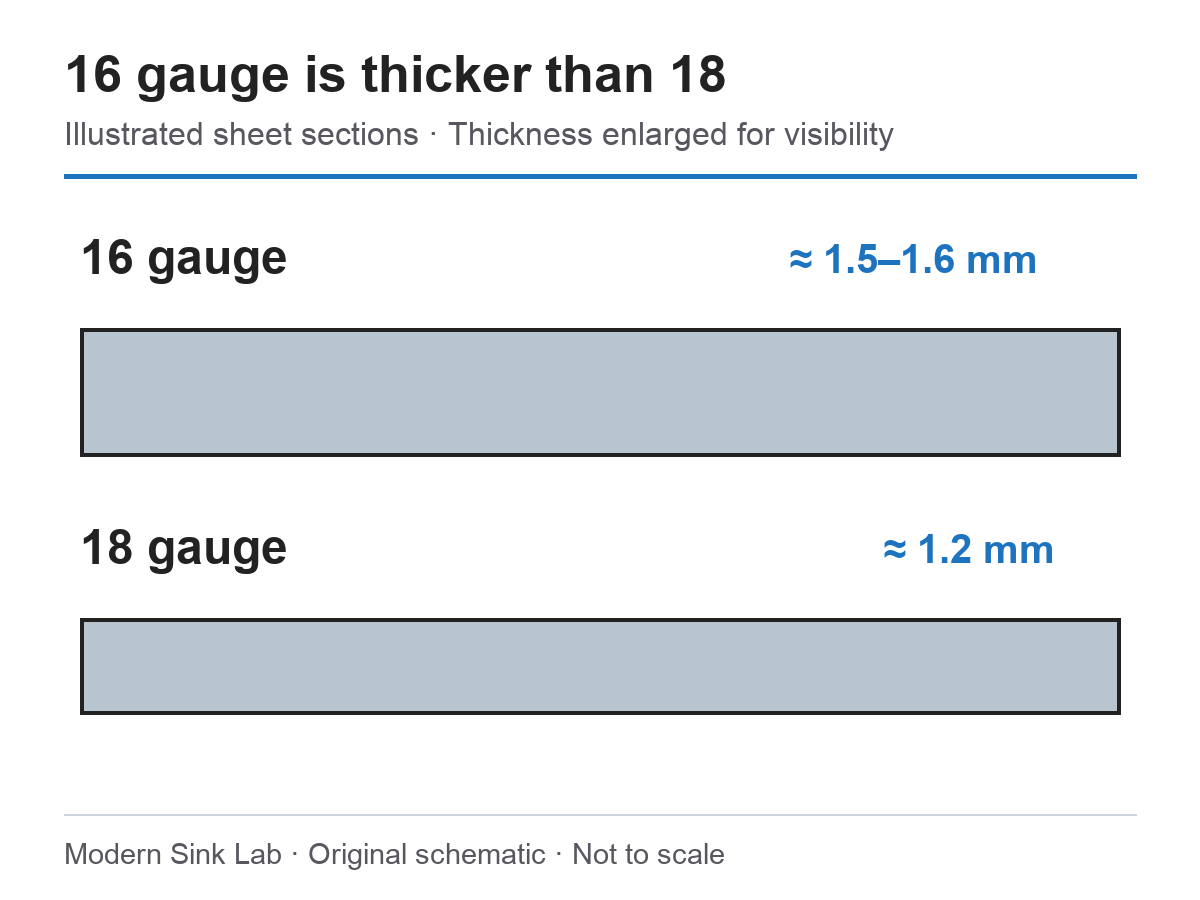
Gauge describes sheet thickness: the lower number is thicker. Published sink guides commonly put 16 gauge around 1.5–1.6 mm and 18 gauge around 1.2 mm. Different charts and rounded manufacturer descriptions can show slightly different values, so use the exact model’s specification when precision matters.
| Question | 16 gauge | 18 gauge |
|---|---|---|
| Which sheet is thicker? | Thicker | Thinner |
| Typical published nominal thickness | About 1.5–1.6 mm | About 1.2 mm |
| Useful reason to consider it | Extra material where resistance to deformation is a priority | A suitable overall design at a more attractive total cost |
| What still needs checking? | Steel grade, finish, construction, sound treatment and fit | The same factors |
| Does it settle scratch or noise performance? | No | No |
The “16” on a listing should describe the sink’s relevant steel construction. If a product mixes materials or promotes the thickness of one component, ask what the number actually applies to. A thick-looking rim is not a measurement of every part of the bowl.
Dents and scratches are different problems
A dent changes the shape of the metal; a scratch marks its surface. More sheet thickness can help resist deformation when other factors are comparable. Bowl geometry, forming, reinforcement and the particular impact still affect the outcome. It is not possible to infer a controlled dent-test result from a gauge label alone.
Scratching is not solved by buying a thicker sheet. A surface can still be marked by cookware or abrasive cleaning. Finish, the materials rubbing against it and your care routine matter. We would reject a blanket “16 gauge will not scratch” claim even if it appears in a persuasive product description.
A compatible bottom grid can keep cookware from resting directly on much of the bowl floor. It also needs cleaning underneath and around its feet. Treat it as an accessory with trade-offs, not a guarantee that the entire sink will stay unmarked.
Buying implication: if visible wear is your main concern, inspect the finish and read the care instructions. If handling heavy pots is the issue, consider thickness alongside bowl shape, support and how you place cookware in the sink. Those are different shopping questions.
Why “thicker means quieter” is incomplete
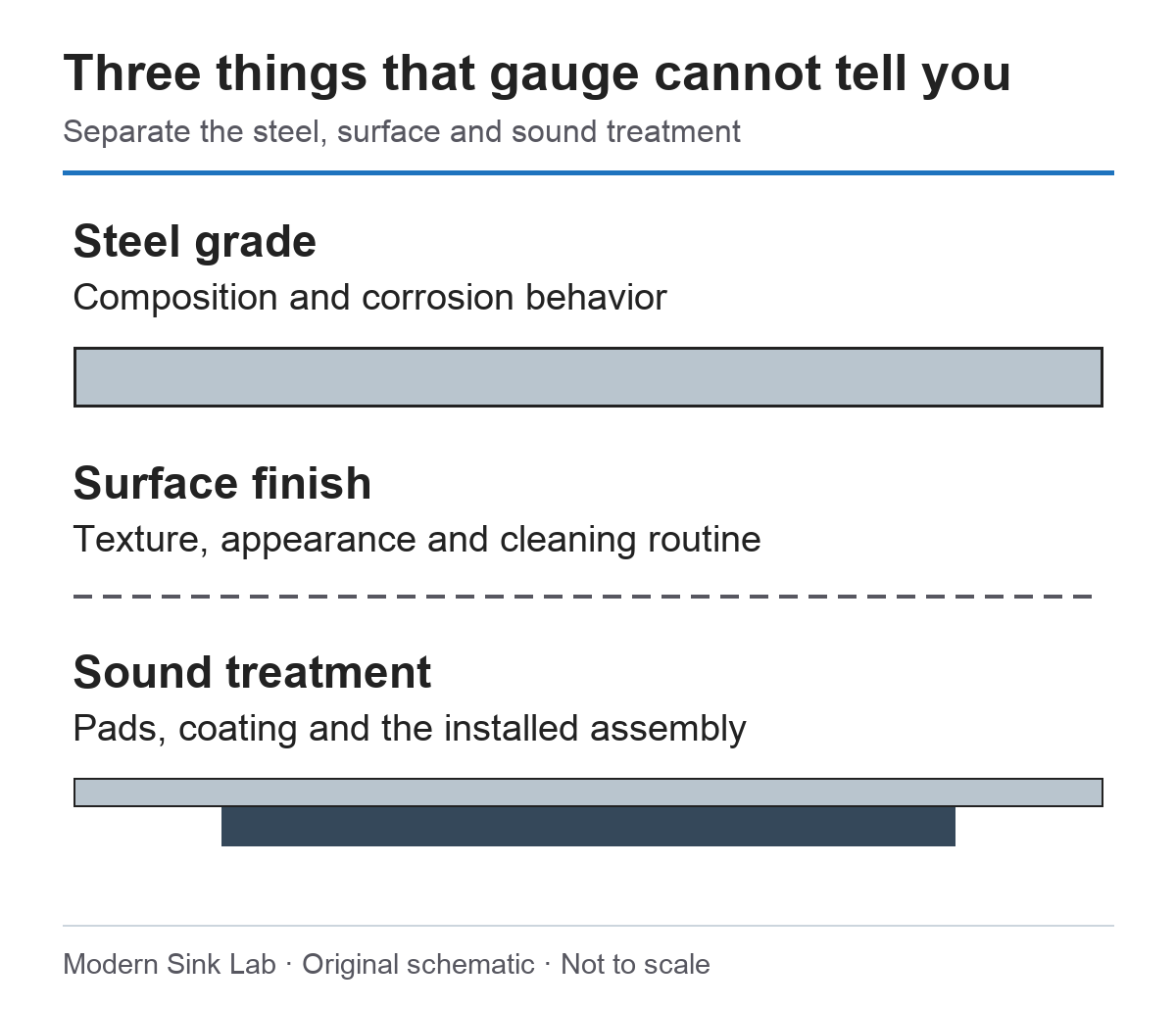
The noise you hear comes from a complete installed assembly. Water strikes the bowl; cookware contacts metal or a grid; a disposal can transmit vibration. Sound pads, undercoating, bowl shape, mounting and the surrounding cabinet can all change the result.
A 16-gauge model with one construction cannot be fairly ranked against every 18-gauge model by thickness alone. Look for documented sound treatment and photographs of the underside. If noise is a major priority, a repeatable test of the exact models is much more useful than a brand’s general adjective.
We have not performed an installed noise comparison, so this guide does not give either gauge a decibel advantage. Tapping two loose sinks in a showroom can help you notice differences, but it is not a substitute for comparing them in the same installed conditions.
Gauge, steel grade and finish are separate specifications
Gauge describes thickness. A steel grade such as Type 304 describes a material classification. “18/10” refers to nominal chromium and nickel content; it does not mean 18 gauge. A product can have an 18/10 composition description and a 16-gauge thickness at the same time.
Finish describes the surface treatment or appearance. Brushed, satin and coated finishes do not become equivalent because two sinks share a gauge. Compare the actual finish and its cleaning instructions, especially if you are switching from uncoated stainless steel to a colored coating.
Corrosion behavior also cannot be settled by gauge alone. Material composition and exposure matter. Follow the manufacturer’s care directions, including its advice on cleaning chemicals, metal implements and drying. Do not assume “stainless” makes every chemical or cleaning tool appropriate.
Ruvati’s stainless steel care guide, for example, treats cleaning methods and drying as part of ownership. That is useful context for either gauge. If you want a low-effort routine, read the care document before choosing a finish you will need to maintain.
If the alternative is granite composite, leave the gauge scale behind
A molded quartz-composite sink does not have an equivalent steel-gauge score. Compare the finish you want, the permitted cleaning routine, the bowl layout and the complete installation instead. A wider uninterrupted bowl may come from choosing single-bowl geometry, not from choosing stainless steel; do not confuse those two decisions.
Use our stainless steel versus granite-composite decision guide if you are still choosing the material. It separates care habits, color, layout and project cost before returning to specific KRAUS examples. Once you have chosen stainless, the gauge comparison on this page becomes the relevant next filter.
How to compare two real candidates
Write down the exact models and compare these items in order. The goal is to avoid attributing the value of a whole product bundle to one thickness number.
- Fit: minimum cabinet, mounting method, exterior size, depth and countertop opening.
- Usable shape: one or two bowls, corners, drain location and room for your cookware.
- Construction: documented gauge and grade, finish, underside treatment and required support.
- Ownership: accessories you need, replacement compatibility, care and applicable warranty.
- Total cost: sink plus genuinely necessary extras and installation work.
For instance, a more expensive 16-gauge kit might include a board and rack that the 18-gauge alternative does not. If you would buy those anyway, count their value separately. If they would sit unused, they are not savings. Likewise, a less expensive sink that requires changing your countertop opening may not be the less expensive installation.
Use our sink measurement worksheet for the first step. If the candidates use different mounting styles, compare that difference using the undermount versus drop-in guide before focusing on gauge.
When is an upgrade worth paying for?
There is no universal amount worth spending to move from 18 to 16 gauge. The better question is what changes in the particular purchase. If the two products fit equally well, offer comparable features and require the same installation, the price difference is easier to evaluate.
As a purely hypothetical example, suppose two otherwise suitable sinks differ by $75. That is not a current price quote or a recommended upgrade budget. Consider whether you would rather spend that amount on extra sheet thickness, a better faucet fit, a useful accessory or resolving a plumbing issue. Prioritize the item that addresses an actual problem in your project.
| Your situation | What deserves priority? |
|---|---|
| Heavy cookware used frequently | Consider 16 gauge, while comparing shape and construction |
| A suitable 18-gauge model is within budget | Keep it on the shortlist; check the whole specification |
| Noise is the main concern | Sound treatment and credible model-specific evidence |
| You want a surface that never scratches | Reconsider that expectation; inspect finish and care needs |
| The thicker model has the wrong cutout or drain position | Fit and installation take priority over gauge |
A real 18-versus-16-gauge choice
The KRAUS Fairlane KHU640-33 is an 18-gauge undermount. The Standart PRO KHU100-32 is a 16-gauge undermount. Both specify a 36-inch minimum cabinet width and 24 inches front-to-back, so they provide a useful example of why thickness is only one buying factor.
| Specification | KHU640-33 | KHU100-32 |
|---|---|---|
| Gauge | 18 | 16 |
| Outside footprint | 32½ × 19 in | 32 × 19 in |
| Bowl opening | 30½ × 17 in | 30 × 17 in |
| Listed bowl depth | 8⅝ in | 10 in |
| Drain | Offset | Rear center |
These are different sink designs, not a controlled test isolating gauge. Both document sound pads and undercoating; we cannot assign either a measured noise, dent or scratch advantage. An identical minimum cabinet requirement does not make their cutouts interchangeable. Confirm the exact KHU100-32 model: KHU100-32/18 is a separately documented 18-gauge builder-pack variant.
KRAUS KHU640-33
Check KRAUS KHU640-33 on Amazon →KRAUS KHU100-32
Check KRAUS KHU100-32 on Amazon →The full KHU640-33 versus KHU100-32 comparison covers the bowl geometry, accessories and installed-height checks. If you want a workstation ledge, the KWU110-32 versus RVH8300 comparison remains useful; both of those models are 16 gauge.
Questions about stainless steel gauge
Is 18 gauge too thin for a kitchen?
The number alone is not a reason to reject a residential sink. Judge the actual model, its intended use, construction, warranty and fit. Thicker steel can be a preference without making every thinner alternative unsuitable.
Is 18/10 stainless steel the same as 18 gauge?
No. The former is a composition description; the latter is a thickness designation. Record both when they are supplied.
Will 16 gauge last longer?
We cannot assign a service life from gauge alone. Installation, material, finish, use and care all matter. A lifetime warranty is also a set of coverage terms, not a measured lifespan.
Should I replace a working 18-gauge sink just to get 16 gauge?
First identify what you want to improve. If the current sink fits, drains and serves your routine, a gauge change alone may solve little. Replacement is more persuasive when it addresses a specific layout, condition or usability problem.
Continue your sink research
- KRAUS Kore KWU110-32 vs Ruvati RVH8300: Which to Buy?
- Kitchen Sink Size Guide for 30-, 33- and 36-Inch Cabinets
- Undermount vs Drop-In Kitchen Sinks: Which Fits Your Remodel?
Sources and research method. KOHLER Sink Material Information; Ruvati 16 Gauge vs 18 Gauge guide and Stainless Steel Sink Care Guide (October 2024); KRAUS KWU110-32 and Ruvati RVH8300 specifications; KHU640-33 (March 4, 2024), KHU100-32 (April 30, 2019) and KHU100-32/18 specifications. Manufacturer promotional performance claims were not treated as comparative test results.
Material sources originally checked September 14, 2026; the KHU640-33/KHU100-32 model comparison and US shopping variants were rechecked September 25, 2026. This guide uses documentation-based research and analysis; no physical installation or comparative performance testing was performed. Illustrations are original explanatory schematics, not product photographs or fabrication drawings. Model details, seller bundles and warranty terms can change.
Read our editorial policy and affiliate disclosure.
Finish your buying checklist
Steel thickness does not decide accessory fit. Use our bottom-grid measurement checklist and consider which workstation tools you will actually use.