
By Modern Sink Lab. Research checked September 25, 2026. This is a document-based guide, not a hands-on test.
Affiliate disclosure: As an Amazon Associate I earn from qualifying purchases.
Rust-colored spots on a KRAUS stainless steel sink do not, by themselves, prove the sink needs replacing. First check whether the mark follows something left in the bowl, sits on a mineral deposit, or remains in a visibly damaged surface. Those are different situations, and a photograph alone cannot reliably separate them.
For a new buyer, the useful question is whether the care routine suits the household. A 16-gauge stainless sink can still need rinsing, drying and prompt removal of residues. Thickness does not make its surface immune to staining.
Start with the history of the mark
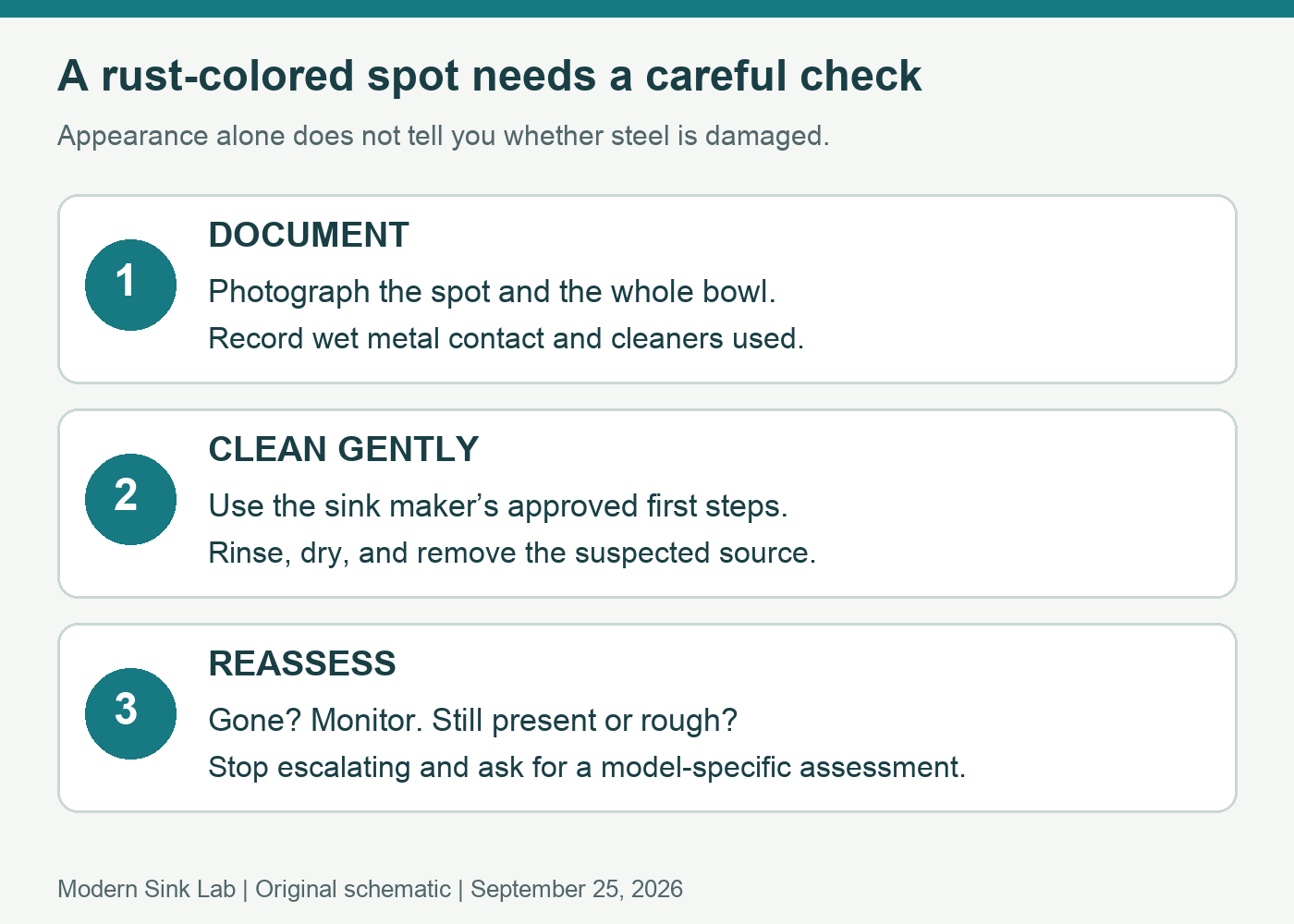
- After a cast-iron pan or another metal object sat in the bowl: transferred rust is a possibility. KRAUS specifically identifies other kitchen objects as a source of rust staining. Remove the object before cleaning; do not keep repeating the same wet contact.
- With a pale, chalky ring or water outline: mineral buildup may be part of the problem. Color is not a reliable chemical test. Treat the deposit according to the sink maker’s instructions rather than assuming every brown patch is damaged steel.
- With a pit, rough patch or an area that keeps returning: stop escalating the cleaning method. Record its location and ask KRAUS to assess the finish and maintenance history. A surface stain and permanent damage require different responses.
Before touching a new installation, take a close photograph and one showing the whole bowl. Note when the mark appeared, what was resting there and which cleaners have already been used. This preserves useful evidence if you need product support later.
Use a gentle first cleaning pass
For ordinary stainless steel, KRAUS’s current care guidance starts with a soft sponge and mild, ammonia-free liquid soap, followed by thorough rinsing and drying with a microfiber cloth. Follow the grain when wiping. Clean the surrounding area too, so a dirty grid or wet utensil is not immediately putting residue back.
Use the maker’s stainless-specific care instructions for a remaining mineral deposit or rust spot. Its care page lists a rust-cleaning product family, but that does not mean every bottle or formulation under that brand is suitable. Read the exact product label, check compatibility with your finish, and follow its dilution, contact-time and rinsing instructions. Do not combine cleaning products.
Avoid steel wool, wire brushes, harsh abrasive powders and chlorine bleach. KRAUS warns that chlorides and aggressive cleaners can damage stainless steel. More force is not a useful diagnostic test. If a gentle, approved treatment leaves a persistent mark or exposes roughness, photograph the result and seek model-specific guidance before doing more.
Keep the grid from becoming a hidden wet area
A bottom grid separates pans from the bowl, but it still needs to be lifted for cleaning. Check underneath it and around its feet. A grid does not turn the area below into a maintenance-free surface; residues can remain out of sight while the top looks clean.
If a replacement grid is needed, match the sink model and drain position. Our sink-grid measuring guide explains why an exterior sink width is not enough to order one.
What this means before buying a KHU100-32
The KHU100-32 is a 32 × 19-inch undermount sink with a 30 × 17-inch bowl and a published 10-inch depth. Its specification calls for a minimum cabinet 36 inches left to right and 24 inches front to back, and includes a KBG-100-32 bottom grid. Check the actual cabinet, template and plumbing with the installer; these dimensions do not prove it will fit an existing opening.
It is a reasonable candidate if you want an open stainless bowl and accept routine care. It is a poor choice if your expectation is a surface that never shows water marks or needs no drying. If prep accessories are important, compare the KHU100-32 with the KWU110-32 workstation before purchasing.
Already own a usable sink? Do not replace it solely because of an unexplained spot. A purchase link is for buyers planning a sink installation; it is not a treatment for the mark in your current bowl.
When to ask for an assessment
- The mark survives appropriate cleaning or returns after its suspected source has been removed.
- There is a visible pit, unusual roughness, peeling or a change in the surface finish.
- The sink has a colored or coated finish and you are unsure whether ordinary stainless instructions apply.
- You want a warranty decision: provide the model, purchase record, photographs and cleaning history. Coverage depends on the actual warranty and assessment.
For a broader material decision, see stainless steel versus granite composite. Changing materials changes the care tradeoffs; it does not eliminate them.
Research scope: KRAUS Stainless Steel Kitchen Sinks care guidance, product FAQ and KHU100-32 specification; current US product listing. We have not inspected your sink or tested stain-removal products.
Water underneath the bowl is a separate problem from marks on its working surface. Our under-sink moisture observation guide helps you record where water first appears and when, so an installer can assess the source before you buy a replacement. Factory undercoating does not repair a leaking connection.
If a line remains after a removable deposit is gone, reassess it as a possible finish mark rather than repeating stronger stain treatments. Our stainless sink scratch assessment and protection guide separates fine usage lines from deeper damage and explains why plain-steel care must not be copied onto a colored or coated surface.