
By Modern Sink Lab. Document-based buying guidance; checked September 20, 2026. We have not hands-on tested these products.
Affiliate disclosure: As an Amazon Associate I earn from qualifying purchases.
Short answer: a typical half-sheet pan looks comfortably smaller than the Ruvati RVH7300’s published bowl dimensions. That makes this sink a reasonable candidate for a baker, but it does not prove that your pan will lie flat on the grid or pass through the finished countertop opening. Measure the pan’s outside rim, including handles, and check the narrowest usable space at the height where it will rest.
The useful question is not whether a “30-inch sink” can hold an “18-inch tray.” Those labels describe different things. The sink’s outside flange does not become washing space, and the pan’s baking surface may exclude its rolled rim.
Start with two measured rectangles
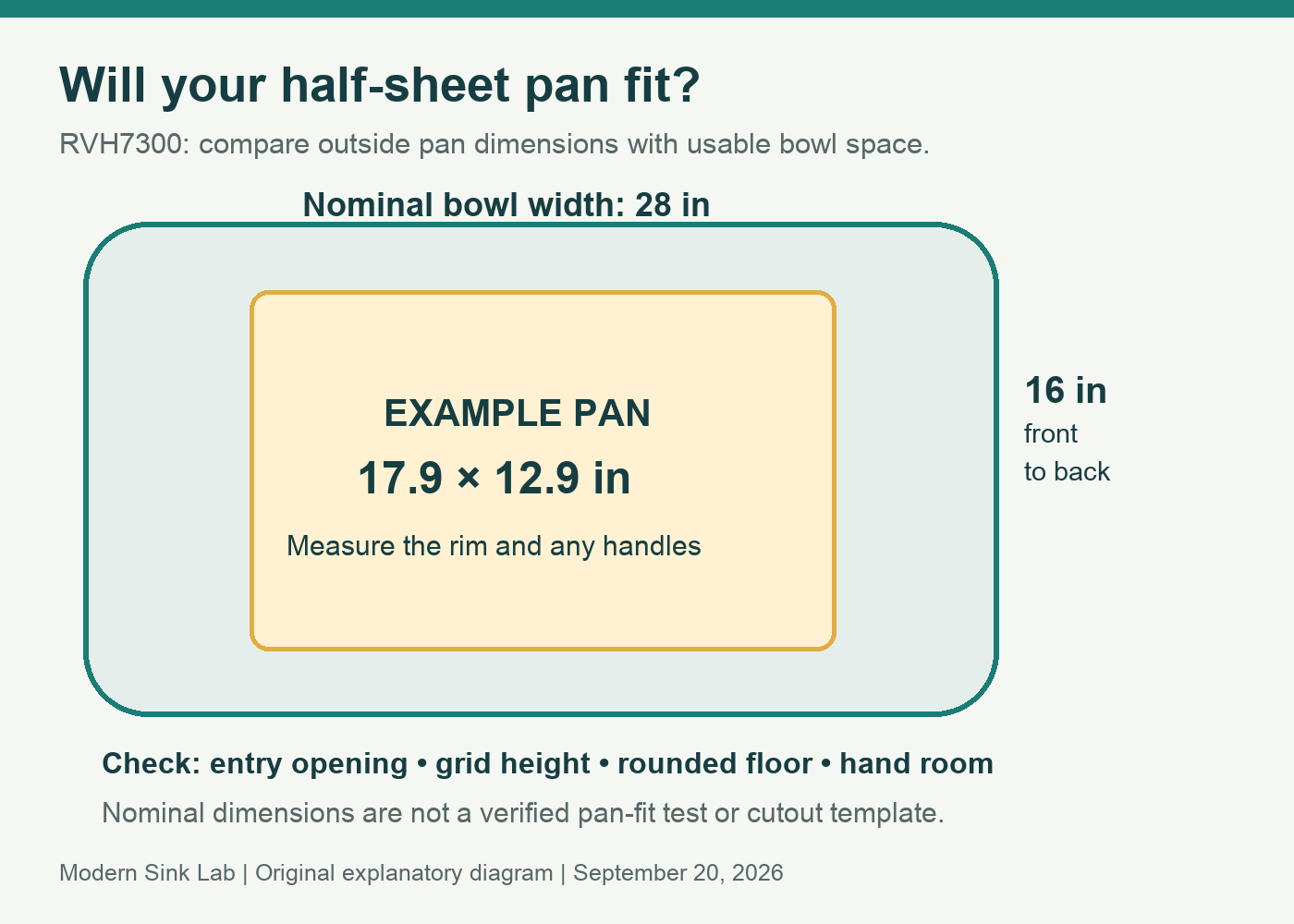
Ruvati’s RVH7300 specification lists a 30 × 18-inch exterior, a 28 × 16-inch interior bowl and a 10-inch bowl depth. As one concrete cookware example, Nordic Ware lists the pan in its Naturals Half Sheet with Multi-Purpose Oven/Cooling Rack set, SKU 43330, at 17.9 × 12.9 × 1 inches. Different half-sheet pans can have different exterior dimensions.
- Align the example pan’s 17.9-inch side with the bowl’s 28-inch width.
- The nominal width difference is 28 − 17.9 = 10.1 inches.
- The nominal front-to-back difference is 16 − 12.9 = 3.1 inches.
These are total dimension differences, not measured gaps around a real pan. The smaller front-to-back margin is the one to investigate first. A long handle, raised grid edge or narrowing bowl wall could matter there before the left-to-right width becomes a problem.
Match model RVH7300 and the 30-inch rounded-corner version. Check the selected package and current offer before buying.
Three places can change the fit
1. The opening at the countertop
An undermount sink sits beneath a separate cutout. Countertop material projecting over the bowl can reduce the entry space. A tray might fit inside the bowl once tilted yet be awkward to lower and lift with wet hands. Use the finished opening, faucet position and backsplash as part of the check. Our guide to undermount sink reveal explains why the edge treatment matters.
2. The height where the tray rests
The RVH7300 includes a bottom rinse grid and has rounded corners. Do not treat the published bowl rectangle as a guaranteed flat floor rectangle. Measure above the grid if that is where you intend to wash trays. If you prefer to remove the grid, repeat the check at the lower resting position rather than assuming the same usable width.
3. The space for your hands
A pan that just fits is not necessarily pleasant to wash. Leave room to grasp two edges, rotate it under the faucet and reach the dirty side. Try the motion with your largest roasting tray as well as your half-sheet pan. Handles often make the roasting tray the more demanding object.
A practical check before installation
- Measure the cookware you own. Record the longest and widest outside dimensions. Include protruding handles and rolled edges.
- Make a full-size cardboard rectangle. Label it with the actual pan dimensions. It is a planning aid, not a sink cutout template.
- Check a physical sink when possible. Place the template at the grid and bowl floor heights. Better still, bring the clean pan to a showroom or inspect the delivered sink before countertop fabrication.
- Simulate entry and lifting. Ask the installer how much of the bowl the chosen reveal will expose. Check faucet reach and room above the pan.
- Keep the installer’s template separate. The supplied sink template and the actual sink determine fabrication. Cookware clearance arithmetic does not authorize a countertop cut.
The cabinet must also qualify
Use Ruvati’s documented 33-inch minimum base cabinet as the starting requirement. At our check, the Amazon feature text said 30 inches while Ruvati’s product page and specification said 33. We would not approve this sink for a 30-inch cabinet based on that retail bullet. Have the installer confirm the actual cabinet, supports and mounting clearance against the current manufacturer specification.
This is a separate decision from pan capacity. A bowl can suit your cookware while the sink assembly fails the cabinet plan. The cabinet-size checklist covers that installation step.
Who should shortlist it?
The RVH7300 is worth considering if you want one open washing area for baking trays and do not need a workstation ledge. It is less compelling if your priority is keeping soaking water separate from rinsing, or if you want accessories to ride inside an integrated ledge. Compare those habits in our single-bowl versus double-bowl guide.
Our recommendation is conditional: shortlist the RVH7300 for its documented bowl space, then verify your cookware and installation. We cannot promise a particular pan will sit flat without that physical check.
View the RVH7300 package and current offer
Research basis: Ruvati RVH7300 product page and specification; Nordic Ware SKU 43330 exterior pan dimensions; US Amazon model and offer check on September 20, 2026. No fit, drainage or durability test was performed.
If you also want a ledge for prep accessories, compare the RVH7300 open bowl with the RVH8310 workstation. The added workflow options come with different exterior dimensions and accessories to store and clean.