
As an Amazon Associate I earn from qualifying purchases.
For the KRAUS undermount examples reviewed here, adhesive and mounting hardware are separate parts of the documented installation. The KHU instructions show anchors, material around the sink rim and hardware securing the bowl. A quote that only says “glue in the sink” leaves an important question unanswered: what complete mounting system is being supplied for this sink and countertop?
This guide helps a buyer ask that question before installation. It does not size a support, rate an adhesive or approve drilling into a countertop. Different sink and countertop combinations need their own documented arrangement.
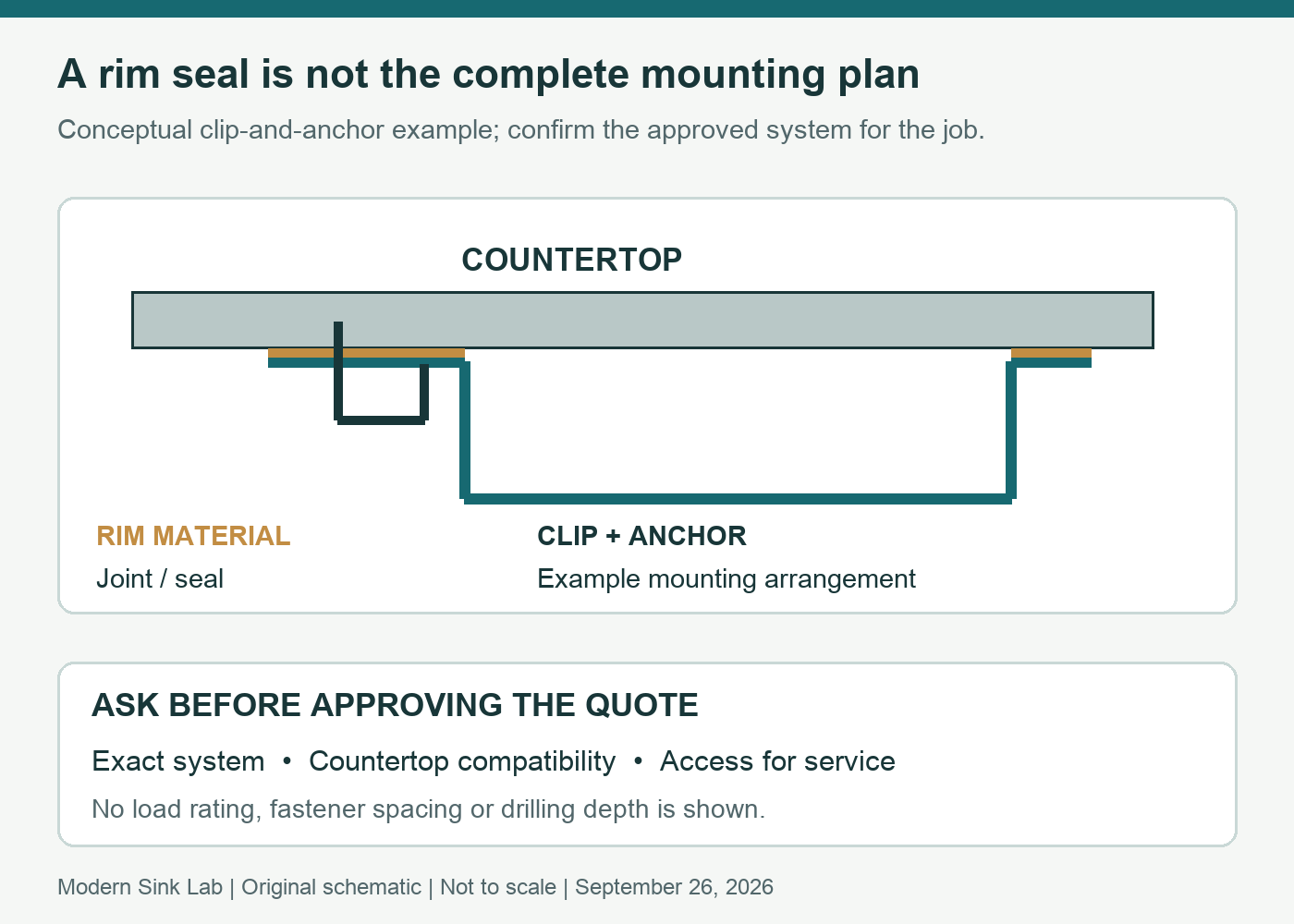
Separate the seal from the mounting arrangement
The narrow joint between the sink rim and countertop needs a suitable sealing arrangement. The installation also needs a way to secure the bowl. One material may have more than one function in a particular approved system, but you cannot establish the whole system’s suitability from the word “silicone” or “epoxy” alone.
Our diagram separates those questions visually. It is a conceptual example, not a shop drawing. It shows why a neatly finished bead is not enough information to judge what is holding the sink in place.
Likewise, the presence of several clips does not by itself prove a sound installation. The anchors, countertop material, positioning and assembled condition matter. Buying a packet labelled “universal sink clips” before identifying the existing mount can turn a straightforward repair discussion into guesswork.
What the KRAUS documents actually establish
The KHU100-32 specification lists mounting hardware among the included items. In the KHU installation sequence, the manufacturer treats the rim application and attachment of mounting hardware as separate steps. The KBU44 manual uses the same basic distinction.
These documents are useful references when comparing an installer’s proposal with the sink’s requirements. They do not mean that every countertop can accept the supplied anchors or that all KRAUS models use an interchangeable mounting kit. Keep the exact sink, countertop and proposed mounting method together in the discussion.
Five questions for an installation quote
- What is the complete mounting method? Ask for the hardware or system name, not just the adhesive brand.
- Why does it suit this countertop? The answer should address the actual material and its condition, especially when reusing an existing opening.
- Who supplies the parts? Clarify whether the sink’s included hardware is being used or another approved arrangement is proposed.
- What stays accessible? Include the rear of the sink, faucet fittings and areas where supports will be installed.
- When can the completed installation be used? Obtain the instructions for the products and system actually installed, rather than adopting a generic cure time from another sink job.
A useful quote makes these decisions understandable. It should also distinguish sealing or mounting work from plumbing reconnection, countertop repair and cabinet modification, so a lower headline price does not hide necessary work.
Check the cabinet as a working space
A cabinet can be wide enough for the bowl while providing awkward access to its rear edge. Rails, partitions, drawers, the disposal and water-treatment equipment may compete for the same space. Ask the installer to review the proposed sequence before the cabinet is crowded with other components.
For a replacement job, photograph the underside while it is visible. Save the sink label, mounting parts and countertop information. A future service technician will have more useful information than a close-up of the finished top joint alone.
Do not assume a farmhouse support frame and an undermount clip system solve the same installation. If you are changing sink type, treat the support plan as a separate part of that redesign.
When an existing sink appears loose
A visible gap, movement or a change in the rim joint calls for an assessment of the whole installation. Avoid treating a fresh bead around the visible edge as proof that the underlying attachment has been restored. Have the installation inspected before putting it back into normal loaded service.
Prepare observations rather than a diagnosis: where the gap appears, whether water leaks, when it changed and what equipment is attached below. This helps the person inspecting it distinguish a sealing issue from a mounting or countertop problem without relying on a photograph alone.
Choosing the sink after the support review
The KHU100-32 remains a conventional single-bowl option for a buyer who can arrange a compatible undermount installation. Its included hardware reduces one shopping task; it does not remove installation planning. If your priority is retaining a countertop and minimizing changes, compare the full fitted solution rather than the sink price by itself.
Use our undermount versus drop-in guide to choose an installation approach. For crowded cabinets, continue with drainage and service clearance. The farmhouse retrofit guide covers the different front-face and support questions for that sink type.
Research scope: KHU100-32 specification, KHU installation manual and KBU44 installation manual, reviewed September 27, 2026. No load test, adhesive test or installed combination was evaluated.