
Research guide by Modern Sink Lab. Reviewed September 28, 2026. Based on manufacturer documentation; no hands-on product testing.
Affiliate disclosure: As an Amazon Associate I earn from qualifying purchases.
Often yes, but the existing opening decides which replacement is possible. A new sink must work with the whole cutout shape, the remaining countertop edge and the cabinet below. Two sinks advertised as 32 inches can require different openings. Keeping the countertop also does not guarantee that the old sink can be removed from underneath without additional work.
Before ordering, ask the countertop fabricator or installer to assess the opening and the removal route together. This guide helps you prepare that assessment; it is not a stone-cutting or sink-removal procedure.
First identify what you are trying to preserve
There are three different projects: keeping the countertop with its opening unchanged; keeping the slab but modifying the opening; or replacing the countertop. Ask for the first route to be assessed before treating the second as inevitable. A sink that needs a larger hole may be possible in one slab and unsuitable near a seam, a narrow rail or a damaged edge in another.
Photograph the entire opening from above and the mounting arrangement from below. Include the cabinet front, any center stile, the drain and the faucet connections. A straight-on picture of the bowl alone omits the places that can stop the replacement.
Match the perimeter, not just width and length
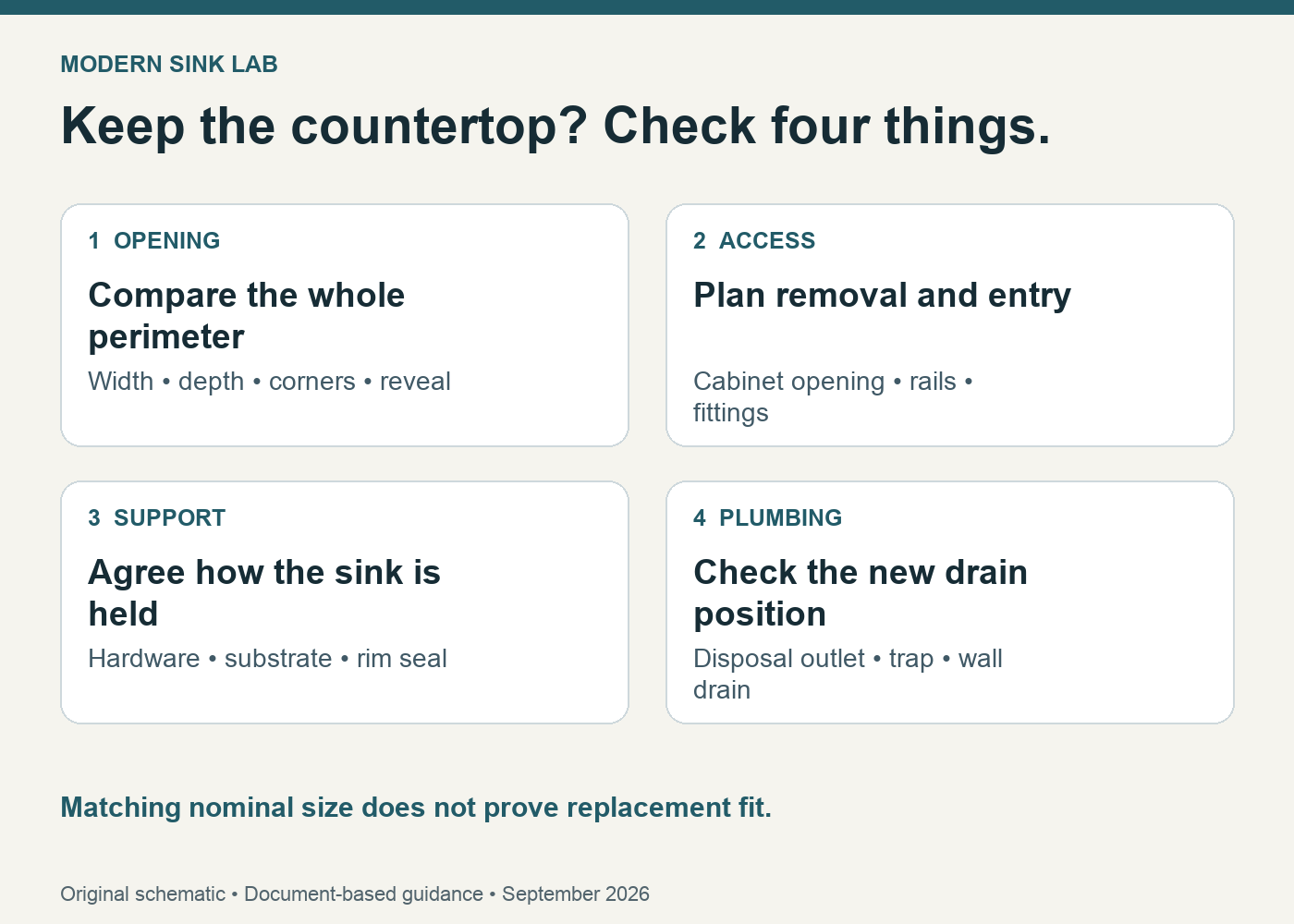
Record the visible opening’s left-to-right and front-to-back dimensions, corner shape and any curved or stepped rear edge. Note whether the counter overhangs the old bowl or exposes a strip of its rim. That exposed relationship is the undermount reveal. Do not assume the visible edge is the old sink’s outer edge.
Have the installer compare the actual opening with the proposed sink, its current template and its mounting requirements. KRAUS’s KHU installation guide explicitly calls for checking the template against the actual sink and allowing space for the backsplash, faucet and plumbing. A product photograph or a scaled browser printout cannot replace that comparison.
Corner mismatch is enough to reject an otherwise promising candidate. A rectangular opening with broad rounded corners and one with tight corners do not become interchangeable merely because their maximum width is the same. Likewise, an asymmetric double-bowl opening may not suit the single bowl you want.
A familiar 32-inch sink is a candidate, not a retrofit guarantee
The KRAUS KHU100-32 is a 16-gauge stainless undermount with a 32 × 19-inch footprint and a 30 × 17-inch bowl. Its specification sheet calls for a 36-inch minimum cabinet. Those measurements help screen candidates; none is an instruction to cut the countertop to 32 × 19 inches.
The documents and retail listing give differing overall vertical dimensions around the same 10-inch bowl depth. For a tight installation, obtain the current drawing and measure the delivered sink rather than budgeting clearance from the headline depth alone. Our drain and disposal clearance worksheet addresses the next check.
Shortlist this model when you want a conventional large single bowl and your installer confirms the opening, support and cabinet fit. Do not order it simply because the old sink also says 32 inches, or if your main requirement is a built-in workstation ledge.
Check KHU100-32 options on Amazon
Confirm the old sink can leave and the new sink can enter
Ask the installer to describe the removal path before disconnecting anything. The cabinet’s usable access opening may be smaller than the sink’s outer rim. Existing rails, disposal hardware or a face-frame stile can constrain movement. A sink installed before the countertop was placed may present a different access problem from one fitted afterward.
Have the quote identify any cabinet work, temporary support and countertop work separately. Avoid accepting “we will work it out after removal” as the entire plan when retaining the slab is essential to your budget. Do not cut a cabinet member or pry against stone based on a generic online diagram.
Get a complete replacement quote
- Opening: unchanged or modified, with the intended reveal agreed in writing.
- Attachment: what supports the new sink and whether existing anchors can actually be reused.
- Water seal: preparation and sealing of the sink-to-counter joint.
- Plumbing: drain location, disposal outlet height and reconnection of the dishwasher where applicable.
- Access: removal, cabinet changes and restoration included or excluded.
- Acceptance: inspect alignment, support and leaks before normal use.
A single-bowl conversion also changes the plumbing arrangement below a former double bowl. It is not just removal of the divider. Decide the bowl layout you actually want, then have the whole replacement route priced.
When keeping the old sink is the better decision
If the bowl itself is sound and the concern is a failing seal, loose attachment or surface marks, get that problem assessed before replacing the sink. A cosmetic upgrade becomes poor value if it forces countertop work you did not want. Conversely, a confirmed compatible replacement can be worthwhile when bowl damage or an unsuitable layout makes daily use difficult.
Our buying rule: keep the countertop only after geometry, access, support and plumbing all have an answer. A good price on the sink does not compensate for an unresolved opening.
Research basis: KRAUS KHU100-32 specification sheet and KHU installation instructions, checked September 28, 2026. Dimensions are screening information; the actual sink and current manufacturer template govern fabrication.