
By Modern Sink Lab
As an Amazon Associate I earn from qualifying purchases. Purchases through our links may earn us a commission at no extra cost to you.
If the kitchen faucet handle hits the backsplash, compare the handle’s complete operating path with the finished wall—not just the upright faucet body. Before buying a replacement or drilling a new hole, identify the exact faucet, its permitted installation orientation and the space your hand needs to use it.
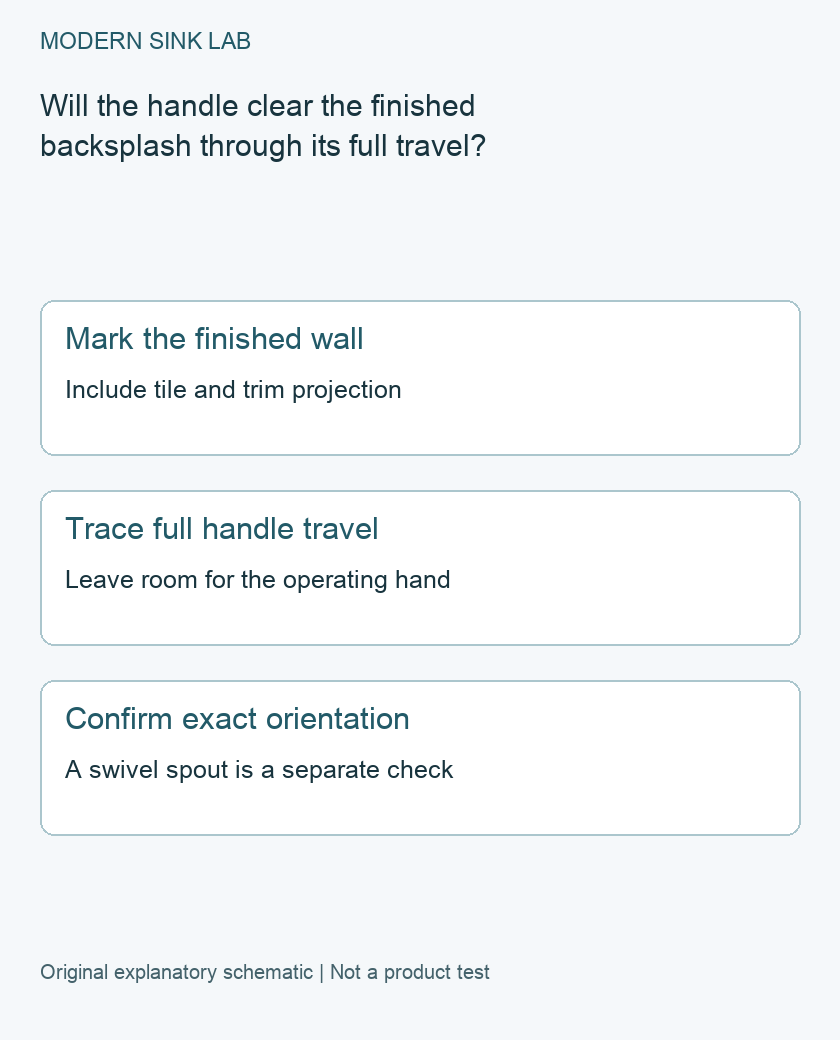
Separate three different movements
A swiveling spout, a lever that changes temperature and a lever that opens the flow do different jobs. A large spout swivel angle does not establish that the handle clears a wall. Likewise, a faucet that fits through the deck hole can still be uncomfortable or unable to reach part of its operating range.
KRAUS describes a 90-degree forward-rotating handle on the documented KPF-1610MB/KSD-43MB package and on the cited Britt design. This is evidence for those descriptions, not a rule that every KRAUS faucet or every installation orientation needs no rear space. Verify the drawing supplied with the exact ordered product before relying on a direction of travel.
Use the finished backsplash as the reference
For a planned kitchen, include tile, adhesive build-up, trim and any window ledge in the final projection. A measurement to an unfinished wall can overstate the available space. For an existing kitchen, measure to the nearest finished obstruction at the height where the moving lever and your hand pass it.
Record the mounting-hole center, the rear obstruction and nearby fixtures on a simple plan. Then add the lever’s complete envelope from the exact model drawing or an approved dry fit. Keep body clearance, lever clearance and operating-hand space as three separate notes. There is no universal setback in this guide.
Try a full-travel mockup before committing
- Mark the proposed mounting center on a paper plan or a safe, non-damaging template.
- Mark the finished wall and other fixtures at their actual projected positions.
- Trace the handle’s path in every required operating direction using verified dimensions.
- Allow a realistic hand position instead of testing only whether two hard surfaces barely miss.
- Check spout reach into the bowl and the mounting hardware below the deck separately.
If the faucet is already installed, do not force the lever against the wall to demonstrate the problem. Photograph the collision point and identify which normal position cannot be reached. Keep water off when a dry observation suffices; there is no need to run very hot water to document a mechanical obstruction.
Compare remedies in the right order
Keep the faucet and verify an allowed orientation: ask the manufacturer whether the proposed position is permitted, how the handle will then move and whether markings or controls remain correct. Rotating a fixture does not automatically preserve forward lever movement. Do not improvise a valve modification.
Select another faucet: compare its verified operating envelope with the same marked wall. A shorter body or smaller spout is not proof of a better handle path. Check both flow and temperature operation as well as the reach into the bowl.
Change the mounting position: coordinate with the countertop fabricator and installer before drilling. A new position must also accommodate the sink rim, mounting parts, hoses and material requirements. This is a project change, not a default do-it-yourself fix for an obstructed lever.
What to put in the installation quote
Request the exact faucet package and drawing revision, finished wall projection, permitted handle position and a confirmation that full operation will be checked before sign-off. Keep this with the sink and fixture-layout plan. If an installer cannot establish clearance, resolve that gap before the countertop is altered.
We have not tested comfort or splashing for these examples. The useful result is a documented fit decision, not a promise that a forward-rotation description solves every crowded backsplash.
Related guides
- Undermount Sink Faucet Holes: Plan the Whole Countertop Layout
- Kitchen Faucet Spout Reach: Match the Outlet to Your Sink
- Single-Hole Faucet on a Three-Hole Sink: Plate or Hole Covers?
Sources and research scope
Reviewed October 26, 2026. KRAUS KPF-1610MB/KSD-43MB commercial faucet and dispenser product description; KRAUS Britt commercial faucet description. This is document-based guidance by Modern Sink Lab. The decision worksheet and proposed owner checks are editorial recommendations, not hands-on test results. Exact model, hardware revision and current instructions govern where details differ.