
As an Amazon Associate I earn from qualifying purchases. Purchases through our links may earn us a commission at no extra cost to you.
A single-hole faucet can work on a three-hole kitchen sink when its mounting requirements are met and the unused openings are properly covered. You may be able to keep the sink. The buying decision is whether to use the faucet’s compatible deck plate or separate covers for the spare holes.
Start with the exact faucet instructions. “Single handle” describes the control; it does not prove that the installation uses only one opening. A separate spray, control or accessory can change the layout.
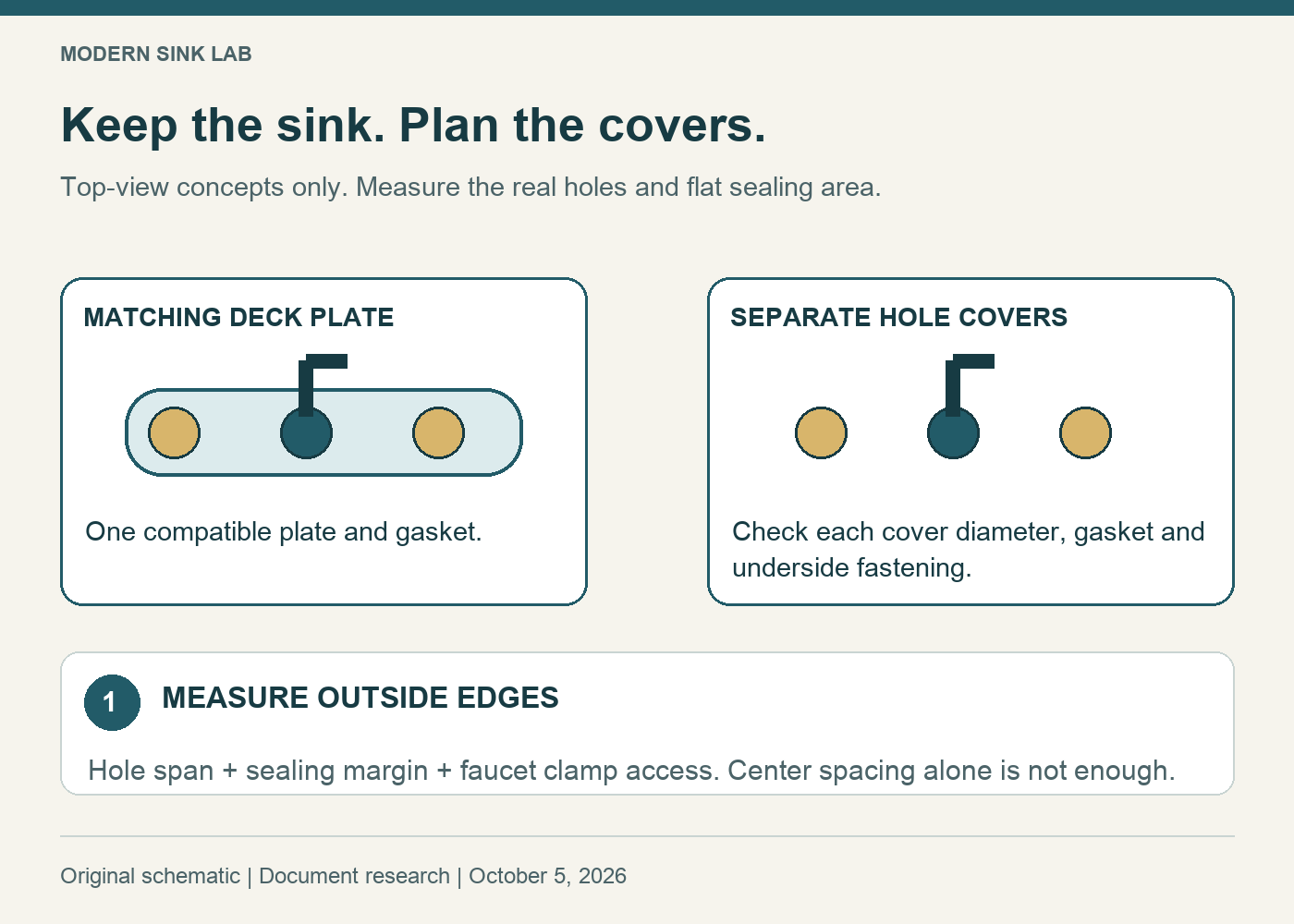
Route one: the faucet’s matching deck plate
A deck plate, also called an escutcheon, sits under the faucet and covers the other openings. Moen’s INS10992 instructions, for example, show different gasket arrangements for one-hole and three-hole installations. That illustrates the method; it is not a universal parts list for every faucet.
Prefer the plate and gasket specified for your faucet. The center opening, faucet base, underside shape and fasteners must work together. A plate advertised as “universal” still needs to cover your actual holes and sit flat on the sink deck.
The useful measurement is the area that must be covered, not just the distance between hole centers. Sketch the holes at full size on paper. Mark the outside edges of the two farthest openings and compare that outline with the plate drawing and its sealing footprint. A plate that just reaches the outer edges leaves no demonstrated sealing margin.
Route two: individual covers for unused holes
Separate sink-hole covers can be worth considering when you want the faucet base visible without a long plate. Check the cover’s supported hole diameter, mounting thickness, gasket and fastening method. There must be room underneath to secure each cover without fouling faucet hoses or the sink’s mounting channel.
This route has a practical tradeoff: the finished deck has several separate sealing points and edges to clean. A plate has a larger footprint that can conceal an old stain or mark; small covers may leave that mark visible. Inspect the deck after removing the old fixture before judging the appearance.
Do not order a drain stopper to cover a faucet opening. The two parts solve different problems. If you plan to use a spare opening for soap instead, compare the soap dispenser hole and mounting requirements first.
Five checks before buying the parts
- Opening: record each hole’s diameter and position; do not assume every three-hole deck has the same spacing.
- Flat area: include the deck’s raised edges, curves and the distance to the backsplash.
- Mounting stack: compare faucet shank reach with the actual sink, support and gasket arrangement.
- Underside access: sketch the clamp or nut, supply lines and any pull-down hose travel.
- Seal: use the gasket or sealant method specified for the actual parts and surface. Extra sealant cannot make an undersized cover fit.
A three-hole sink example: Elkay D125223
The satin Elkay Dayton D125223 is a 25 × 22-inch drop-in sink with three faucet holes and a 30-inch minimum cabinet. It is a candidate when that complete sink layout fits your project. The three-hole pattern alone does not certify your chosen faucet or deck plate.
Check Elkay D125223 — 25 × 22, three holes
The link selects the sink, not a faucet-and-plate conversion kit. Verify the three-hole variant before buying. If the current sink is sound and the faucet conversion fits, buying a replacement sink solely to remove two unused holes may be unnecessary. For a full sink replacement, use our D125223 cabinet and opening checks.
A simple acceptance check
Before final installation, have the installer confirm that the faucet and covers sit flat and can be secured as intended. After installation, check normal faucet operation, hose movement and the underside for water. Record which parts and sealing method were used so a future leak can be traced to a specific joint.
Research scope: Elkay D125223 specifications and selected US listing, plus Moen installation guidance, checked October 5, 2026. The measurement sequence is an editorial planning aid. No mixed-brand faucet/sink combination was installed or certified.