
By Modern Sink Lab
As an Amazon Associate I earn from qualifying purchases. Purchases through our links may earn us a commission at no extra cost to you.
Choose the drainboard side by tracing where wet dishes go after washing, then checking the worktop space it occupies. Do not choose from handedness alone. A fixed drainer may suit a regular hand-washing routine; a sink without one plus a removable drying solution may suit a counter that must change jobs during the day.
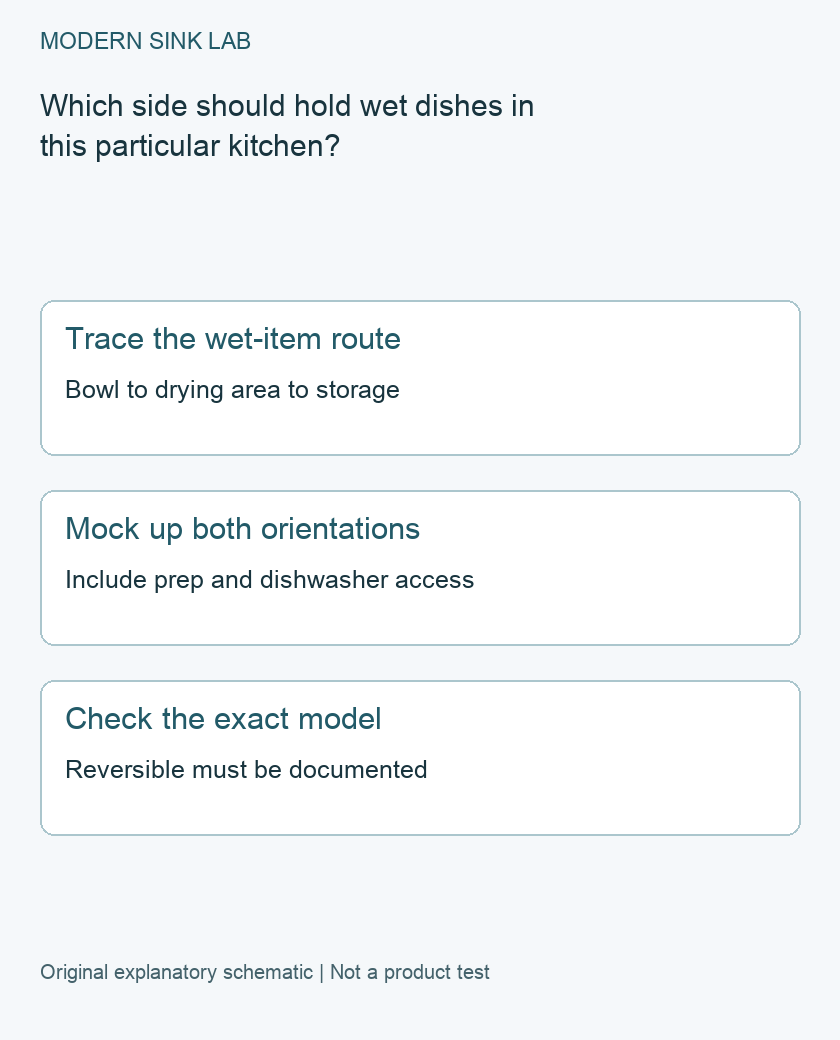
Start with the route, not a product photo
Imagine an ordinary cleanup with the kitchen in use. Where do dirty items arrive? Where are they washed? Where will wet glasses or pans rest? Where are dry dishes stored? Mark that sequence on a plan viewed from the normal standing position at the sink.
Now add the dishwasher door, a second person’s preparation area and the counter needed for food handling. A drainer on the apparently convenient side can block the only useful preparation area. Another orientation may avoid that conflict even when it is not the default suggested for your dominant hand.
Run a two-orientation footprint exercise
Use paper or removable markers on a clean dry counter to show the actual overall footprint of each candidate. Do not use a bowl-only measurement for a product with an integrated drainer. Mark the bowl, drainer and faucet area separately so the lost or retained landing space is visible.
- Act out washing a large pan and putting it down without crossing an occupied preparation area.
- Act out unloading the dishwasher while someone stands at the sink.
- Act out clearing the drying area and returning the counter to its next use.
Repeat with the drainer on the other side. Write down which task becomes awkward in each orientation. This is an editorial planning exercise, not a measured ergonomic test or a guarantee against spills. If there is no existing counter, do the same exercise on a scaled layout with the actual product drawings.
Fixed drainer, reversible sink and removable rack are different choices
BLANCO’s international LEGRA range includes documented reversible drainer versions, allowing the bowl to be positioned on either side of the drainer. Other listed versions have different layouts. The example establishes that reversible products exist; it does not make every LEGRA or every sink reversible, and it does not establish US availability.
Before rotating a sink in a plan, confirm the exact model’s approved orientation, faucet-hole arrangement, installation drawing and waste layout. A symmetrical outline is not enough. If an order description says bowl left, ask whether that description is from the user’s standing position and have the supplier confirm it on a drawing.
A removable rack or tray is a different way to allocate drying space. It can be stored when the counter is needed, but must still fit, remain stable and be used as its maker directs. It does not automatically provide the same drainage behavior as an integrated drainer. Decide how it will be cleaned and stored, rather than counting its footprint as permanently free.
Keep cabinet fit separate from overall counter footprint
An integrated drainer can extend over worktop beyond the bowl. Do not infer the required cabinet from overall width alone or assume that only the bowl matters for the cutout. Use the exact manufacturer’s cabinet and countertop instructions together with the fabricator’s plan.
For a corner or a short counter run, mark nearby walls, appliance openings and access for cleaning. Leave the faucet and accessory plan in the same drawing. Changing drainer orientation after the worktop is cut may be impossible without a larger project change.
Make the final choice conditional
Prefer a fixed drainer when the marked footprint supports your regular wet-item route and you accept dedicating that counter area to it. Prefer a removable arrangement when flexibility matters more and you have a workable storage and cleanup routine. If neither orientation passes, change the layout or candidate before ordering.
No particular sink or accessory has been established as a safe purchase from handedness alone. Take the marked plan, exact model and installation drawing to the supplier; do not substitute a different market version merely because its photograph looks right.
Related guides
- Single-Bowl vs Double-Bowl Kitchen Sink: Which Fits Your Routine?
- What Size Sink Fits a Corner Cabinet? A Measurement Guide
- Kitchen Sink Size Guide for 30-, 33- and 36-Inch Cabinets
Sources and research scope
Reviewed October 26, 2026. BLANCO LEGRA international range: reversible versions; BLANCO WorkFlow guidance: drainer orientation and removable drip trays. This is document-based guidance by Modern Sink Lab. The decision worksheet and proposed owner checks are editorial recommendations, not hands-on test results. Exact model, hardware revision and current instructions govern where details differ.