
As an Amazon Associate I earn from qualifying purchases. Purchases through our links may earn us a commission at no extra cost to you.
The RVH7300 is the simpler choice when you mainly want one open basin for washing. The RVH8310 earns its place when you will regularly move preparation or drying onto its accessory ledge. Both are 30-inch undermount models with a documented 33-inch minimum base cabinet. The workstation does not let you use a narrower cabinet.
The useful comparison is what happens during one meal: where you rinse vegetables, cut them, set a colander and wash the cookware afterward. Buying a workstation makes less sense if you would immediately remove every accessory and leave it in a cupboard.
Specification comparison · Meal workflow · Fit and replacement · Buying decision
Similar bowl depth, different rim and corners
| Manufacturer specification | RVH7300 | RVH8310 |
|---|---|---|
| Exterior width × front-to-back | 30 × 18 inches | 30 × 19 inches |
| Bowl width × front-to-back | 28 × 16 inches | 28⅜ × 16 inches in specification PDF |
| Bowl depth | 10 inches | 10 inches |
| Minimum cabinet width | 33 inches | 33 inches |
| Construction | 16-gauge T304 stainless steel | 16-gauge T304 stainless steel |
| Corners and accessory support | Rounded; no workstation ledge | Sharp; single-tier workstation ledge |
| Drain position | Rear center | Rear center |
The workstation’s extra inch is in the exterior front-to-back dimension. It is not an extra inch of published bowl depth from front to back: both sheets list 16 inches there. That distinction matters when fitting a countertop around a faucet and backsplash.
The RVH8310 product page has also listed a 28½-inch interior width, while its PDF shows 28⅜. We use the PDF figure above and retain that discrepancy in our RVH8310 fit guide. Neither number should become a countertop cutting dimension.
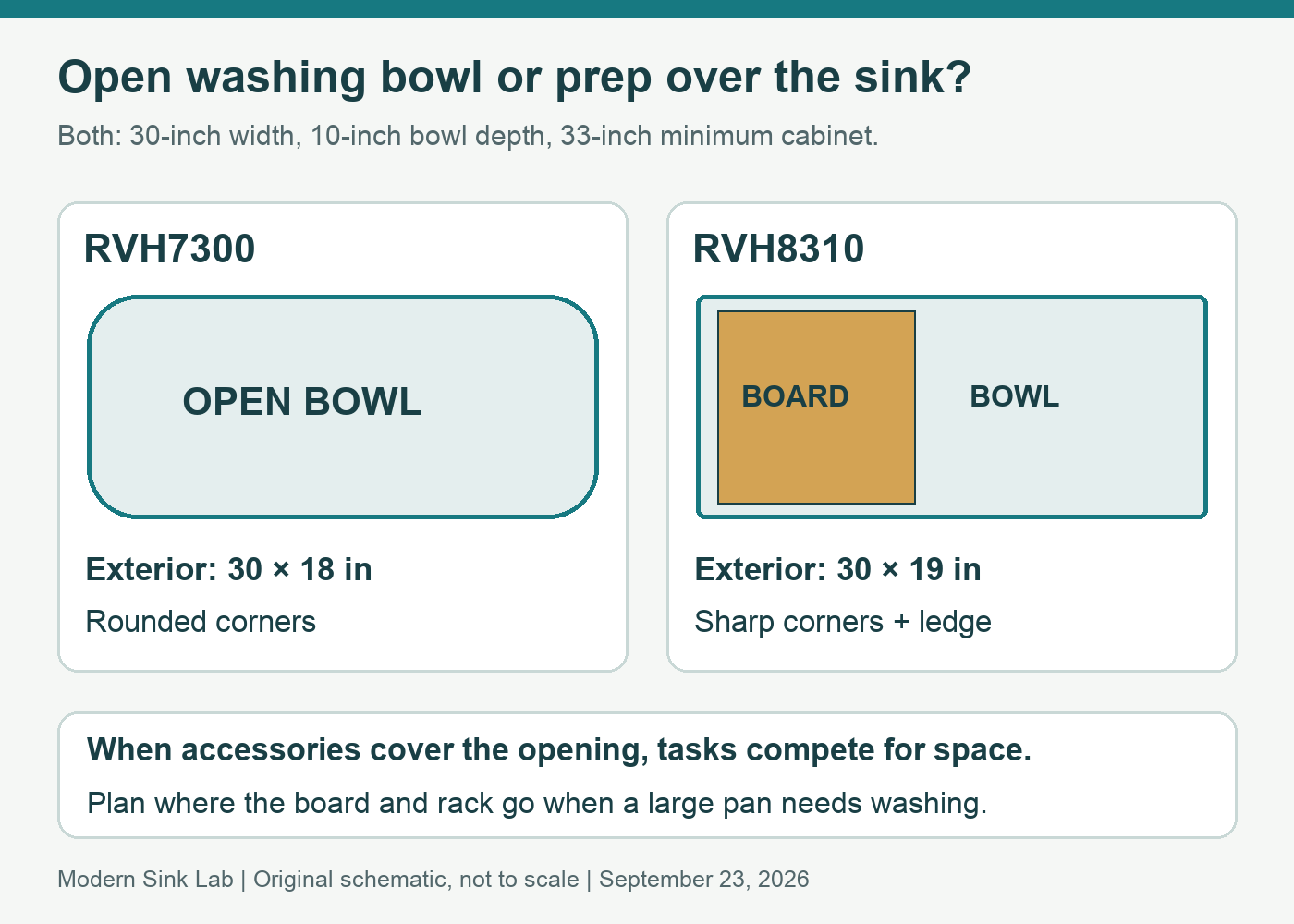
Try the dinner workflow before buying the ledge
When the RVH7300 is easier to live with
Imagine unloading a roasting pan and several mixing bowls. If you already have a comfortable prep area beside the sink, a clear basin leaves fewer pieces to move before washing. A separate rack elsewhere also lets dishes dry while the whole sink remains available.
The RVH7300’s standard package includes a rinse grid, strainer, drain cover, mounting clips and template. Its appeal is the washing space, not a sliding board. For large trays, use our RVH7300 pan-fit check and measure the outside rim and handles of the pan you own. Nominal capacity does not prove flat-bottom clearance.
When the RVH8310’s accessories solve a real problem
The RVH8310 package adds a cutting board, colander and folding rack, supported by its ledge. In a small preparation area, you could rinse ingredients in the colander, move to the board and leave some items over the bowl to drain. The benefit is relocating tasks you already do, not acquiring more accessories for their own sake.
There is a cost in space and handling. When a board covers part of the opening, that part is unavailable for lowering a large pot. Plan where the wet board and colander go when you need the whole bowl. Two people working at once may prefer separate counter and sink areas rather than sharing the same opening.
Check RVH8310 workstation on Amazon
Cleaning is a choice of geometry and habits
Rounded and sharp corners ask different things of a cloth or brush. A broad wiping motion is easier to visualize in the RVH7300; the RVH8310 needs attention along its tighter intersections and accessory ledge. We have not measured cleaning time, drainage or staining on either model.
Count the accessories you expect to leave in regular use, and consider where each will dry. A single bowl can still become a crowded work area if racks, boards and dirty dishes all accumulate there. If your main problem is separating soaking from rinsing, the single-versus-double-bowl decision may be more relevant than adding a ledge.
One cannot automatically replace the other
The common 30-inch width and rear-center drain are not a replacement guarantee. Rim shape, corners, front-to-back footprint, support and the countertop reveal still have to agree. Have the fabricator inspect the actual sink before making the opening, especially where a ledge accessory must clear the countertop edge.
For the RVH7300, use Ruvati’s 33-inch cabinet requirement even if a retail bullet mentions 30 inches. Check cabinet interiors and mounting access rather than treating the cabinet’s nominal outside width as free space. The undermount reveal guide explains the separate countertop-edge choice.
A simple way to make the purchase decision
- List three tasks. For example, rinsing produce, chopping vegetables and washing a sheet pan.
- Assign each a place. Sketch the sink and adjacent counter. Include a place for accessories when removed.
- Find the conflict. If food preparation blocks washing at your busiest moment, an accessory ledge may not solve your layout.
- Compare complete packages. Include the sink, missing fittings, fabrication, plumbing and accessories you would otherwise buy.
Our preference is conditional: RVH7300 for a clear washing bowl beside usable counter space; RVH8310 for a small kitchen where the ledge has a specific daily job. If you cannot name that job, keep the simpler model on the shortlist and verify fit before paying for the workstation.
View RVH7300 package and offer
View RVH8310 package and offer
Research basis: Ruvati RVH7300 and RVH8310 specification PDFs and product pages; US Amazon 30-inch rounded-corner and 30-inch undermount-workstation variants. No pan-fit or accessory-clearance test was performed. Checked September 23, 2026. This is document-based buying guidance, not a hands-on test. Product packages and offers can change.