
As an Amazon Associate I earn from qualifying purchases. Purchases through our links may earn us a commission at no extra cost to you.
The Ruvati RVH7433 suits buyers who want a broad single basin with a fairly rectangular working shape, small rounded corners and no workstation ledge. The useful trade-off is cleaning access versus the shape you prefer for pans. It is not a promise that a tight-radius sink cleans itself or drains every crumb without rinsing.
The selected model is the 33-inch stainless RVH7433, not the similar black-finish or glass-rinser versions. We checked Ruvati’s product page, two-page specification and selected US listing on September 17, 2026. This assessment is based on those documents; we have not installed the sink or compared cleaning times in a laboratory.
Tight radius is still a rounded corner
“Zero radius,” “tight radius” and “rounded” are easy to blur together in store listings. They describe different shapes. A near-square junction preserves a more rectangular outline but requires cleaning right into that junction. A broader curve gives a cloth or sponge more room to sweep around the corner, while curving farther into the basin.
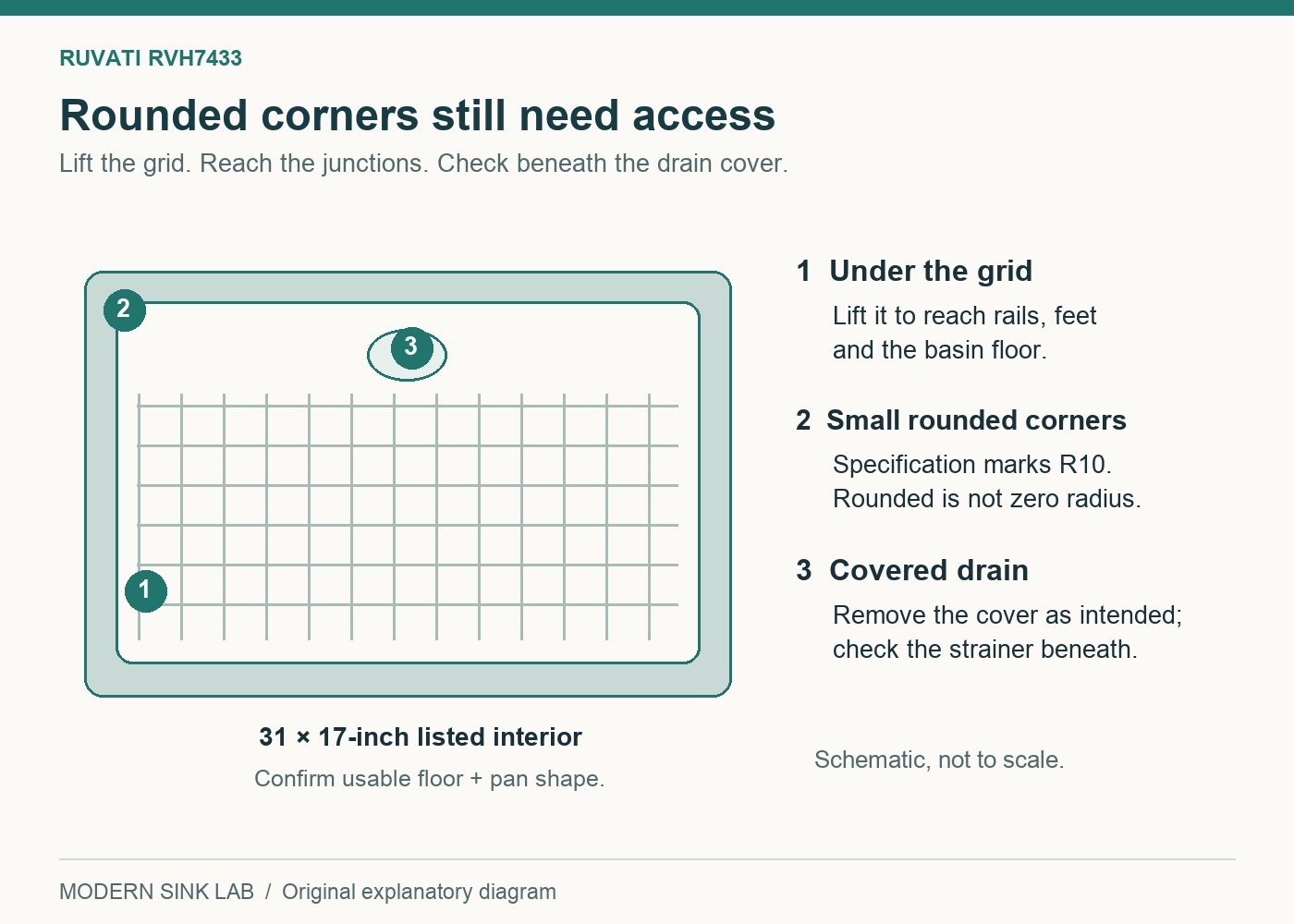
Ruvati describes the RVH7433 as having rounded inside corners, and the dimension drawing labels the top-view corner R10. That makes it a small-radius example, not a truly sharp zero-radius bowl. We would use the actual drawing and delivered sink to assess the shape rather than a promotional word such as “commercial.”
| Corner choice | Practical question to ask |
|---|---|
| Very square junction | Can your usual cloth or brush reach the junction comfortably? |
| Compact rounded corner, as on RVH7433 | Does it offer the cleaning access you want without changing the bowl shape too much? |
| Broadly rounded bowl | Will the curve get in the way of the pans or racks you intend to lay flat? |
None of those shapes proves superior drainage, hygiene or durability on its own. Installation level, the base slope, food residue and how you rinse all influence the result. We would reject a cleaning claim stated as a percentage unless it came from a repeatable comparison.
A 31 × 17-inch bowl is a useful starting point—not a floor guarantee
The specification lists a 33 × 19-inch exterior, a 31 × 17-inch interior bowl and 10-inch bowl depth. The minimum base cabinet is 36 inches wide. The basin has a rear-center drain, a slanted bottom and drain grooves. Its steel is specified as 16-gauge T304.
To make those numbers useful, measure your largest pan’s outside rim and handles. A hypothetical tray with a 26 × 18-inch outside footprint is narrower than the listed 31-inch span in one direction but wider than the 17-inch span in the other. It will not sit flat in that orientation merely because the sink is sold as a 33-inch model. Angling it may help with washing, but is a different use case from laying it down.
Even an item smaller than both published interior dimensions needs a real shape check. The wall transition, corner radius and bottom grid can reduce the usable flat footprint. Have the installer compare the object or a full-size paper outline at the intended resting height. Do not order a grid by the sink’s outside dimensions.
Our sink-grid measuring guide explains this distinction. For cabinet and countertop constraints, use the cabinet-size checklist separately. Pan fit and cabinet fit answer different questions.
Ruvati RVH7433 — 33-inch tight-radius stainless single bowl
Check price on AmazonThe included accessories add cleaning surfaces
Ruvati lists a bottom rinse grid, basket strainer, decorative drain cover, mounting clips and a cutout template in the package. The grid and cover can be useful: one creates a separate resting surface for dishes, while the other conceals the drain opening. Neither eliminates the need to reach the sink underneath.
Build a short routine around three locations. First, lift the grid to rinse the floor beneath its rails and feet. Second, clean the rounded wall junctions, where a quick rinse may leave food behind. Third, remove the decorative cover as intended and check the strainer area. Reassemble only after loose debris and cleaner have been rinsed away.
A covered drain also changes diagnosis. If drainage becomes slow, inspect accessible debris and the strainer before assuming the bowl geometry is at fault. Persistent slow draining can involve the waste connection; that needs a separate check. The presence of drainage grooves alone cannot rule a plumbing problem in or out.
A buyer’s cleaning-access test
- Imagine the sink with the grid installed. Decide where you will put the grid while cleaning. A large accessory needs a place to drain too.
- Check your reach to the back corners. A 10-inch-deep basin can be spacious and still be inconvenient for a particular user or counter height.
- Check the faucet’s useful reach. A pull-out head should be able to rinse the far corners without the hose catching below.
- Consider the drain cover as a removable part. If you dislike lifting accessories, a simpler exposed drain arrangement may fit your routine better.
- Read the supplied care instructions. Keep cleaning methods appropriate to the finish, grid and other components rather than relying on one aggressive all-purpose product.
This is a practical acceptance exercise, not a claim about how often every kitchen needs cleaning. Cooking habits, food residue and water conditions vary.
What this plain basin does not give you
The RVH7433 should not be confused with a workstation sink designed around an integrated accessory ledge. A bottom grid supports items inside the bowl; it is not the same thing as a sliding preparation surface near counter height. If chopping, straining or drying over the sink is your main reason for upgrading, read our workstation-sink decision guide before choosing a plain basin.
Likewise, the included basket strainer is not a garbage-disposal flange. Ruvati lists disposal accessories separately in its documentation. Specify the disposal and connection arrangement with the installer; do not assume an included drain kit completes every installation.
The 36-inch cabinet minimum is another boundary. A 33-inch sink is not a promise to fit a 33-inch cabinet. A rear drain may help organize space below, but the actual disposal body, trap, supply valves and drawers decide whether that space is usable.
Who should choose the RVH7433?
| Good fit | Reason to choose another layout |
|---|---|
| You wash wide cookware and want one uninterrupted basin. | You need two filled basins for washing and rinsing at the same time. |
| You like a rectangular appearance with small rounded corners. | You specifically want very broad curves or a truly sharp zero-radius look. |
| You will lift and clean removable accessories. | You want the fewest removable parts to handle. |
| Your fabricator approves the undermount installation and clearances. | You need a drop-in replacement without changing the countertop arrangement. |
Questions before checkout
Is it a zero-radius sink?
No. The manufacturer’s drawing and description show rounded corners. Its compact-radius shape should not be relabeled as a sharp 90-degree junction.
Does 16 gauge make it quieter than every thinner sink?
No universal conclusion follows. Ruvati specifies damping pads and undercoating, but we have not measured installed sound. Support, mounting and the items being washed also matter.
Can the old countertop cutout be reused?
Only after a template comparison and inspection. Similar outside dimensions, or the fact that both sinks are undermount, do not prove matching corners, reveal or mounting space.
Our recommendation
Choose the RVH7433 for its combination of a broad plain basin, compact rounded corners and removable accessories, provided the 36-inch cabinet and undermount requirements work. The strongest reason to buy it is that the shape matches how you wash—not a generic promise of effortless cleaning.
Ruvati RVH7433 — confirm the 33-inch stainless variant
Check price on AmazonResearch notes: Ruvati RVH7433 product documentation and two-page specification sheet, including the corner drawing and accessory list; selected US listing. Checked September 17, 2026. The tray example is a hypothetical dimensional check, not a physical fit test.