
By Modern Sink Lab
As an Amazon Associate I earn from qualifying purchases. This maintenance guide does not select a replacement product or include a shopping button.
If water spits from the dishwasher air-gap vent during draining, check the route from the air gap to the disposal or sink drain before buying another air gap. Whirlpool identifies discharge here as a clue to a downstream restriction. Water appearing around the mounting base is a different observation: first establish whether it ran down from the vent or started underneath the fitting.
Stop the cycle if water is escaping onto the counter or into the cabinet. Do not keep running full cycles to reproduce a leak. This guide helps you describe and narrow the problem; it is not a universal hose-removal procedure or permission to change a required backflow-protection arrangement.
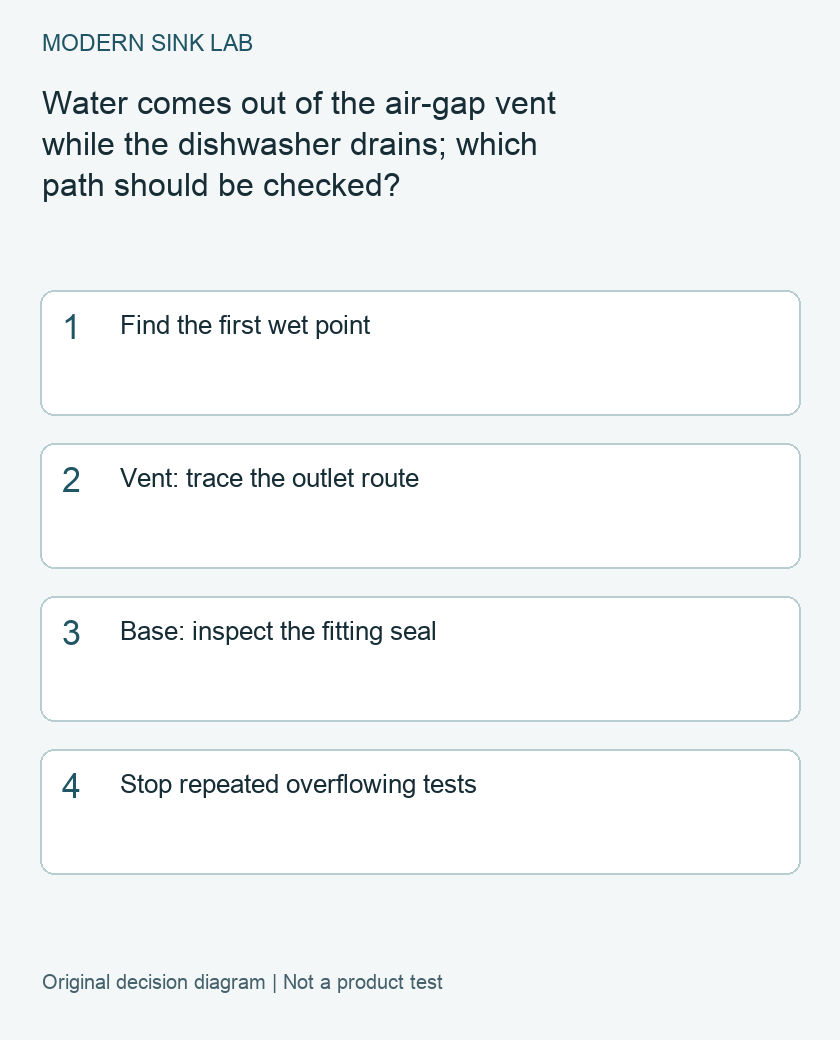
Locate the first wet point
Dry accessible surfaces after the appliance is stopped. Photograph the vent, the mounting base and the cabinet beneath it. The useful question is where water appeared first, not where the largest puddle ended up. A splash running across the countertop can imitate a failed mounting seal.
- Water visibly exits the cap or vent during drain operation: investigate the discharge route.
- The base becomes wet while the vent stays dry: inspect the fitting and connection area using the exact model instructions.
- The cabinet is wet but the countertop is dry: stop using the appliance until the underside source is identified.
Do not remove a cap during an active drain cycle. If the first wet point is not visible without reaching near electrical equipment or disconnecting a hose, leave that inspection to a qualified person.
Draw the route, then check what changed
An air gap separates the dishwasher discharge from the downstream waste connection. GE describes its purpose as protection against drain water backing into the dishwasher. A replacement that merely looks similar does not establish that the connected route is clear.
On a sheet of paper, draw three boxes: dishwasher, air gap and disposal or sink-drain connection. Mark the accessible hose between the last two boxes. Record a visible kink, compression behind a stored object or a low spot; a photograph is more useful than guessing from above the counter. Do not reroute or detach hoses solely to make the drawing look tidy.
Ask when the symptom began. If it followed a disposal replacement, the separate inlet check linked below is important. If nothing was recently changed, do not assume a factory plug has somehow reappeared; an existing restriction or damaged route needs investigation on its own evidence.
Use the sink as a separate observation
Record whether the sink drains normally during ordinary use, slowly, or backs up. Slow drainage in both places makes the shared waste path worth checking. A normally draining sink does not prove that the smaller air-gap outlet connection is clear. These are screening observations, not a diagnosis of an internal dishwasher pump.
Avoid adding drain-opening chemicals to the dishwasher or air gap. Do not plug the vent to hide the symptom: preventing visible discharge is not the same as correcting the route. Internal air-gap cleaning should follow the specific fitting instructions; cap designs and access differ.
What to give the installer or service technician
- Dishwasher model, air-gap brand if known, and disposal model if connected.
- First wet point: vent, top base or underside connection.
- Whether the sink itself drains slowly and whether the problem followed recent work.
- One photo of the whole accessible route and one of each visible connection.
- Any cleaning already attempted, without assuming that it proved the hose was clear.
This record separates three possible jobs: clearing or correcting the discharge route, repairing a leaking fitting, or investigating the dishwasher after its external drain path has been checked. Ask which observation supports the proposed job before authorizing a new pump or air gap.
When replacement makes sense
Consider a replacement fitting when its body is damaged or its model-specific service procedure cannot restore it, rather than because water was seen nearby. Check opening size, clamped deck thickness, hose connections and local installation requirements before ordering. Do not remove an existing air gap in favor of a high loop merely because a general article mentions both.
After work, have the repaired route checked under controlled operation with the cabinet visible and the person doing the work ready to stop the appliance. A dry counter alone is not enough; confirm the cabinet stays dry and the dishwasher completes its drain. No replacement product is selected here because the failed component has not yet been identified.
Related guides
- Dishwasher Air Gap Fit: Hole Size, Deck Thickness and Under-Sink Space
- Dishwasher Not Draining After a New Garbage Disposal? Check the Inlet
- Water Under the Kitchen Sink: Condensation or a Leak?
Research basis and limits
Document-based guide by Modern Sink Lab, checked October 23, 2026. Manufacturer references: Whirlpool Dishwasher Not Draining; GE Does Your Dishwasher Have an Air Gap?. The comparison notes and decision sequence are editorial recommendations. We have not performed this procedure on a physical unit, measured reliability or inspected your installation. Follow the exact model instructions where the procedure differs.