
Modern Sink Lab researches manufacturer documents and product listings; this is not a hands-on product test. As an Amazon Associate, we earn from qualifying purchases. Specifications and purchase destinations checked September 29, 2026.
A dishwasher air gap needs a compatible hole, enough mounting reach through the deck, and room for two hoses below it. Matching the cap finish to the faucet is the easy part. A cover-only replacement does not provide the body or solve an installation-space problem.
KRAUS KAG-1SFS is a candidate for a complete air-gap assembly if its 1¼-inch maximum countertop thickness suits your mounting stack and the hose route fits. However, its current product page and installation guide disagree on the required hole diameter. Confirm the hole requirement for your purchased version before ordering for an existing hole or drilling a new one. Check the KAG-1SFS complete air-gap kit on Amazon.
KAG-1 fit facts, including the unresolved hole dimension
| Check | Verified document information | What to do with it |
|---|---|---|
| Hole diameter | KAG-1SFS product page: 1½ in. KAG installation guide: 1⅜ in. | Ask KRAUS which requirement applies to the exact version. We cannot confirm that every current kit fits an existing 1⅜-in hole. |
| Maximum countertop thickness | 1¼ in in the KAG-1 specification and installation guide. | Measure the complete stack that is actually clamped, including any backing layer. |
| Visible cap | 1⅞ in diameter and 2½ in high; complete assembly about 9 in high. | Check faucet/backsplash clearance; total height does not include the extra space needed for hose bends and service. |
| Hose connections | Guide: ⅝-in inside-diameter dishwasher hose to smaller inlet; ⅞-in inside-diameter hose from larger outlet to the drain Y or disposer. | Identify the two legs correctly. The guide lists the hoses and clamps as items not included. |
The hole discrepancy is material: do not enlarge a stone countertop hole using a number copied from this article. Give the manufacturer the model, package revision and measured opening, and have the fabricator confirm the approved hole size, location and edge clearances. A countertop that is 1½ inches thick also exceeds the documented 1¼-inch KAG-1 limit; a matching cap cannot fix that.
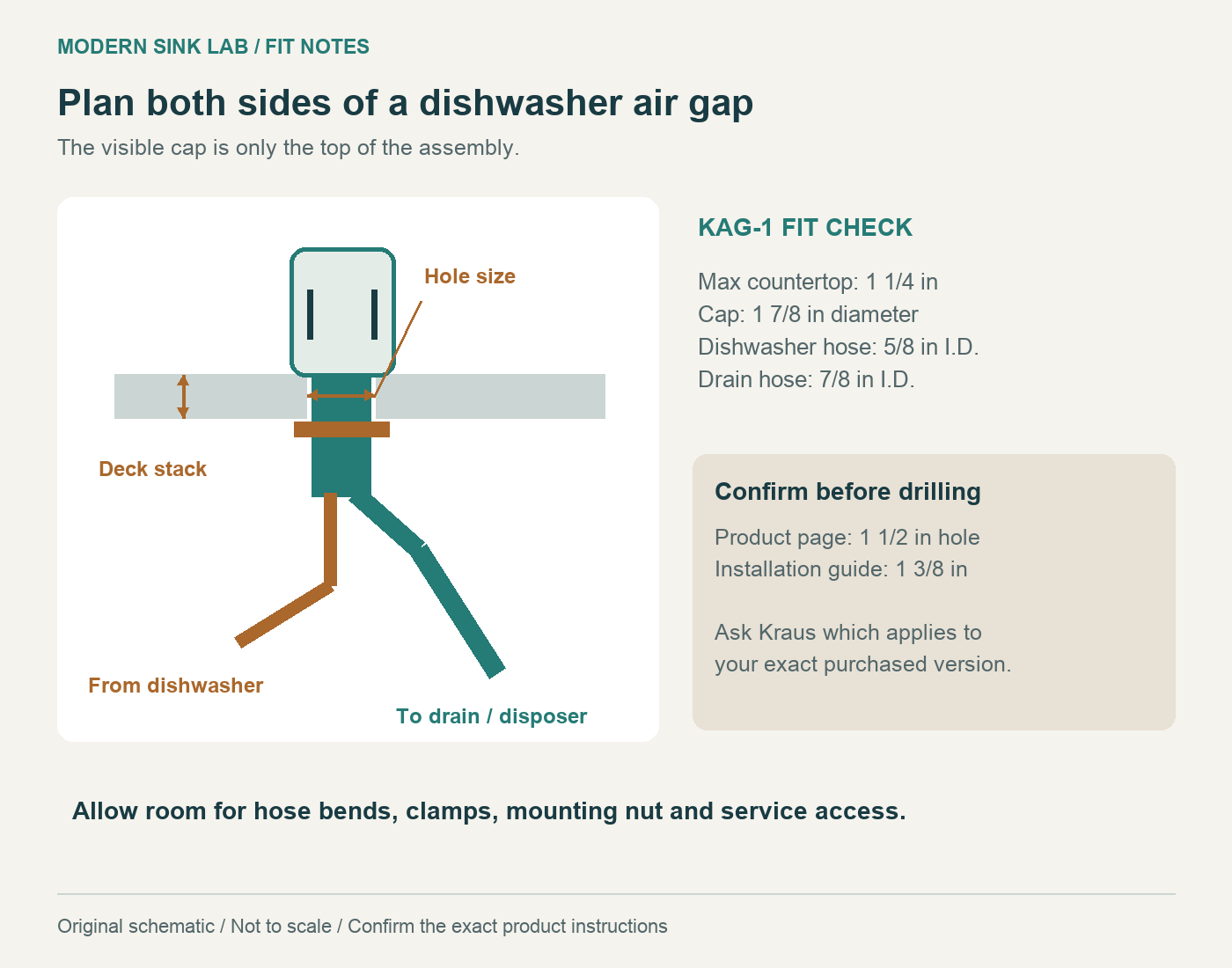
Check the space underneath before choosing the location
A top-down photo cannot show a mounting nut colliding with a sink flange or a large outlet hose crossing a pull-down faucet weight. Inspect beneath the proposed hole and identify the sink rim, clamps, faucet hardware, disposal, supply lines and any filtration equipment.
- Mounting access: can the body pass through the opening, and can the nut be tightened without removing unrelated equipment?
- Hose route: can both hoses reach their intended connections without being pinched, kinked or forced around a tight bend?
- Working space: can the faucet hose and weight move through their full travel without catching either drain hose?
- Service access: can the cap and connection clamps be reached later?
The KAG guide places the flood-level mark at or above the sink’s flood level. Follow the actual diagram for that relationship and cap orientation; lowering the body to gain mounting reach is not a substitute for the required installation position.
If the overall accessory layout is still open, use our faucet and accessory hole-layout guide before committing to a location. A soap dispenser and an air gap may both look like small counter accessories, but their mounting limits and under-counter shapes are different. The soap-dispenser hole and deck-thickness guide covers that separate decision.
Complete kit, replacement cap or a different kind of air gap?
The verified KAG-1SFS listing is the complete body and cap in Spot Free Stainless Steel. Other bestseller entries are replacement covers only. Buy a cover only when the existing air-gap body is sound and the replacement cap is explicitly compatible with it; cap diameter or finish alone is not enough.
Also check the appliance being served. Reverse-osmosis systems can use an air gap with much smaller tubes. A search result about installing an RO air gap is not a dishwasher hose-sizing instruction, even when the top cap looks similar. For this article, the hose sizes come from the KAG dishwasher installation diagram.
Does every dishwasher need one?
Check the dishwasher’s installation instructions and the plumbing requirements that apply to your location. This article does not claim that every U.S. installation requires the same arrangement, or that a high loop is an acceptable substitute everywhere. Resolve that requirement before allocating a countertop hole.
For a connection to a newly installed disposal, follow that disposal’s instructions for its dishwasher inlet and any factory plug. Before closing up the cabinet, the installer should verify the route and check for leaks and correct drainage during operation. We have not performed that installation test for the products here.
When to hold the purchase
Hold if the hole requirement is unresolved, the deck stack exceeds the documented maximum, or the two hoses cannot follow the required route. Save the model and blocking issue in the sink-and-drain comparison resource; “pending manufacturer confirmation” is a useful decision, not a failed comparison.
Sources and selection
KAG-1SFS appeared in Amazon U.S. Kitchen Sink Installation Parts Best Sellers during our September 29 check; that is not a performance rating. The fit facts come from the KAG-1 specification sheet, January 30, 2024 and KAG-1/KAG-2 installation guide, November 22, 2022. The conflicting 1½-inch hole statement remains on the manufacturer’s KAG-1SFS product page. We have not confirmed a revision-specific resolution with the manufacturer.
If drainage stopped immediately after a disposal replacement, follow the new-disposal dishwasher inlet checks before buying an air gap or replacement pump. The actual hose route and model-specific factory plug are separate from this fitting’s dimensions.