
As an Amazon Associate I earn from qualifying purchases. Purchases through our links may earn us a commission at no extra cost to you.
A black granite-composite sink can work in a hard-water kitchen if you are willing to rinse and dry it regularly. Choose the KRAUS KGD-433B for its dark finish and separate wash-and-rinse bowls—not because black means maintenance-free. If you normally leave water, pans and a drying mat in the sink overnight, that routine deserves more attention than the color swatch.
The KGD-433B is a quartz-composite, 50/50 double-bowl model with drop-in and undermount installation options. This guide uses its current specification sheet and KRAUS care instructions, checked September 17, 2026. We have not installed this sink or tested its stain resistance. Our recommendation is based on documented requirements and the everyday compromises below.
The decision: buy for the finish and workflow
| Your priority | Our take |
|---|---|
| A dark sink with two separate working areas | A sensible candidate if the cabinet, countertop and drain layout are compatible. |
| The fewest visible water marks with almost no wiping | A poor match for that expectation. A dark surface does not remove minerals from drying water. |
| Laying large sheet pans flat in one uninterrupted basin | Check your cookware carefully; the center divider remains a physical obstacle. |
| Putting hot pans straight down after cooking | Plan a separate heat-safe landing spot. Heat resistance is not permission to skip a trivet. |
KRAUS KGD-433B — Black Onyx, 33-inch double bowl
Check price on Amazon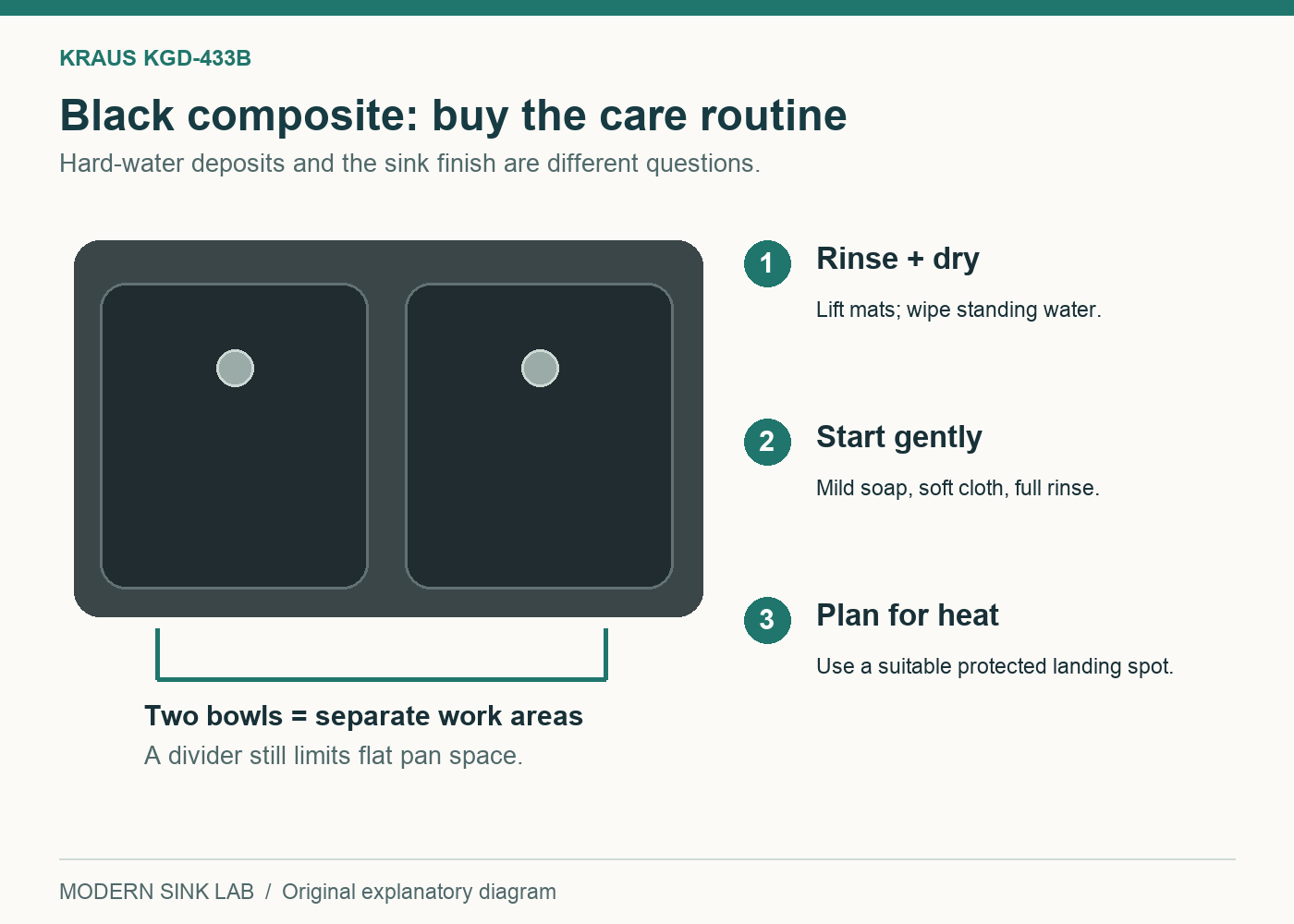
Hard water changes the maintenance calculation
A pale film on a dark sink is not, by itself, proof that the black material has faded. Water can leave mineral deposits as it dries; soap residue can also change how the surface looks. The useful first question is whether a gentle clean changes the mark, not whether a stronger chemical can strip it away.
KRAUS tells owners to rinse the inside and wipe it with a microfiber cloth after use to help prevent water spots, clouding and discoloration. That is a small task when the sink is empty. It is less convenient when a drying rack, dishes and a damp mat permanently cover the bottom. Consider where those items will go during cleaning before making the sink your kitchen’s darkest surface.
A practical routine that starts gently
- Remove loose food and lift removable items. Cleaning around a mat leaves the area underneath unchecked.
- Use mild, ammonia-free liquid soap and a soft sponge or cloth. Work on the surface rather than attacking one mark with a metal tool.
- Rinse away the cleaner completely. A remaining soap film can make the result difficult to judge.
- Dry the basin and the area around the drains. Check the dry surface in ordinary kitchen light before escalating treatment.
For a persistent deposit, identify the sink material and follow the current KRAUS guidance plus the cleaner’s label. A cleaner suitable for stainless steel is not automatically suitable for composite. Avoid abrasive powders, steel wool and harsh bleach, ammonia or chlorine cleaners. Do not mix cleaners. If a mark remains, ask the manufacturer whether it is removable residue or surface damage before experimenting further.
This is deliberately a maintenance plan, not a promise to restore every stain. Scratches, heat discoloration and mineral film can call for different responses. An online photograph rarely establishes which one an owner has.
Heat resistance still needs a landing plan
The KGD-433B specification sheet explicitly warns that items taken directly from a stove or oven may discolor the surface. It recommends a trivet or rolling mat for very hot items. We would not choose this sink on a single advertised temperature number: the important buying question is where your hot pan will rest during dinner preparation.
Make that choice concrete. Stand at the hob and trace the route of a heavy roasting pan. If its usual destination is the bare sink bottom, provide a suitable protected area before changing materials. Do the same for a boiling pot being drained. A new color should not depend on everyone in the household remembering a different routine without any place to put cookware.
The double-bowl compromise is separate from the material
A 50/50 split helps when you want to keep washing and rinsing apart. It can also leave one side available while the other holds dishes. It does not turn two smaller basins into the flat working area of a single bowl. A large pan may fit on an angle yet still be awkward to scrub, rinse or set down safely.
Use the largest item you wash every week as the test—not your dinner plates. Include handles when measuring a stockpot. For a baking sheet, record its outside rim dimensions. Ask the installer to compare those measurements with the actual bowl shape; published top-opening dimensions are not a guarantee of flat usable floor area because walls and corners curve.
If the divider itself is the unresolved issue, read our single-bowl versus double-bowl guide before settling on a finish. If you want a more open stainless basin with compact rounded corners, our RVH7433 corner and cleaning guide addresses that different workflow.
Check the complete purchase, not just the sink price
| Check | KGD-433B buying implication |
|---|---|
| Exact model and color | This recommendation is KGD-433B in Black Onyx, not a similarly named white or different-split version. |
| Overall footprint | The specification lists 33 × 22 inches. This is not the countertop cutout. |
| Base cabinet | The listed minimum is 36 inches wide and 24 inches front to back. Internal obstructions still need inspection. |
| Mounting method | Choose drop-in or undermount with the fabricator; confirm the countertop and support method before cutting. |
| Drain hardware | The specified package has basket strainer BST-2 and strainer ST-2. A disposal installation needs its own compatible flange arrangement. |
| Total project cost | Include removal, fabrication, support, plumbing changes and any faucet or accessory work. |
“Dual mount” gives you a choice of installation method; it does not make the two cutouts interchangeable. Obtain the correct template for the selected method and check it against the delivered sink. Keep any irreversible countertop work until the product and its dimensions have been confirmed. Our mounting comparison explains why the countertop edge and support matter.
Three questions buyers ask
Will a black sink hide all scratches and dirt?
No. The dark finish can be attractive, but appearance depends on lighting, residue and wear. We have not measured scratch resistance and would not rank it above stainless steel on that basis. Buy the finish you like with a care routine you can maintain.
Does this sink need sealing like a stone countertop?
Do not assume so. This is a manufactured quartz-composite sink, and its care instructions govern treatment. Do not apply a countertop sealer or coating merely because the product name contains “granite.” Confirm any treatment with KRAUS first.
Should hard water rule it out?
Not automatically. If you already dry the sink after cleaning, the routine may fit easily. If regular wiping feels unrealistic, choose on that basis rather than expecting a dark finish to hide deposits indefinitely.
Our recommendation
Shortlist the KGD-433B when you want the black finish, use two bowls purposefully and accept regular drying. Pass when you need an uninterrupted pan-washing basin, want to put hot cookware directly on the surface, or expect virtually no visible residue without upkeep. Those are practical mismatches, even if a product is popular.
KRAUS KGD-433B — confirm Black / 33 Inch / 50/50 Double Bowl
Check price on AmazonResearch notes: KRAUS KGD-433B specification sheet, revision January 6, 2025; KRAUS Care & Cleaning Guide, Granite Kitchen Sinks section; US model listing. Checked September 17, 2026. We use the specification’s heat-care warning rather than conflicting temperature claims. No hands-on durability or cleaning test is implied.