
By Modern Sink Lab
As an Amazon Associate I earn from qualifying purchases. Purchases through our links may earn us a commission at no extra cost to you.
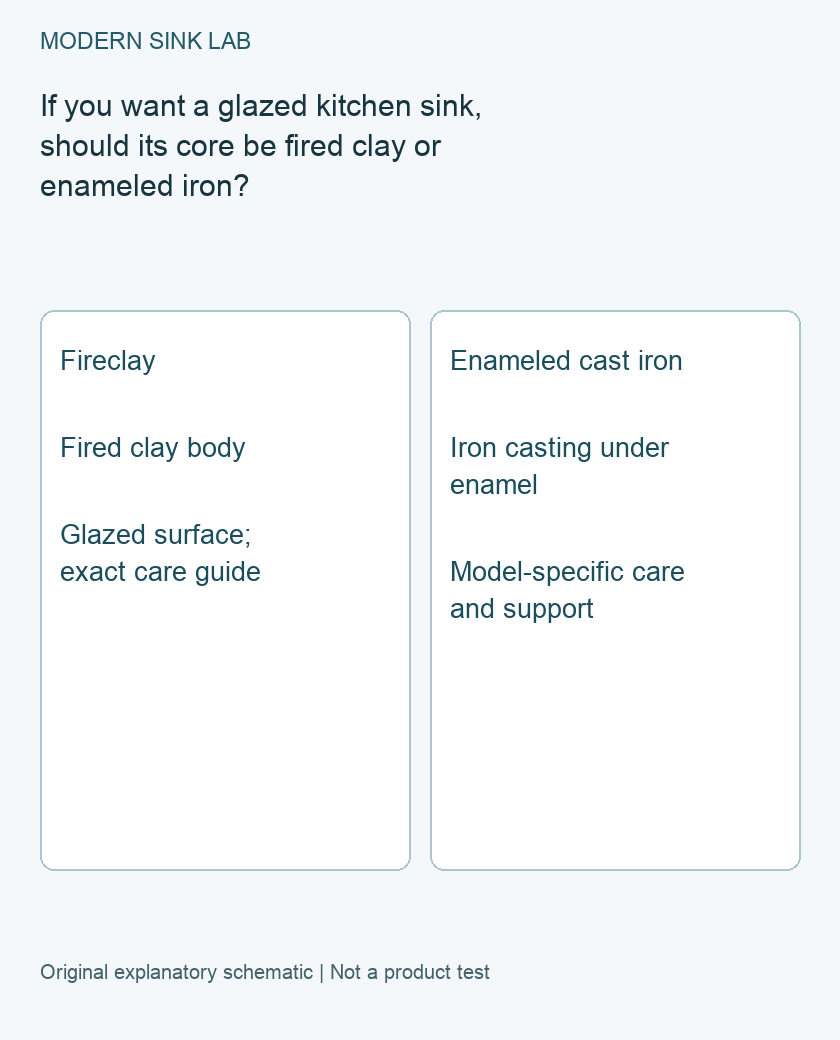
Choose between fireclay and enameled cast iron using the exact sink’s shape, finish, care instructions and installation plan—not the white surface alone. Fireclay has a fired-clay body; enameled cast iron has an iron casting beneath its fused enamel surface. Neither material name establishes that a sink fits your cabinet or outperforms every example of the other.
KOHLER describes fireclay as dense clay heated and cured, with a glazed nonporous surface. It describes enameled cast iron as an enamel coating fused to an iron casting at high temperature. Those construction differences are a starting point, not a controlled durability comparison between two complete products.
Compare two actual models, not two material labels
First choose the bowl task: washing a large pan, separating dishes, or maintaining uninterrupted basin space. Then list the exact model, bowl opening, drain position, mount and available finish for each candidate. If one has a divider or a taller apron, that difference can matter more to daily use than the core material.
Keep a sample or a clear finish reference for the actual color where possible. A photograph labeled white does not show how two surfaces look together under your kitchen lighting. Do not pay for a material change when what you really want is a different bowl shape or apron profile.
Turn care claims into a routine you can follow
Obtain the care sheet for each exact model. Write down approved cleaning tools, excluded cleaners and what the maker says about cookware marks or accidental damage. Do not transfer a stainless-steel scratch-removal method to a glazed sink, or treat a general cleaner’s label as approval from the sink manufacturer.
KOHLER’s cast-iron care guidance distinguishes cookware metal marks from damage to the sink finish and gives its own cleaning route. A visible gray line alone therefore should not be called a chip. If a surface is actually broken or the body is cracked, photograph it and ask the manufacturer about the exact product before selecting a repair treatment.
We do not rank these materials by a claimed universal scratch, stain or chip-resistance score. A marketing statement about one manufacturer’s finish is not a result from dropping the same object into two sinks. Choose a care routine you are willing to maintain and retain the written instructions.
Compare installation cost before the sink price
For each candidate, ask the installer to specify support, handling, countertop preparation, apron treatment if applicable, drain connection and future access. Use the product’s weight and installation instructions rather than assuming one material family always requires less work.
Matching nominal widths do not establish interchangeable cutouts. A support arrangement approved for one unit also does not automatically transfer to another. If keeping an existing counter, have the fabricator confirm the proposed opening and edge treatment before ordering either material.
For a disposal connection, identify the approved flange and the actual thickness being clamped. A thick-looking bowl does not supply a complete drain-fitting specification. Check the sink and disposer documentation together; our extended-flange guide explains which measurements need to be recorded.
A worksheet for a useful comparison quote
- Identity: full model and finish, material construction, bowl configuration.
- Cleaning: approved product and tools; cookware-mark guidance; what requires support advice.
- Installation: mounting method, actual template, support and handling requirements.
- Parts: drain or disposal components, grid if desired, and compatibility of supplied accessories.
- Total project: sink plus parts, cabinet/counter work and installation—not just the advertised item price.
If a seller cannot identify the material precisely, ask for the model documentation. Terms such as ceramic, porcelain-look and farmhouse are not interchangeable specifications. Farmhouse describes a configuration; it does not identify the core.
Which direction should you take?
Shortlist fireclay when a specific fired-clay model supplies the shape, finish and care arrangement you want and the installation has been confirmed. Shortlist enameled cast iron when a specific coated-iron model meets those requirements. Keep your existing sink or compare another material if neither project makes sense. There is no need to force a winner without comparable models.
For one enameled-cast-iron example, our K-6488-0 cabinet guide covers a Whitehaven short-apron installation. That is a model-specific route, not a substitute for reviewing a fireclay candidate’s own instructions or proof that cast iron is universally the better purchase.
Check the exact option only after it fits
If you choose enameled cast iron and the K-6488-0 installation fits your project, this is the exact Whitehaven destination used in our existing cabinet guide. Read that guide’s support and apron checks first; confirm the current package and details on Amazon. No current price or stock is asserted.
KOHLER Whitehaven K-6488-0 — enameled cast iron, short apron
Related guides
- Farmhouse Sink in a 36-Inch Cabinet: Apron, Support and Retrofit Checks
- Stainless Steel vs Granite Composite Sink: Choose for Your Daily Routine
- Extended Garbage Disposal Flange: Which Sink Thickness Needs One?
Sources and research scope
Reviewed October 24, 2026. KOHLER Sink Material Information; KOHLER Enameled Cast Iron Sink Care; KOHLER K-6488 US-CA specification. This is document-based guidance by Modern Sink Lab. The decision worksheet and proposed owner checks are editorial recommendations, not hands-on test results. Exact model, hardware revision and current instructions govern where details differ.