
As an Amazon Associate I earn from qualifying purchases. Purchases through our links may earn us a commission at no extra cost to you.
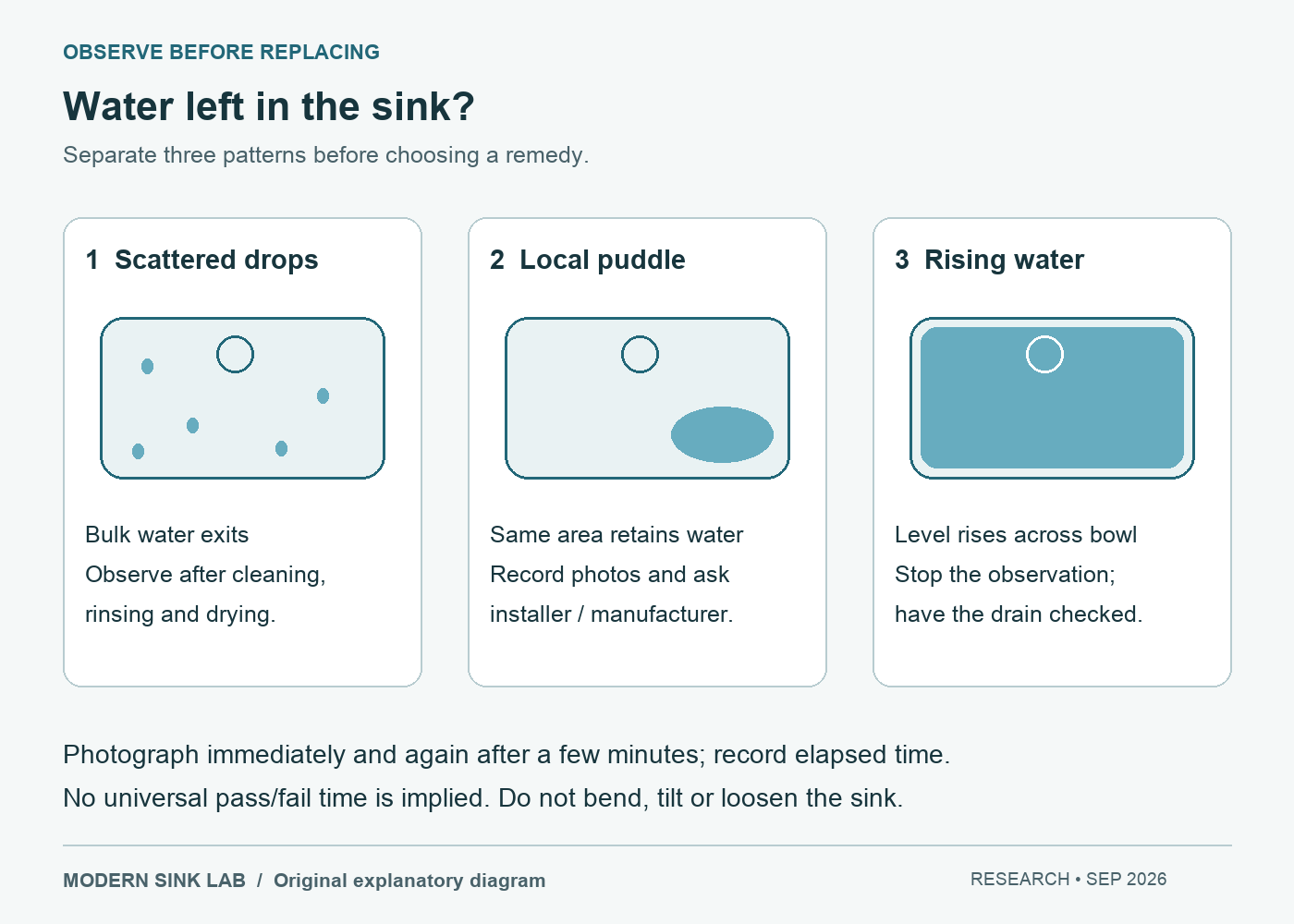
First separate leftover surface droplets, a puddle trapped in one area, and a basin that backs up while the faucet runs. They call for different checks. Replacing a stainless steel sink before identifying which pattern you have can leave the original problem in place.
A sloped bowl and drainage grooves help water move toward the outlet; they do not establish that every drop will disappear without wiping. Equally, a persistent pool should not be dismissed as normal just because a sink is stainless steel. This guide helps you collect useful evidence for the installer or manufacturer without loosening the sink, bending its floor or altering the plumbing.
Start with an empty, gently cleaned bowl
Remove dishes and removable accessories so you can see the actual floor and drain entrance. Empty a removable strainer according to its instructions. Keep hands and tools out of a disposal; do not dismantle it as part of this observation.
Use the care instructions for the exact finish. For plain stainless steel, KRAUS recommends routine cleaning, rinsing and drying; avoid treating a surface with an unknown coating as identical to bare steel. If the main complaint is discoloration left after water dries, use our mineral deposits and rust-colored spots guide instead of assuming a drain defect.
Briefly run water while watching the bowl. Stop if the level rises unexpectedly. After turning the faucet off, photograph what remains immediately and again after a few minutes. Use the same view and note elapsed time. Those times document your observation; they are not a pass/fail standard for every sink.
Read the pattern before choosing a remedy
| What you observe | What to investigate next | What it does not prove |
|---|---|---|
| Scattered drops or a thin wet film; the bulk water exits | Whether ordinary rinsing and drying resolve the complaint | A plumbing blockage or a failed sink |
| A pool remains in the same corner while the outlet area is clear | Installer check of mounting plane, support, local bowl shape and drain seating | That you should bend the sink or change its tilt yourself |
| Water rises across the bowl, or drainage is much slower than before | Strainer/stopper position and qualified drain inspection | That buying a new bowl will clear the downstream route |
These are starting points, not remote diagnoses. More than one issue can coexist. For example, a dirty strainer can slow the exit while a separate local low spot retains some water afterward. Record both observations rather than selecting whichever explanation sounds easiest to fix.
What to ask the installer to check
Send the sink model, installation date, drain or disposal model and the two photographs. State whether the behavior was present from installation or appeared later. An installer can then check the mounting plane against the sink’s instructions, confirm the support has not shifted, and inspect the drain seating and waste route as appropriate.
Do not infer installation level by laying a ruler on an intentionally sloped bowl floor. Do not jack up one corner, loosen clips under a loaded bowl or try to press a new slope into the steel. Those changes can stress the mounting and complicate the manufacturer’s assessment. Ask for a documented correction if the installation or product is found to be wrong.
For a new sink that repeatedly retains a distinct pool, keep the packaging label and order details while you contact the manufacturer. Ask what observation or measurement it needs and what tolerance applies to that exact model. We do not supply a universal allowable depth, volume or drain-down time because the documents checked do not establish one.
Can a grid or mat fix it?
A bottom grid raises dishes above the bowl. It does not change the slope of the metal underneath or repair a restricted pipe. A mat can also hide the surface you are trying to inspect. Lift removable accessories when observing the problem, then check them separately for trapped debris and drain access.
Use the grid-versus-mat comparison to choose surface protection after the drainage question is understood. Buying a different accessory solely to hide standing water is not a resolved installation.
Buying a replacement only after the cause is understood
The KRAUS KHU100-32 is a relevant conventional stainless option when you already need a new 32-inch undermount bowl. KRAUS describes a sloped bottom and channel grooves; the checked package includes a grid and strainer. That is documented design information, not our proof that it drains faster than your present sink.
It requires a specified 36-inch minimum cabinet, has a deep bowl and needs its own approved cutout and mounting arrangement. It will not solve a downstream drain problem. If the existing sink can be corrected, resolve that option before paying for a countertop and plumbing replacement.
Check KHU100-32 details and current offer on Amazon
If water appears under the sink rather than remaining inside it, follow the condensation-versus-leak observation guide. The location and timing of the moisture are different evidence.
Research scope: KRAUS KHU100-32 drainage description and care guidance, plus the current US product listing, checked September 29, 2026. The symptom table and evidence checklist are editorial decision aids, not physical testing, a plumbing diagnosis or a warranty determination.