
As an Amazon Associate I earn from qualifying purchases. Purchases through our links may earn us a commission at no extra cost to you.
A magnet sticking to a stainless steel sink is not, by itself, proof that the sink is fake or poor quality. A magnet not sticking is not a certificate of 304 steel either. Treat the observation as one question to investigate alongside the exact model and its documentation, not as a reason to replace an otherwise suitable sink.
This is a materials-reference and purchase-verification guide, checked October 2, 2026. We have not magnet-tested the linked sink or analyzed its alloy.
Why one part of a sink can attract a magnet
The British Stainless Steel Association explains that stainless steel families have different magnetic behavior. Austenitic steels can develop a magnetic response through cold working, including forming. Response can therefore differ between a flat area and a worked corner; a weld can also behave differently from adjacent material. A household magnet cannot resolve the steel’s chemical composition.
Keep the object being observed clear. The bowl, a drain basket, mounting hardware and a removable grid are separate parts. A result from one accessory should not be presented as a test of the sink bowl. Thickness is a separate buying question; see our 16 versus 18 gauge guide.
Turn the observation into useful evidence
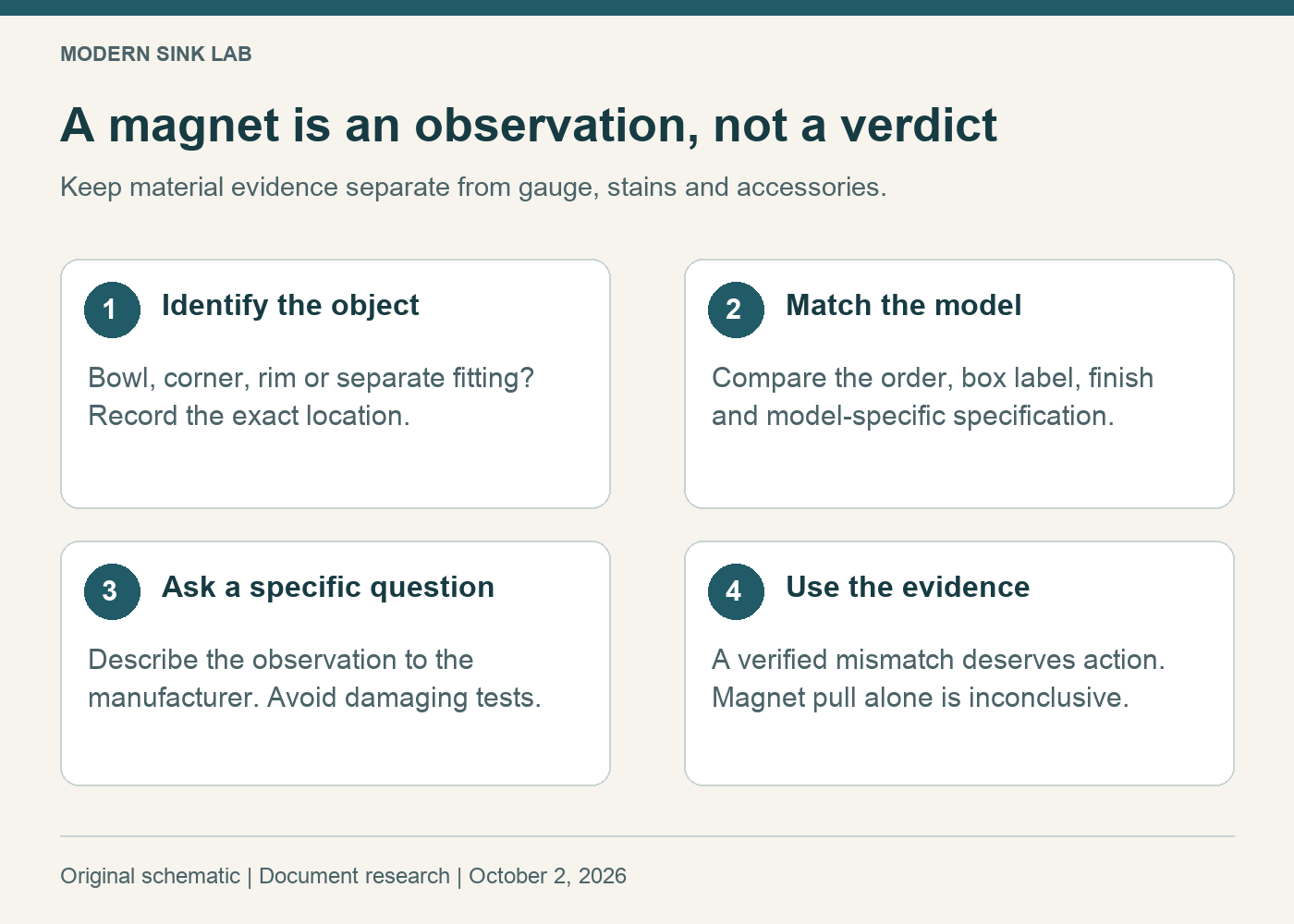
- Identify the purchased item. Keep the order description, seller, model suffix, finish and package label together. A retailer’s shared product page can contain several sizes or finishes.
- Describe exactly what happened. Note where you noticed attraction and whether that was the bowl, rim or a separate fitting. Photograph the location. There is no need to drag a magnet across a new finish or repeat the experiment with a stronger magnet.
- Find the actual material promise. Distinguish an explicit alloy designation from the broader words “stainless steel.” Save the claim you relied on at purchase; do not substitute a specification for a neighboring model.
- Ask a narrow question. Send the manufacturer the model and location of the observation, and ask whether that response is expected and what specification applies. Keep any response with the order record.
A useful note might read: “The label says model X, finish Y. Attraction was noticed at this bowl corner. Which material specification applies to this exact version?” That is more answerable than a claim that the whole product has failed a kitchen magnet test.
What would change the buying decision?
On a narrow screen, scroll the table sideways if needed.
| Evidence you have | Useful next step |
|---|---|
| Magnet attraction, with matching labels and no other problem | Seek model-specific clarification if concerned; do not infer a defect from attraction alone. |
| Order and box identify different models or finishes | Resolve the item mismatch with the seller before fabrication or installation. |
| A claimed alloy grade is important to your project | Request supporting model documentation; a household magnet does not verify it. |
| A stain, pit or damaged surface | Document the visible issue separately and follow its care or warranty route. |
Do not use acid, heat, grinding or deliberate salt exposure to “prove” a new sink’s composition. Those actions can create damage without settling your purchase question. For a visible deposit, our rust-spot assessment guide addresses the surface problem without turning it into an alloy verdict.
A documented model is a better starting point
The KRAUS KWU110-32 is one example of a sink with a model-specific specification: 16 gauge stainless steel, a 32 × 19-inch outside size and a specified 36 × 24-inch minimum cabinet. That sheet does not certify what your magnet should do on an individual delivered unit. We would choose it for its fit and workstation layout, not as a “nonmagnetic” upgrade.
If you are shopping rather than diagnosing a sink you already own, first read the plain-bowl versus workstation comparison. An unnecessary replacement is a poor answer to an inconclusive observation.
View the 32-inch KWU110-32 on Amazon
The link selects the stainless steel, 32-inch single-bowl sink, ASIN B07S2DX7J9. Verify the selected size and package before checkout. Research basis: BSSA Magnetic Properties of Stainless Steels, SSAS 2.81; KRAUS KWU110-32 specification sheet. Reviewed October 2, 2026.