
As an Amazon Associate I earn from qualifying purchases. Purchases through our links may earn us a commission at no extra cost to you.
Choose a sink depth by checking where your hands will work after installation, not just the depth printed on the box. An undermount bowl sits below the countertop. Its rim-to-floor depth is therefore different from the distance down from the finished worktop. A deep bowl may contain a stockpot conveniently while making small dishes at the bottom harder for you to reach.
This guide is for comparing everyday reach before ordering a kitchen sink. It is not an accessibility certification or a medical recommendation. Each regular user should try the proposed arrangement. If seated access or a prescribed accessible design is required, have the complete installation assessed separately.
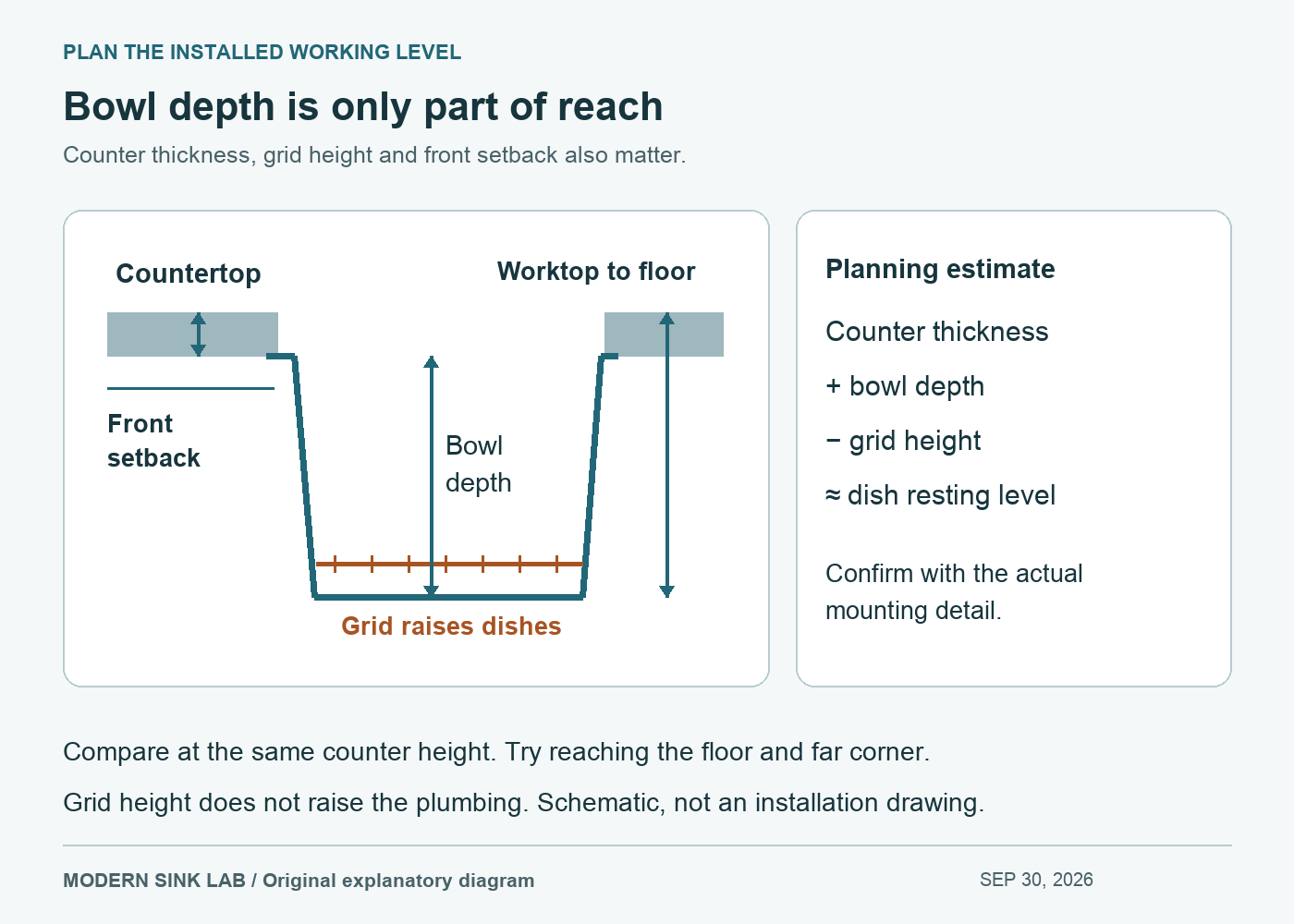
Measure the working level, not only the bowl
For a simplified undermount layout, the distance from the countertop surface to the bowl floor is approximately:
Countertop thickness + rim-to-floor bowl depth.
If dishes rest on a correctly fitted grid, subtract the grid’s actual height above the floor to estimate their resting level. The rim geometry, mounting detail and sloped floor affect the final measurement, so this is a planning calculation, not a fabrication dimension. Do not substitute overall exterior sink height for interior bowl depth.
For example, an 8-inch bowl under a 1¼-inch countertop places the floor roughly 9¼ inches below the worktop; a 10-inch bowl under the same top places it roughly 11¼ inches below. Those are illustrative numbers, not dimensions for a particular sink. Adding the same countertop thickness to both does not erase the two-inch difference.
Two real depths to compare
KRAUS lists the Fairlane KHU640-33 at 8⅝ inches of bowl depth and the Standart PRO KHU100-32 at 10 inches. The difference is 1⅜ inches. At the same mounting level, that is a meaningful change to the floor position, even though both specify a 36-inch minimum cabinet width and 24 inches front to back.
| Check | KHU640-33 | KHU100-32 |
|---|---|---|
| Published bowl depth | 8⅝ in | 10 in |
| Published bowl plan | 30½ × 17 in | 30 × 17 in |
| Use in this decision | Shallower floor to try first if reach is the concern | Deeper bowl to try with your largest cookware |
| What remains unproven | Comfort for your body and counter layout | Comfort for your body and counter layout |
Both are conventional undermount sinks with included bottom grids, not workstation ledge systems. Their shape, drain location and cutout differ. For the full model comparison, see KHU640-33 versus KHU100-32 dimensions and package details.
Check KHU640-33, 8⅝-inch bowl, on Amazon
Check KHU100-32, 10-inch bowl, on Amazon
Horizontal reach can change the decision
Depth is only one direction. Measure from the front countertop edge to the bowl’s near edge, then to the place where you normally wash. A generous front strip of countertop moves that work farther away. A faucet stream near the back can also make you reach across the bowl.
Picture rinsing a mug at the front, cleaning the bottom of a large pot, and wiping the rear corner. These are three different tasks. A layout that works for one should not be assumed comfortable for all three. Record the counter height and front setback alongside the vertical depth so two showroom displays can be compared fairly.
A useful showroom check
- Find a mounted display close to your planned counter height. Ask the showroom for the actual bowl depth and countertop thickness.
- With permission, use a clean lightweight pan or an empty container resembling your usual cookware. Try the ordinary washing position without adding hot water or a heavy load.
- Try reaching the floor and the far corner. Compare with the intended grid installed, then consider the separate task of removing that grid for cleaning.
- Have each regular user repeat the check. Note which task feels awkward and which measurement changed between displays.
A cardboard outline can help compare opening size, but it cannot reproduce a mounted sink’s reach or support a loaded pot. If there is no suitable display, give the measurements and task list to the kitchen designer instead of selecting depth from a photograph alone.
What a grid does—and does not—change
A model-matched grid raises dishes within the bowl. It does not raise the sink’s drain connection, move the countertop edge, or change the floor you must clean beneath it. Do not stack loose protectors to create a makeshift elevated platform. Choose accessories approved for the bowl and consider their removal and cleaning as part of the routine.
The plumbing decision remains separate: use our sink-depth and disposal-clearance worksheet to check the space underneath. Passing that check does not answer whether you like working at the sink.
When to choose a shallower or deeper bowl
Start with the shallower option if your existing complaint is reaching the floor and your cookware still fits its usable width and depth. Keep the deeper option on the shortlist if you regularly wash tall items and the mounted reach check works for the household. Neither choice should proceed until the cabinet, cutout, mounting and plumbing are confirmed.
Research scope: KRAUS KHU640-33 and KHU100-32 specifications and exact US offers checked September 30, 2026. The reach calculation and comparison checklist are original planning aids. We have not physically installed these models or measured user comfort.