The part most buyers miss
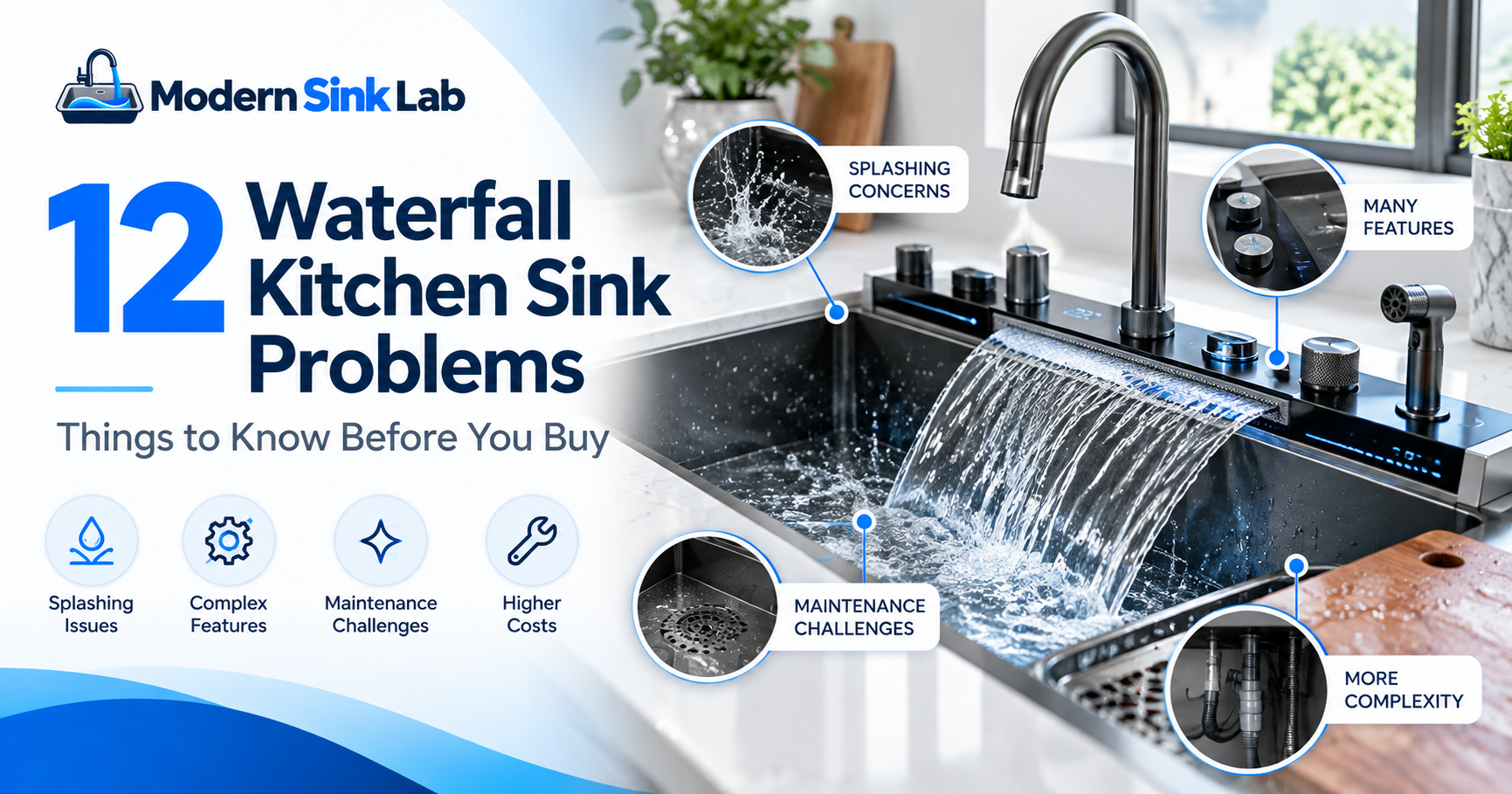
A waterfall sink is not just a regular sink with a prettier faucet.
Many models combine the sink, faucet, waterfall outlet, cup washer, controls, extra hoses, valves, accessories, and sometimes a digital display into one system.
That can be genuinely useful. But it also means there are more things that need to fit, connect, drain, seal, and remain repairable after installation.
30-second takeaway
The biggest waterfall sink problems usually show up after purchase — not on the product page.
Before buying, check the cabinet size, countertop cutout, drain and disposal fit, water connections, drainage slope, hard-water maintenance, replacement parts, installation instructions, and warranty support.
Why the Spec Sheet Can Be Misleading
Amazon listings naturally highlight what looks impressive: 16-gauge stainless steel, nano coating, waterfall mode, digital temperature display, cutting board, cup washer, pull-out faucet and a long list of included accessories.
Those features are not useless. The problem is that they tell you very little about the questions that become expensive once the sink is already installed.
1. Will It Actually Fit?
A “33-inch sink” does not automatically fit every 33-inch cabinet. Cabinet width, rim design, faucet deck, cutout size, and under-sink space all matter.
2. Will Your Plumbing Fit?
Check the drain opening, garbage disposal fit, hot and cold water connections, supplied hoses, and whether unusual fittings will be difficult to replace later.
3. Will It Be Easy to Live With?
Waterfall spray, slow drainage, standing water, hard-water scale, scratches, corners, and black finishes can matter every single day.
4. What Happens When Something Breaks?
The stainless-steel bowl may last a long time. The harder question is whether you can still buy the right cartridge, valve, hose, control part, or display several years later.
The expensive mistake happens before installation.
A toaster that disappoints you can go back in the box. A sink is different. Once a countertop has been cut, plumbing has been changed, and the sink has been sealed into place, replacing it becomes much more disruptive and expensive.
That Is Why We Use a Pre-Install Risk Audit
Instead of asking only “How many features does this sink have?”, we look at what becomes difficult to change after installation.
Before we feel comfortable recommending a complex sink, we want clear answers to:
- Does the manufacturer clearly document cabinet and cutout requirements?
- Does it use common plumbing and drain sizes?
- Can a normal garbage disposal be installed?
- Does the basin actually move water toward the drain?
- How much cleaning will the finish and waterfall outlet require?
- Can wear parts be replaced without replacing the entire sink system?
- Are installation instructions and warranty support easy to find?
Why You’ll Also See Regular Workstation Sinks in This Guide
Not every sink we use as a reference is a waterfall sink. Mature workstation models from brands such as KRAUS, Ruvati, and Lordear help us see what good fit information, standard plumbing compatibility, documentation, and long-term serviceability can look like without as many integrated components.
One More Thing: We Won’t Pretend Every Sink Has the Same Problems
This is a research-based guide. We use manufacturer specifications, installation documents, product structure, retailer information, and repeated patterns in owner feedback to identify problems worth checking.
A buyer complaint is not automatically a universal defect. We also will not claim that we installed or tested a sink unless that actually happened. The goal is to help you know what to verify before your kitchen reaches the point of no easy return.
Quick reality check
Is a Waterfall Kitchen Sink Actually More Likely to Cause Problems?
Not automatically. The waterfall feature itself is not the real issue. The bigger question is how much extra complexity has been built around it.
A simple rule that explains most of the risk:
More integrated features = more things that must be installed, cleaned, sealed, controlled, and eventually replaced.
That does not make those features bad. It simply means a feature-rich sink needs better engineering, clearer documentation, and stronger parts support to stay easy to own.
Think of Kitchen Sinks as a Complexity Ladder
Standard Kitchen Sink
The sink mainly handles one job: holding and draining water. The faucet and disposal are usually separate components.
Typical complexity: bowl + drain + faucet + optional disposal.
Workstation Sink
The plumbing may still be fairly conventional, but the sink adds a ledge for cutting boards, drying racks, colanders, and other accessories.
New questions: ledge dimensions, accessory fit, countertop reveal, bowl size, drainage, and whether replacement accessories remain available.
Smart / Waterfall Sink
Now the sink may combine the workstation platform with extra water outlets, a cup washer, pull-out faucet, separate controls, additional hoses, valves, and sometimes a temperature display or other integrated components.
New questions: extra plumbing, water pressure, proprietary fittings, controls, replacement cartridges, displays, valves, service parts, and installation support.
More features do not automatically mean more trouble.
A well-designed waterfall sink with clear installation instructions, standard connections, replaceable parts, and good support may be easier to own than a poorly designed basic sink. The problem starts when complexity increases without the documentation and serviceability to support it.
What Actually Raises the Risk?
Extra Water Connections
Every additional hose, valve, sprayer, cup washer, or waterfall outlet adds another connection that needs to fit and seal correctly.
Proprietary Parts
A unusual cartridge or valve may work perfectly today but become frustrating if the exact replacement cannot be sourced later.
More Surfaces to Maintain
Waterfall outlets, black coatings, flat ledges, corners, and controls can create more places for mineral scale, water spots, and grime to collect.
Weak Documentation
Complex products become much riskier when cabinet requirements, cutout dimensions, plumbing diagrams, warranty terms, or parts information are unclear.
The feature test
For every “smart” feature, ask three simple questions.
1
What extra parts does this feature add?
2
What extra cleaning or maintenance does it require?
3
If it fails, can I repair it without replacing the sink?
A Simple Example
Imagine two sinks that both use a 16-gauge stainless-steel bowl.
Sink A
Standard faucet, standard 3.5-inch drain opening, simple workstation accessories, clear installation guide.
Sink B
Waterfall outlet, cup washer, digital display, multiple control valves, several extra hoses, and brand-specific replacement components.
Sink B is not automatically the worse purchase. But it requires more answers before installation because there are more ways the system depends on parts beyond the stainless-steel bowl.
The Best Waterfall Sink Is Not Necessarily the One With the Most Features
A better target is the sink that gives you the features you will actually use while keeping fit, plumbing, drainage, maintenance, and future repairs as predictable as possible. That is the standard we will use throughout this guide.
Problems #1–2
Cabinet Fit & Countertop Cutout: The Mistakes You Want to Catch Before Installation Day
Some sink problems are annoying. Fit problems can become expensive. Once a countertop has been cut and plumbing work has started, changing to a different sink may no longer be a simple return.
Problem
The Sink Is “33 Inches” — But Your Cabinet Still May Be Too Small
One of the easiest mistakes to make is matching the number in the product title to the width of the cabinet.
A 33-inch sink does not mean “fits a 33-inch base cabinet.”
The sink body needs room inside the cabinet, and undermount models may also need space for mounting hardware. Many full-size workstation sinks specify a cabinet several inches wider than the nominal sink width.
What to check before you order
Do not rely only on the number in the product name. Find the full width, front-to-back depth, and bowl depth.
Look specifically for wording such as “minimum base cabinet” or “minimum cabinet width.”
Cabinet walls, supports, drawers, disposal units, plumbing, and existing brackets can reduce the usable space inside.
A useful benchmark
Mature workstation products usually make cabinet requirements easier to find. For example, full-size models such as the KRAUS Kore KWU110-32 and Ruvati RVH8300 publish a minimum cabinet requirement rather than expecting the buyer to guess from the sink width alone.
That is the kind of documentation we want to see from a smart or waterfall sink too. If the seller provides a long feature list but no clear cabinet requirement, that is worth slowing down for.
🚩 Red Flag: “Ask Your Installer” Is Not a Substitute for Basic Dimensions
A plumber or countertop fabricator can confirm whether a sink works in your kitchen, but the manufacturer should still provide enough dimensional information for that professional to make the decision. If basic cabinet and cutout information is missing, the installer is being asked to solve a documentation problem that should have been solved before the product was sold.
Problem
The Countertop Gets Cut Before Someone Checks the Exact Sink
This is one of the highest-cost mistakes in the entire buying process.
Stone countertops are cut to fit a specific sink and mounting style. A different model with the same advertised width can still have a different rim, corner radius, bowl shape, faucet area, workstation ledge, or cutout requirement.
The countertop rule
Never approve the countertop cutout from an Amazon title or generic sink size.
The fabricator should work from the actual sink, the manufacturer’s cutout template, or the exact technical drawing for that exact model.
Why Waterfall Sinks Need an Extra Fit Check
A basic sink mainly needs space for the bowl, drain, faucet, and optional disposal. A feature-heavy smart sink may need considerably more room around and below the basin.
Extra water channels or connections may occupy space behind or below the sink.
Adds another water connection and may need clearance below the deck.
Multi-function controls can add valve bodies and hoses under the countertop.
Temperature displays or turbine-powered components may create additional routing and service-access needs.
✅ The 5-Minute Fit Check
Before ordering, find these five pieces of information:
- Exact sink dimensions — width × depth × bowl depth.
- Minimum base cabinet width — not just the product width.
- Installation type — undermount, drop-in, farmhouse, or another method.
- Exact cutout drawing or template — preferably from the manufacturer.
- Under-sink clearance — especially if using a disposal, filter, RO system, or smart controls.
When We Would Pause the Purchase
We would hesitate to order a fixed-installation sink if the listing does not make the following information reasonably clear:
- Minimum cabinet size
- Exact overall dimensions
- Mounting method
- Cutout requirements
- Drain opening specification
- Installation documentation or meaningful manufacturer support
A sink can have an impressive feature list and hundreds of positive reviews, but if the information needed to install it correctly is missing, that uncertainty becomes part of the purchase price.
Problems #3–4
Plumbing & Garbage Disposal Compatibility: “It Fits the Counter” Is Only Half the Job
Once you know the sink physically fits the cabinet, the next question is simpler: Can the plumber connect everything without creating a custom puzzle under your sink?
Quick answer
A waterfall sink is much easier to own when its basic plumbing still uses familiar, replaceable connections.
Extra features are not the problem by themselves. The risk rises when extra hoses, valves, drains, or fittings use unusual sizes and the seller provides little documentation about how they connect.
Problem
The Sink Arrives With Plumbing Parts Your Installer Wasn’t Expecting
A basic kitchen sink is relatively easy to understand. You normally have hot and cold water feeding the faucet, plus a drain underneath.
A multifunction waterfall sink may add several more connections: a separate waterfall outlet, cup washer, control valve, spray hose, additional water lines, or other integrated components.
The Question Is Not “How Many Hoses?” — It Is “How Replaceable Are They?”
Easier Ownership
- Clearly labeled hot and cold connections
- Common drain dimensions
- Replaceable faucet cartridge
- Documented hose connections
- Parts diagram or installation manual
- Replacement parts available from the brand
Higher Ownership Risk
- Unlabeled or unusual fittings
- No plumbing diagram
- No replacement-part numbers
- Proprietary valve assemblies
- Seller cannot identify cartridges or hoses
- Instructions only show a finished installation
🔧 The Plumbing Check We Would Do Before Ordering
Open the product page, manual, or installation diagram and try to answer these five questions:
- What size is the drain opening? Do not assume every sink uses the same drain hardware.
- How are hot and cold water connected? Look for actual fitting information, not just a photo of two hoses.
- What supplies the waterfall and cup washer? Are they fed through a documented valve/manifold?
- Are the hoses and cartridges replaceable? Search the brand site for replacement parts before you need them.
- Is there a real plumbing diagram? A useful manual should show what connects where underneath the sink.
🚩 Red Flag: Lots of Features, Almost No Under-Sink Photos
If a listing shows ten beautiful photos of the waterfall and accessories but never clearly shows the valves, hoses, drain assembly, or underside connections, you are missing the part of the product your plumber actually has to work with.
Problem
“Garbage Disposal Compatible” Does Not Mean the Under-Sink Layout Will Be Easy
Many kitchen sinks can accept a garbage disposal. But the drain opening is only the beginning of the fit check.
The disposal itself takes up a large amount of cabinet space. A deep bowl lowers the drain position, and a smart sink may also place hoses, valves, filters, or control components in the same area.
Five Things to Check If You Use a Garbage Disposal
1. Drain Opening
Confirm that the sink opening is compatible with the disposal flange you intend to use.
2. Bowl Depth
A 10-inch-deep bowl places the disposal lower than a shallower sink would.
3. Wall Drain Height
The P-trap still needs a workable gravity path to the drain connection in the wall.
4. Smart Components
Check whether valves, hoses, or control assemblies occupy the same cabinet space as the disposal.
5. Everything Else
RO tanks, water filters, instant-hot systems, soap reservoirs, and pull-out trash bins may all compete for the same space.
“Compatible” and “Comfortable to Install” Are Two Different Things
A disposal may technically attach to the sink and still leave an awkward cabinet layout. The best time to discover that is on paper — before the sink, disposal, filter system, and plumbing are all competing for the same twelve inches of space.
A Surprisingly Useful Trick: Draw the Cabinet From the Side
You do not need CAD software. A simple side-view sketch can reveal problems before installation.
Write down:
- Countertop height
- Sink bowl depth
- Approximate disposal height
- Wall drain connection height
- Location of water valves
- Any RO tank, filter, or smart-sink valve assembly
Your plumber can confirm the final layout, but this quick sketch often reveals whether you are trying to fit too many systems into one cabinet.
✅ The “Send This to Your Plumber” Checklist
Before ordering a complex waterfall sink, send your installer:
- The exact product model
- Installation manual or plumbing diagram
- Overall dimensions and bowl depth
- Drain opening specification
- Garbage disposal model, if you already selected one
- Photos or diagram of all supplied valves and hoses
- A list of other under-sink equipment you plan to install
When We Would Pause the Purchase
We would slow down if a waterfall sink has multiple integrated water functions but the listing does not clearly explain its plumbing connections, drain dimensions, disposal compatibility, or replacement components.
The goal is not to avoid complicated products. It is to avoid a product that is more complicated than the support behind it.
Problems #5–6
Water Control, Splashing & Poor Drainage: The Problems You Notice Every Single Day
A difficult installation is frustrating once. A sink that splashes everywhere or leaves water sitting in the bowl can annoy you every day.
30-second takeaway
Don’t ask only whether a sink has a waterfall outlet or drainage grooves.
Ask whether you can control the water comfortably, where the stream lands, how the basin moves water toward the drain, and how much manual rinsing you will realistically need after washing dishes.
Problem
The Waterfall Looks Great in a Video — Then It Splashes Across Your Counter
Splashing is often described as a simple “high water pressure” problem. In reality, several things happen at the same time.
The amount of water matters, but so does how far it falls, where it hits, how deep the bowl is, and whether a plate, pan, or cutting board happens to be sitting directly in the stream.
Think of Splashing as a Four-Part Equation
1. Water Flow
More flow creates more energy when the water hits the basin. What matters most is whether the waterfall can be comfortably adjusted, not simply whether it looks powerful.
2. Where the Water Lands
Water landing near the center of a deep empty bowl behaves differently from water hitting a vertical pot, plate, or utensil near the front edge.
3. Bowl Depth
A deeper basin generally gives splashing more room to stay inside the sink, but depth alone cannot compensate for a poorly positioned or overly aggressive stream.
4. What’s in the Sink
Real kitchens contain pans, bowls, racks, cutting boards, and dishes. These can redirect a smooth stream sideways in ways an empty-sink demo never shows.
The Better Question Is: Can You Control the Water?
A dramatic waterfall mode is useful only if you can reduce the flow when you do not need it. Before buying, look for clear information about how the waterfall is controlled, whether flow can be adjusted smoothly, and whether normal faucet use remains simple.
💧 What to Look for on the Product Page
- Multiple flow levels or meaningful flow control — not just a waterfall ON/OFF demonstration.
- Video showing normal use — preferably with dishes or cookware in the bowl, not only an empty showroom sink.
- A sufficiently deep basin for the way you normally wash cookware.
- Clear outlet positioning so you can see where the waterfall actually lands.
- Separate control logic that does not make everyday faucet use unnecessarily complicated.
🚩 Red Flag: Every Demo Uses an Empty Sink at the Same Water Setting
A polished product video can show that the waterfall works. It does not necessarily show how the sink behaves when washing a large pan, filling a bowl, using the cup washer, or running the water at a lower setting. Those everyday conditions matter more than the first five seconds of the demo.
Problem
The Sink Has “X-Shaped Drainage Grooves” — But Water Still Doesn’t Move the Way You Expected
X-shaped channels and drain grooves are common features on modern workstation and waterfall sinks. They can help guide water toward the drain.
But the grooves themselves are not magic. The overall shape and slope of the basin still determine how easily water and debris move.
“Fast Drainage” Does Not Mean the Bowl Cleans Itself
Even a well-designed sink may still need a quick spray to move crumbs, rice, coffee grounds, or soap residue toward the drain. The realistic goal is good water movement with reasonable cleanup — not expecting gravity to remove every particle by itself.
Four Things Matter More Than the Shape of the Grooves
Basin Slope
Water needs a meaningful downhill path. A nearly flat bottom may look sleek but can require more manual rinsing.
Drain Location
Rear and offset drains can improve under-sink storage, but the entire bowl still has to guide water efficiently toward that location.
Bowl Geometry
Very wide flat surfaces and tight corners can create areas where crumbs or thin films of water need extra help reaching the drain.
Real Kitchen Debris
Water is easy to drain. Rice, vegetable scraps, grease, soap film, and food particles are a much better test of everyday usability.
🔎 The 30-Second Drainage Check
Before buying, see how many of these questions the seller can answer:
- Does the manufacturer explicitly say the basin is sloped, or does it only advertise “X-shaped grooves”?
- Where is the drain located — center, rear center, or rear offset?
- Does a product drawing show the basin profile or drainage design?
- Do owner reviews repeatedly mention standing water or chasing food toward the drain?
- Does the brand publish enough technical information to explain how the drainage design actually works?
✅ A Better Expectation for a Large Workstation Sink
You should expect water to move toward the drain without large areas constantly holding puddles. But you should also expect to use the faucet sprayer occasionally to move food debris across a wide single-bowl sink. Good drainage reduces cleanup; it does not eliminate cleanup.
If Possible, Pay Attention to Drainage Before the Project Is Completely Finished
Once the sink is connected and your installer can safely run water, look at how the basin behaves before assuming every part of the project is finished.
- Does water naturally move toward the drain?
- Are there obvious low spots holding noticeable puddles?
- Does the waterfall hit the intended area of the bowl?
- Can the flow be reduced comfortably?
- Does normal dishwashing create excessive splash outside the sink?
If something appears wrong, it is better to investigate while the installer, packaging, documentation, and return information are still easy to access.
Our Rule: Judge Water Movement, Not Marketing Vocabulary
“Powerful waterfall,” “deep bowl,” “X-shaped grooves,” and “fast drainage” are useful clues — but none of them alone tells you what daily ownership will feel like. The better product is the one whose flow is controllable, splash is manageable, and basin geometry makes cleanup predictable.
Problems #7–8
Hard Water, Scratches & “Rust”: Know What You’re Actually Looking At
Not every white mark is damage. Not every red spot means the stainless steel is rusting. And not every scratch means the sink is defective.
30-second takeaway
A sink finish is not maintenance-free just because the listing says “nano-coated,” “304 stainless,” or “scratch resistant.”
Your water quality, cleaning products, cookware, drying habits, and finish type can all change how the sink looks after months of normal use.
Problem
Hard Water Leaves Behind More Than an Ugly Water Spot
If your tap water contains a lot of dissolved minerals, some of that material can remain on the sink after the water evaporates.
On a simple stainless-steel bowl, that may show up mainly as water spots or a dull film. A multifunction waterfall sink gives those minerals more places to collect.
Where Hard Water Can Become More Noticeable
Waterfall Outlet
A wide water outlet can leave mineral residue along the lip, especially when water repeatedly dries there.
Cup Washer
Small spray openings and wet surfaces can collect residue if water regularly dries around them.
Controls & Flat Ledges
Flat areas around knobs, buttons, and workstation ledges can hold droplets long enough for visible mineral spots to form.
Dark Finishes
White mineral residue can be visually obvious against a dark surface, even when the underlying sink is otherwise functioning normally.
Hard Water Is Not Necessarily a Reason to Avoid the Sink
The more useful question is whether you are comfortable with the maintenance. If your existing faucet, shower glass, or kettle already develops visible mineral scale, expect a feature-rich sink to need regular wiping and occasional mineral-deposit cleaning too.
✅ A Simple Hard-Water Reality Check
You probably already know whether hard water will matter in your kitchen. Look at three things you already own:
- Your current kitchen faucet aerator
- Your shower glass or showerhead
- The inside of a kettle or coffee machine
If white scale builds up quickly on those surfaces, assume the same water will eventually reach the waterfall outlet, cup washer, faucet, and sink finish.
Don’t Copy Cleaning Advice From Another Sink
Bare brushed stainless steel, black coatings, PVD finishes, nano-treated surfaces, faucets, and electronic controls may have different care requirements. Before using vinegar, abrasive pads, chlorine-based cleaners, or strong chemicals, check the care instructions for the exact sink and finish you purchased.
Problem
A Red Spot, Scratch, or Discoloration Gets Labeled “Rust” Too Quickly
Stainless steel is corrosion resistant, not magically immune to every stain, contaminant, cleaning chemical, or surface mark.
When you see a red or orange spot, the first step is to identify what it actually is before assuming the sink itself is corroding.
“Rust-Like” Marks Can Have Several Causes
Mineral or Iron Deposits
Minerals carried by the water supply can sometimes leave colored deposits on the surface.
Rust Transfer
A cast-iron pan, steel wool, tool, or another ordinary steel object can leave iron contamination that later looks like the sink is rusting.
Chemical Damage
Certain harsh cleaners or prolonged chemical exposure can damage the protective surface and create discoloration or corrosion risk.
Actual Surface Corrosion
If a mark repeatedly returns, spreads, pits the metal, or does not respond to approved cleaning methods, it deserves closer investigation.
Scratches Are a Different Question
A brushed stainless-steel sink is a working surface. Pots, pans, grids, utensils, and cleaning can create fine surface scratches during normal use.
Mature manufacturers commonly treat minor surface scratching as part of normal ownership, not automatically as structural damage. Over time, fine marks may blend more naturally into the overall brushed finish.
What About Black and “Nano” Waterfall Sinks?
Dark finishes can look striking, especially on a feature-heavy waterfall sink. But the phrase “nano coating” by itself tells you very little about long-term ownership.
Before buying, we would want to know:
- What is the actual finish or coating process?
- What cleaning products does the manufacturer allow?
- What cleaners or pads are specifically prohibited?
- Does the warranty cover finish defects?
- Does the brand explain how to repair or handle finish damage?
🚩 Red Flag: “Scratch-Proof” or “Never Rusts” With No Care Documentation
Strong marketing claims are less useful than a real care guide. A manufacturer that explains what cleaners to use, what to avoid, how to handle water spots, and how to maintain the finish gives you much more actionable information than a one-line durability promise.
This Is Where Mature Brands Give Us a Useful Benchmark
Brands such as KRAUS and Ruvati publish dedicated care guidance for stainless-steel sinks, including water spots, mineral deposits, scratches, discoloration, rust-like marks, recommended cleaners, and products to avoid.
A newer smart or waterfall sink does not need to copy those instructions, but we would still like to see the same level of clarity about how its finish should be maintained several years after installation.
✅ The 60-Second Finish & Hard-Water Check
Before buying, try to find clear answers to these six questions:
- What material is the sink actually made from?
- What finish or coating is applied to the surface?
- Does the brand publish a cleaning and care guide?
- How should hard-water deposits be removed?
- Which cleaners and scrubbers should never be used?
- What does the warranty say about the sink finish?
Our Rule: Buy the Finish You’re Willing to Maintain
Stainless steel, black finishes, and coated smart sinks can all look excellent. The better choice is not automatically the one that looks best on day one. It is the one whose cleaning routine, water-spot visibility, scratch behavior, and long-term care match the way you actually use your kitchen.
Problems #9–10
Displays, Controls & Replacement Parts: The Sink Bowl May Not Be the Part You Worry About Later
Stainless steel is only one part of a multifunction sink. The longer-term question is what happens when a valve, cartridge, hose, control, display, or other smaller component eventually needs attention.
30-second takeaway
Before buying a smart sink, ask one question most listings never answer: “If one feature fails later, what exactly do I have to replace?”
The best outcome is usually a small, identifiable, replaceable part. The worst outcome is discovering that a minor failure is buried inside a proprietary system with no clear repair path.
Problem
The Digital Display or Control System Fails — But Nobody Explained What That Actually Means
A temperature display or multifunction control can be useful. But “smart” features should never be treated as one mysterious black box.
Before buying, try to understand which components are simply giving you information and which components actually control the water.
Not Every Smart-Sink Failure Has the Same Consequence
Lower impact
Display Stops Working
If the display is only informational, the sink may still perform its core job normally. The inconvenience is real, but the sink may remain usable.
Medium impact
One Special Mode Fails
A waterfall outlet, cup washer, or secondary spray function may stop working while the main faucet remains usable.
Higher impact
Core Water Control Fails
If the failed component is part of the main valve or water-routing system, normal sink use may be affected until that part can be repaired or replaced.
Don’t Assume You Know How the Display Is Powered
Different smart sinks can use different designs. Do not assume a temperature display needs a wall outlet, batteries, or any particular power source just because another model works that way. Check the manual for the exact product and understand what happens if that system stops working.
Modern Sink Lab 5-Year Repair Test
Imagine this exact model disappears from Amazon five years from now.
Could you still identify and replace the parts most likely to wear out?
Is there a model or part number?
Standard connection or proprietary?
Can the assembly be replaced separately?
Is the outlet/service hardware documented?
Can it be removed and replaced?
Does the sink remain usable if it fails?
Problem
The Sink Is Fine — But the $15–$50 Part You Need Is Impossible to Identify
This is one of the least glamorous parts of shopping for a kitchen sink, and one of the most important.
A large stainless-steel basin may remain perfectly usable while a much smaller cartridge, hose, O-ring, valve, sprayer, or control component becomes the reason you need service.
Our Serviceability Ladder
✅ Do This Search Before You Buy
Take the exact brand and model number and search for:
[model] replacement cartridge
[model] replacement hose
[model] replacement valve
[model] replacement parts
[model] installation manual
[model] parts diagram
[model] warranty
You are not expecting every search to return dozens of results. You are checking whether a repair path exists at all.
Five Questions Worth Asking the Seller
- What is the replacement cartridge model or size?
- Can I buy the faucet hose and valve assembly separately?
- Can the waterfall outlet or cup washer be replaced individually?
- If the temperature display stops working, does the main faucet still function normally?
- Where can I buy replacement parts after the warranty ends?
Why this matters more on feature-rich models
A Multifunction Sink Has More Parts Worth Asking About
A model such as the Feibus 33-inch waterfall workstation combines a large sink platform with multiple water functions and a temperature-display feature. That does not make it a bad design. It simply means there are more components whose future serviceability matters.
Our question is not “Does it have more features?” It is “Can those features be maintained without turning one failed component into a reason to replace the entire setup?”
🚩 Red Flag: The Seller Can Describe Every Feature but Cannot Name a Single Replacement Part
A product page can explain ten spray modes and twenty included accessories while telling you almost nothing about the cartridge, valve, hoses, or controls. For a permanently installed product, that information gap matters.
Warranty and Repairability Are Not the Same Thing
A warranty can be valuable, but it does not automatically make a product easy to repair. Warranty coverage eventually ends, sellers change, and product models are replaced.
What matters long term is whether the part can still be identified, sourced, accessed, and replaced.
Our Rule: Buy Features You Can Afford to Lose — or Repair
A smart feature is much easier to recommend when the sink remains useful without it or when the failed component has a clear replacement path. The feature becomes a bigger ownership risk when one small proprietary part can disable a major function and nobody can tell you what that part is.
Problems #11–12
Weak Instructions, Missing Parts & Remodel Timing: Problems That Can Turn a Good Sink Into a Bad Project
Some sink problems come from the product. Others come from discovering important information too late in the renovation.
30-second takeaway
Do not wait until installation day to discover whether your sink is complete, documented, and actually the right size.
Inspect the product soon after delivery, confirm the parts, verify the dimensions, find the installation manual, and understand the seller’s current return policy before the remodel moves past the point of easy change.
Problem
The Sink Has a Huge Feature List — But Almost No Useful Installation Documentation
A permanently installed sink should not require your installer to reverse-engineer the product from marketing photos.
The more complicated the sink becomes, the more important clear documentation becomes. A waterfall outlet, cup washer, extra valve, digital display, or proprietary connection adds very little value if nobody can explain how it is supposed to be installed or serviced.
What Good Documentation Should Help You Answer
Exact Dimensions
Overall width, front-to-back depth, bowl depth, rim dimensions, and minimum cabinet requirement should be easy to find.
Countertop Cutout
A template or technical drawing should show the fabricator what needs to be cut, not leave them guessing from the product title.
Plumbing Layout
The installer should be able to understand the drain, supply lines, valves, waterfall outlet, cup washer, and other integrated water paths.
Parts Identification
Cartridges, hoses, valves, drains, controls, and accessories are much easier to service when they can be identified by name or part number.
Care Instructions
The brand should explain what cleaners are safe, what products to avoid, and how to maintain the exact finish.
Warranty & Support
Buyers should know who handles support, what the warranty covers, and how to request help when something is missing or fails.
Documentation Is Part of the Product
A useful comparison is a mature workstation sink with clearly published specifications, installation information, cutout guidance, care instructions, and warranty details. A newer waterfall sink may offer far more features — but if the information needed to install and maintain those features is harder to find, that difference matters.
🚩 Red Flag: The Manual Is Just a Few Pictures With No Measurements or Parts Information
A basic diagram may be enough for a simple product. It is much less reassuring when the sink integrates multiple water outlets, controls, valves, hoses, and specialty components.
Try the Support Channel Before You Need It
For an unfamiliar smart-sink brand, consider sending one simple pre-purchase question:
“If the faucet cartridge or waterfall valve needs replacement in the future, where can I purchase the correct part?”
The answer can tell you a surprising amount about whether the company has a real post-purchase support system or mainly a sales listing.
Problem
The Sink Sits in a Box Until the Remodel Reaches Installation Day
Kitchen remodels rarely happen on the same schedule as product deliveries.
A sink may arrive long before the cabinet, countertop, plumber, or fabricator is ready. That creates a dangerous temptation: leave the box unopened until installation day.
Your Remodel Schedule and Your Return Window Are Two Different Clocks
Retailer and seller return policies can vary by product and can change over time. Do not assume that the product can still be returned simply because your contractor has not reached the installation stage yet. Check the current return terms for the exact purchase.
Modern Sink Lab Arrival-Day Inspection
Open the box while changing course is still relatively easy.
1
OPENDo not leave the package sealed until installation day.
2
INSPECTLook for dents, finish damage, bent edges, cracks, or shipping damage.
3
COUNTCompare every faucet, hose, valve, accessory, drain part, and fastener with the parts list.
4
MEASUREVerify the actual sink dimensions against the cabinet and project drawings.
5
DOCUMENTSave the manual, model number, seller information, warranty, and photos of the delivered parts.
6
VERIFY FITConfirm dimensions and compatibility with the cabinet, countertop plan, and installer before fabrication.
🚩 Do Not Permanently Modify the Product Just to “See If It Fits”
Cutting, drilling, gluing, plumbing, removing protective films, or otherwise altering the product may affect return eligibility. Verify dimensions and fit as non-destructively as possible, and follow the seller’s current return conditions.
What to Inspect Before the Sink Disappears Into the Remodel
Sink Body
Check corners, rim, finish, drain area, workstation ledges, and any visible shipping damage.
Faucet & Controls
Confirm that the faucet, handles, knobs, display, valves, and visible controls match the listing.
Hoses & Plumbing Parts
Check that hoses, connectors, drain components, cup-washer parts, and fittings are present.
Workstation Accessories
Confirm cutting boards, racks, colanders, grids, strainers, and other included accessories before packaging is discarded.
📷 Take Five Minutes of Photos Before Everything Gets Installed
Photograph:
- The model label and packaging label
- The complete contents of the box
- All valves, hoses, and connectors
- The underside of the sink
- Any visible damage or unusual parts
- The manual and parts list
Those photos can make it much easier to identify missing components, explain a problem to support, or remember how the original system was configured later.
✅ A Safer Remodel Sequence
Order → Inspect → Measure → Verify With Installer → Confirm Cutout → Fabricate Countertop → Install
The exact construction sequence can vary, but the principle is simple: verify the physical sink before irreversible work depends on it.
Return Policy and Warranty Solve Different Problems
A retailer return policy may help when the product arrives damaged, incomplete, incorrect, or unsuitable within the applicable return conditions.
A manufacturer warranty may address certain defects later. Neither one should be assumed to cover every installation problem, finish issue, compatibility mistake, modification, or missing component. Read both before installation.
Our Rule: Treat Delivery Day as the Beginning of Installation Planning
A sink does not need to be connected to water the day it arrives. But it should not remain an unknown object in a sealed box either. The safest time to discover a wrong size, missing valve, damaged finish, unclear fitting, or missing manual is while you still have options.
Turning the 12 problems into a buying decision
What Does a Lower-Risk Kitchen Sink Actually Look Like?
After all these warnings, it would be easy to conclude that the safest sink is simply the one with the fewest features. That is not our conclusion.
Modern Sink Lab buying principle
The goal is not minimum complexity. The goal is manageable complexity.
A feature-rich sink can still be a sensible purchase when the fit requirements are clear, plumbing is understandable, drainage is documented, maintenance is realistic, and the manufacturer gives buyers a credible path to installation and future service.
Five Signals We Like to See Before Installation
1. Clear Fit Information
Exact dimensions, minimum cabinet width, mounting method, and preferably a cutout drawing or template.
2. Familiar Plumbing
Clearly documented drain size, supply connections, disposal compatibility, and understandable under-sink routing.
3. Useful Documentation
Installation instructions, care guidance, warranty information, and enough technical detail for an installer to work confidently.
4. Serviceable Components
The more specialized the sink becomes, the more we want identifiable cartridges, hoses, valves, accessories, or replacement paths.
5. Realistic Maintenance
A finish and drainage design you are willing to clean, dry, and maintain in your actual water conditions.
These Four Products Are Not Four Competing Waterfall Sinks
Feibus represents the kind of highly integrated waterfall sink this guide is evaluating. Lordear, Ruvati, and KRAUS are mature workstation-sink references. We use them to show what clearer fit information, simpler plumbing, and established installation documentation can look like when fewer integrated systems are involved.
Complex waterfall example
Feibus 33-Inch Waterfall Workstation Sink
This is the type of product that makes a waterfall sink attractive in the first place: a large workstation platform combined with multiple integrated water functions and a temperature-display feature.
That feature set is also exactly why we would apply the full Pre-Install Risk Audit. Before buying, we would want especially clear answers about plumbing connections, water controls, display operation, finish care, and future replacement parts.
What this product teaches us:
- More integrated features deserve more pre-purchase questions.
- A digital feature should not hide the basic plumbing and service details.
- Long-term parts availability matters more here than on a simple sink bowl.
Mainstream drop-in benchmark
Lordear 33-Inch Drop-In Workstation Sink
The Lordear model gives us a useful mainstream reference because its core installation information is easy to understand: a 33 × 22-inch drop-in format, a published 36-inch minimum cabinet requirement, and a standard 3.5-inch drain opening.
Lordear also provides cutout and installation material for this workstation platform. That does not prove the sink will be perfect for every kitchen, but it reduces the number of important dimensions an installer has to guess.
What this product teaches us:
- “33-inch sink” and “36-inch minimum cabinet” are two different measurements.
- A standard drain size makes disposal planning easier to evaluate.
- Cutout information should be part of the buying decision, not an afterthought.
Mature ownership benchmark
Ruvati RVH8300 Workstation Sink
Ruvati’s RVH8300 is useful as a long-established workstation comparison: its specification sheet clearly identifies the 32 × 19-inch exterior, 10-inch bowl depth, 36-inch minimum cabinet, rear-center drain, and 3.5-inch drain opening.
The document also identifies the included workstation accessories individually. That kind of detail matters because ownership does not end with the stainless-steel bowl; grids, cutting boards, colanders, drains, and other accessories may also need attention over time.
What this product teaches us:
- Drain location belongs in the buying conversation.
- Accessories are easier to manage when they are clearly identified.
- A detailed spec sheet reduces ambiguity before countertop fabrication.
Documentation benchmark
KRAUS Kore KWU110-32 Workstation Sink
The KRAUS Kore gives us a useful documentation benchmark. Its published specification identifies the 32 × 19-inch overall size, 10-inch depth, 36-inch left-to-right minimum cabinet requirement, 24-inch front-to-back cabinet requirement, rear offset drain, and 3.5-inch drain opening.
That level of detail does not make every installation effortless. It does something more basic and valuable: it gives the cabinetmaker, countertop fabricator, plumber, and homeowner the same set of numbers to work from.
What this product teaches us:
- Good documentation reduces installation uncertainty.
- Cabinet requirements should include more than one vague width number.
- A feature list is not a substitute for a technical specification.
The Four Products Are Teaching Us Four Different Things
| Product | Role in This Guide | What to Learn From It | Main Question |
|---|---|---|---|
| Feibus | Complex waterfall example | Integrated-function risk | Can every feature be serviced? |
| Lordear | Drop-in benchmark | Fit + standard drain information | Can the installer plan it easily? |
| Ruvati | Ownership benchmark | Dimensions + identified accessories | What does long-term ownership involve? |
| KRAUS | Documentation benchmark | Pre-install technical clarity | How much uncertainty is removed before cutting? |
✅ The Lower-Risk Buying Pattern
The products that make us more comfortable are usually the ones where fewer important questions are left unanswered.
Clear dimensions → documented cutout → understandable plumbing → realistic maintenance → identifiable service path
This Is Not a “More Expensive = Safer” Rule
Price alone does not tell you whether a sink will fit, drain well, remain repairable, or receive good support. We would rather see a simpler product with excellent documentation than a more expensive product whose most important installation details are impossible to verify.
Our Rule: Buy the Features — But Also Buy the Support Behind Them
A waterfall sink can absolutely be worth owning. We simply want the documentation, plumbing clarity, maintenance guidance, and repair path to become stronger as the product becomes more complex. That is what turns impressive features into manageable long-term ownership.
Save this before you shop
The 10-Minute Waterfall Sink Pre-Buy Checklist
You do not need to become a plumber or countertop fabricator before buying a sink. But you should be able to answer 10 basic questions before committing to a product that may soon be built into your kitchen.
Before You Start, Open These Four Things
Our Rule of Thumb: Three Unknowns = Slow Down
If you cannot confidently answer three or more of these questions, we would pause before ordering — especially if one of the unknowns involves cabinet fit, countertop cutout, plumbing, or replacement parts.
This is a practical decision rule, not a scientific product score. The goal is simply to identify uncertainty before installation makes that uncertainty expensive.
What Your Checklist Should Feel Like
🟢 GREEN
Dimensions are clear, installer understands the system, parts are identifiable, and maintenance expectations make sense.
🟡 YELLOW
The product may still be fine, but one or two important details need confirmation from the manufacturer or installer.
🔴 RED
Cabinet fit is unclear, plumbing is undocumented, replacement parts cannot be identified, or support provides no useful answers.
A good sink does not need to answer every imaginable question.
But it should answer the questions that become expensive once the cabinet, countertop, plumbing, and sink are permanently tied together.
Screenshot This Checklist Before You Shop
A beautiful waterfall demo may get your attention. These ten questions are what help determine whether the sink still feels like a smart purchase after the excitement of installation is gone.
The real buying decision
Are Waterfall Kitchen Sinks Worth It? It Depends on What You Actually Want From the Sink
After twelve potential problems, it may sound like the safest advice is simply “don’t buy a waterfall sink.” That is not our conclusion.
Our short answer
A waterfall sink can absolutely be worth it when you will use the extra features and the product has enough support behind them.
It becomes a much weaker value when you are paying for extra plumbing, controls, displays, and maintenance that will rarely change the way you actually use the kitchen.
A Waterfall Sink Makes More Sense If…
✓ You Will Actually Use the Extra Water Modes
A waterfall outlet, pull-out faucet, cup washer, or multiple spray modes make more sense when they solve tasks you already do frequently.
✓ You Like an Integrated Workstation
If you prep vegetables, rinse produce, dry dishes, and use accessories over the bowl, an integrated workstation can reduce countertop clutter.
✓ You Are Comfortable With More Maintenance
More outlets, ledges, controls, and dark finishes can mean more wiping, descaling, and cleaning than a very simple stainless-steel sink.
✓ Your Installer Has Reviewed the System
The cabinet, countertop, drain, disposal, hoses, valves, and under-sink clearance have already been checked before fabrication.
✓ Parts and Documentation Are Reasonably Clear
You can identify the manual, warranty, support channel, and at least a plausible replacement path for wear components.
✓ You Value the Design Enough to Maintain It
If the waterfall look is part of the kitchen design you genuinely want, extra cleaning may feel like a reasonable trade-off instead of a burden.
A Regular Workstation Sink May Be the Smarter Choice If…
You Mainly Want the Workstation Accessories
Cutting boards, drying racks, colanders, and ledges do not require a waterfall outlet or digital display.
You Prefer Simple, Standard Plumbing
Fewer integrated valves and water paths usually mean fewer product-specific connections to understand and maintain.
Your Kitchen Has Very Hard Water
A waterfall sink can still work, but extra outlets and dark finishes may make mineral buildup more visible and add maintenance.
Replacement Parts Are Impossible to Verify
A permanently installed product becomes much less attractive when one proprietary valve or cartridge has no identifiable replacement path.
Your Cabinet Is Already Crowded
Garbage disposal, RO tank, filtration, pull-out trash, plumbing, and smart-sink valves can compete for the same under-sink space.
You Hate Wiping and Maintaining Fixtures
If even your current faucet water spots already annoy you, adding more wet surfaces may not make the kitchen feel simpler.
The Most Important Question: Do You Want a Waterfall Sink — or Do You Really Want a Workstation Sink?
This distinction can save buyers money and complexity.
If your favorite features are the large single bowl, cutting board, drying rack, colander, bottom grid, and workspace over the sink, then a conventional workstation sink may already deliver most of what you want without adding a second water system, extra controls, or a display.
Waterfall Sink vs. Regular Workstation Sink
| Priority | Waterfall / Smart Sink | Regular Workstation Sink |
|---|---|---|
| Workstation accessories | Usually available | Usually available |
| Waterfall outlet | Yes, depending on model | Usually no |
| Digital / integrated controls | Common on smart models | Usually minimal or absent |
| Plumbing complexity | Potentially higher | Usually simpler |
| Number of specialized parts | Potentially higher | Usually lower |
| Best for | Buyers who will use the integrated features | Buyers who mainly want workflow + simplicity |
The “Would I Actually Use It?” Test
For every extra feature, ask how often it will improve a real task in your kitchen.
What task will I use it for that my normal faucet does poorly?
Do we regularly wash bottles, glasses, or cups that make this worthwhile?
Does seeing water temperature meaningfully improve how I use the sink?
Are the extra modes genuinely useful or simply more impressive in a demo?
✅ A Simple Rule of Thumb
A waterfall sink becomes easier to justify when:
You want the features + your kitchen can accommodate them + the installation is documented + the maintenance feels acceptable + the important parts can be serviced
Do Not Pay for Features Just Because They Photograph Well
Waterfall sinks are visually impressive products, which makes them especially easy to shop with your eyes. But a feature that looks excellent in a 15-second product video can become one more thing to clean, connect, or repair for the next several years.
So, Are Waterfall Kitchen Sinks Worth It?
Yes — for the right buyer. They can combine useful prep space, multiple water functions, modern styling, and workstation convenience into one integrated setup.
But not everyone needs that integration. If the workstation itself is what you really want, a simpler workstation sink may deliver most of the everyday benefit with fewer specialized components.
The best choice is not the sink with the longest feature list. It is the one whose useful features still make sense after you include installation, maintenance, repairability, and the way you actually cook and clean.
Final questions before you buy
Waterfall Kitchen Sink FAQ + Final Verdict
By this point, the decision should be much simpler. The question is no longer “Does this sink look impressive?” It is: Does this exact model make sense in my kitchen, with my plumbing, water quality, maintenance habits, and tolerance for future repairs?
Do waterfall kitchen sinks splash more?
They can, but the waterfall feature alone does not determine splash. Flow rate, outlet position, bowl depth, where the water lands, and what is sitting in the sink all matter. A controllable stream is more useful than simply having the strongest waterfall effect.
Are waterfall sinks harder to clean?
Usually there are more surfaces to maintain than on a simple sink. Waterfall outlets, cup washers, flat ledges, controls, dark finishes, and workstation accessories can all collect water spots or mineral residue. How noticeable that becomes depends heavily on your water quality and cleaning habits.
Can you install a garbage disposal with a waterfall kitchen sink?
Many models may support a disposal, but verify the exact sink. Check the drain opening, bowl depth, disposal clearance, wall-drain height, P-trap layout, and whether extra smart-sink valves or hoses occupy the same cabinet space.
Do waterfall kitchen sinks need electricity?
It depends on the exact model. Do not assume that every display or smart feature uses the same power system. Check the installation manual to understand how the display and controls are powered and whether the sink remains usable if that feature stops working.
Do waterfall stainless-steel sinks rust?
Stainless steel is corrosion resistant, but a red or orange spot does not automatically prove that the sink itself is rusting. Mineral or iron deposits, rust transferred from other metal objects, chemical exposure, surface contamination, and actual corrosion can look similar at first. Follow the care instructions for the exact sink before drawing conclusions.
Are black waterfall sinks harder to maintain?
They can show white mineral deposits and water spots more clearly than some brushed stainless finishes. The bigger issue is knowing what the dark finish actually is and which cleaners the manufacturer allows. “Nano-coated” by itself is not enough information to predict long-term maintenance.
Are replacement parts easy to find?
That varies widely by brand and model. Before buying, search for the exact model plus terms such as “replacement cartridge,” “replacement hose,” “valve,” “parts diagram,” and “replacement parts.” The important question is whether a repair path exists before you actually need it.
Are waterfall kitchen sinks worth the extra cost?
They can be if you will genuinely use the waterfall outlet, cup washer, integrated workstation, additional spray modes, or other features. If your main goal is simply a large bowl with a cutting board, rack, and colander, a conventional workstation sink may deliver most of the daily benefit with less complexity.
Modern Sink Lab final verdict
Buy the least complicated sink system that gives you the features you will actually use.
If that happens to be a full waterfall workstation with multiple water functions, great — just make sure the fit, plumbing, drainage, maintenance, documentation, and repair path are strong enough to support the extra complexity.
Route 1
You Really Want the Integrated Waterfall Experience
Start by evaluating a true multifunction model and run it through the full Pre-Install Risk Audit: plumbing, controls, display, maintenance, and replacement parts.
View Feibus Waterfall Sink →Route 2
You Mainly Want Workstation Functionality With Less Integration
Compare mature workstation designs where cabinet requirements, drainage, accessories, and installation documentation are easier to verify.
✅ Before You Click Buy, You Should Be Able to Say:
- I know the exact sink dimensions and minimum cabinet requirement.
- I know what countertop cutout the exact model requires.
- I understand the drain, disposal, and water connections.
- I know what daily cleaning and hard-water maintenance may involve.
- I have checked the main replacement parts and support path.
- I have read the current warranty and seller return terms.
- I will inspect the sink before irreversible countertop work begins.
One Last Reminder About Reviews
Owner feedback is useful for spotting repeated patterns, but an individual complaint does not prove that every unit has the same defect. Use reviews to identify questions worth investigating, then verify critical fit, installation, compatibility, and warranty information using the current documentation for the exact model you plan to buy.
The best time to discover a sink problem is before the countertop is cut.
That is the standard behind every Modern Sink Lab guide: fewer surprises after installation, and better questions before you buy.
Behind this guide
How We Researched These Waterfall Sink Problems
This guide is research-based. We did not install all of the sinks discussed here, and we do not want product research to sound like hands-on testing when it is not.
Our evidence rule
Specifications tell us what a product is designed to do. Owner feedback helps show what questions may deserve a closer look.
Neither source is perfect on its own. We use multiple types of information and try to separate documented facts, recurring ownership patterns, and isolated individual experiences.
The Four Layers of Evidence We Use
Highest confidence
1. Manufacturer Documentation
Specification sheets, installation manuals, dimensional drawings, cutout templates, care guides, warranties, certifications, and official replacement-part information.
Product-level evidence
2. Retailer & Product Information
Current listings help us understand how the product is sold, which accessories are included, what claims are being made, and which details buyers are shown before purchase.
Pattern evidence
3. Owner Feedback
Reviews and owner discussions can reveal recurring questions about fit, drainage, hard water, missing parts, installation, maintenance, or serviceability.
Comparative context
4. Mature Product Benchmarks
Established workstation sinks help us compare documentation, cabinet requirements, drain specifications, installation guidance, accessories, and other ownership basics.
We Separate “Documented Fact” From “Owner-Reported Problem”
Documented Fact
Example: a manufacturer publishes a 36-inch minimum cabinet requirement or specifies a 3.5-inch drain opening.
Owner-Reported Pattern
Example: multiple buyers describe difficulty moving food debris toward the drain or finding a particular replacement component.
The second type of information can be very useful, but it should trigger further investigation rather than automatically being treated as a proven defect affecting every unit.
Why These Four Products Appear in the Guide
| Product | Product Type | Why We Use It |
|---|---|---|
| Feibus | Multifunction waterfall sink | Helps illustrate the additional questions created by integrated water functions, controls, display features, and more specialized components. |
| Lordear | Drop-in workstation sink | Useful reference for cabinet fit, standard drain information, cutout planning, and mainstream workstation design. |
| Ruvati RVH8300 | Undermount workstation sink | Useful for comparing mature specifications, accessories, drainage considerations, and long-term ownership questions. |
| KRAUS Kore KWU110-32 | Undermount workstation sink | Serves as a benchmark for detailed fit, cabinet, drain, installation, and technical documentation. |
What “Research-Based” Means Here
Unless an article specifically states otherwise, Modern Sink Lab does not claim that every product discussed has been physically installed, measured, or long-term tested by us.
When hands-on testing is eventually available, we will distinguish that evidence clearly from documentation-based research and publicly available owner feedback.
Product Information Can Change
Models, included accessories, warranties, seller information, product documentation, prices, and availability can change after publication. Always verify the current information for the exact model before approving countertop fabrication, plumbing changes, or a final purchase.
Modern Sink Lab editorial standard
If the evidence cannot support a precise claim, we would rather leave the answer uncertain than make the page sound more confident than the facts allow.
A fixed-installation product deserves better than confident-sounding guesses.
Learn more about how Modern Sink Lab evaluates products: